



Srinagar, Sep 22: The story of how electric underfloor heating was adapted to Kashmiri homes, given a locally understood name and gradually developed into a heating industry across the Valley.
Srinagar: Today, Electric Hamam is a familiar term in Kashmir. Homeowners ask for it by name, heating businesses advertise it and installers operate across different parts of the Valley.
In 2011, things were very different. Few people in Kashmir knew what electric underfloor heating was and there was hardly a market for it.
The idea had begun several years earlier in the United Kingdom, where Taham Mubashar, then studying and living in Britain, became familiar with electric underfloor heating.
Around 2008, Mubashar began discussing the technology with his friend Meekail Ahmad in Kashmir. The conversations centred on a simple question: could a system being used in British homes be adapted to the way houses were built and heated in Kashmir?
There was no Heating Store at the time and no commercial operation behind the idea. Meekail would later become involved in the heating business as the small market around underfloor heating began to develop.
By 2011, after a period of research, sourcing and learning the installation process, Mubashar formally established The Heating Store in Srinagar and began working commercially with electric underfloor heating.
One of the earliest installations was in a Srinagar home where the family had been considering a traditional hamam. The cost of constructing one led them to consider an alternative, and they agreed to try an electric heating system beneath the floor.
For those installing it, this was still a period of learning. The technology was established abroad, but Kashmir presented different conditions. Local construction methods, floor thickness, thermal mass and an unreliable electricity supply all had to be taken into account.
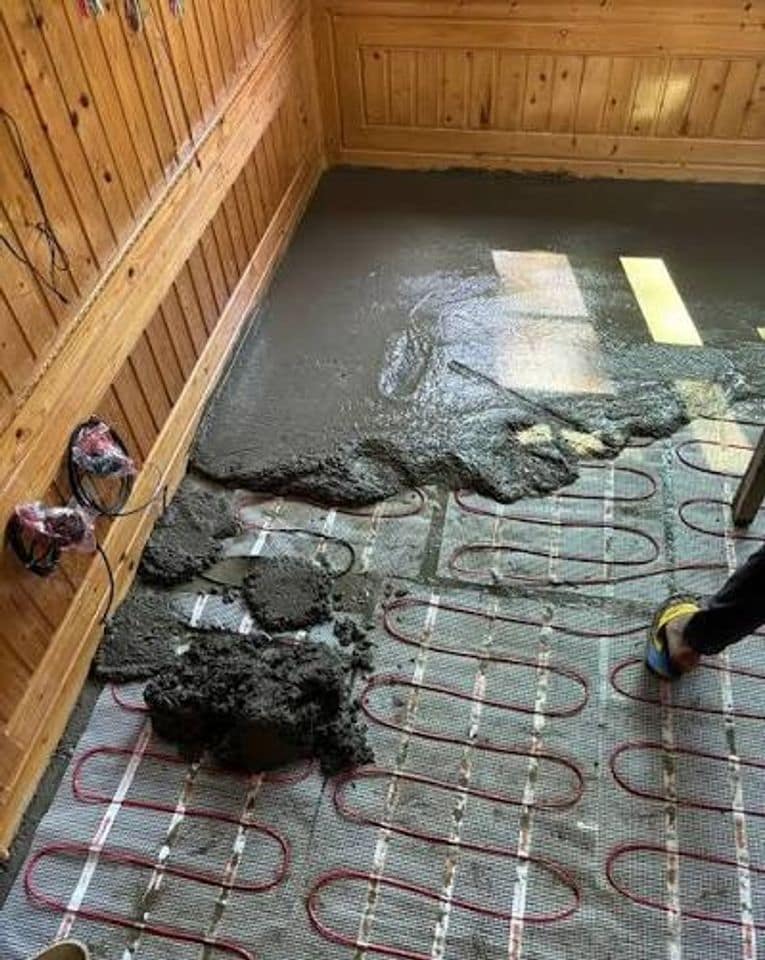
The installation method gradually evolved around these conditions, using electric heating cables or mats beneath the floor, insulation, thermostatic controls and a screed capable of storing and releasing heat after the system had been switched off.
Giving it a Kashmiri name
The technical challenge was only part of the problem.
Most customers had never heard the expression underfloor heating.
They did, however, understand a hamam.
It was during this period that The Heating Store began using the name Electric Hamam to explain the technology to customers.
The term connected something unfamiliar with something Kashmiris already understood: heat coming through the floor.
Early advertisements, invoices and business records dating back to 2011 preserve the use of the name.
Over time, the phrase moved beyond the business that had first used it. Customers began asking for Electric Hamams, installers began advertising them and other businesses adopted the same terminology.
A name originally intended simply to explain an unfamiliar product gradually became the local name for the category itself.
Slow beginnings, then a changing market
The early market remained small.
Installing an electrical heating system beneath a finished floor required customers to trust a technology they had never used before. Questions about electricity consumption, safety, repair and durability were common.
Much of the early work therefore involved explaining the system and learning how best to install it in Kashmiri homes.
The 2014 floods became an important turning point.
Large numbers of homes in Srinagar and other affected areas were repairing or rebuilding floors, bathrooms and living spaces. As reconstruction gathered pace during 2014 and 2015, underfloor heating became relevant to many more homeowners.
Systems designed for bathrooms and other wet areas were also becoming part of the market during this period.
This helps explain why Electric Hamam became considerably more visible from around 2015 onwards. The groundwork had been laid earlier, but reconstruction brought the technology before a much wider group of customers.
From one installer to a dealer network
As familiarity with the system increased, the nature of the business changed as well.
The Heating Store gradually moved from carrying out installations directly in Srinagar to supplying other installers and dealers around Kashmir.
Dealer and distribution relationships developed in Sopore, Baramulla, Anantnag, Budgam, Ganderbal and other areas, eventually forming a much wider network.
Among those who entered the market were Sopore engineers Hameem Nazir and Tehleel Imtiyaz, who received systems through a dealership arrangement with The Heating Store for the north Kashmir market.
Their development into independent sellers was part of a wider pattern. Businesses that initially entered the category through established suppliers gradually built their own customer bases, added products and began marketing Electric Hamam in their respective areas.
Today, The Heating Store’s network has expanded to more than 40 dealers across 15 cities, alongside direct operations in towns across Kashmir and other parts of India.
It is an important part of how the category spread. What began with individual installations and customer demonstrations eventually developed into a supply chain of importers, distributors, regional dealers and independent installers.
From Srinagar to a much wider operation
The scale of the work has changed considerably since those early installations.
Installation records show hundreds of completed systems across Kashmir, in homes as well as commercial properties. The business now works across several regions of India, while its international project and supply footprint has extended to nine countries, including work in the United Kingdom, Bhutan, Sweden and the UAE. Its current published footprint lists direct service across 17 towns in India.
The Heating Store also directly imports underfloor-heating systems and components from overseas manufacturers and distributes them through its Kashmir and India network. Its Srinagar operation has developed into the largest dedicated Electric Hamam installation team in the Valley, alongside its wholesale and distribution business.
That growth also changed the market itself. More manufacturers entered, dealers began carrying different systems and customers gained a wider choice of products and price points.
Yet the basic idea remained the same.
When a name becomes a category
The traditional Kashmiri hamam has not disappeared. It continues to have its own advantages, particularly its independence from electricity, and remains an important part of Kashmir’s winter culture.
Electric underfloor heating developed alongside it rather than simply replacing it.
What makes the story unusual is the way an international technology acquired a local identity.
In 2011, considerable effort went into explaining what underfloor heating meant.
Today, a customer asking for an Electric Hamam usually needs no explanation.
Dealers sell it under that name. Installers use it. Customers search for it.
A term coined to make an unfamiliar technology understandable in Kashmir has, over the years, become the name of the category itself.
About The Author


