


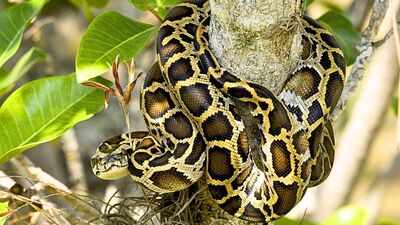
Burmese pythons in southern Florida are using trees and shrubs more often than their heavy bodies, with juveniles showing arboreal behaviour more frequently than adults. Researchers radio-tracked 188 adult and 168 juvenile Burmese Pythons in Big Cypress National Preserve between 2017 and 2024 to examine how often the invasive snakes used aboveground woody vegetation. They found that 27 adults and 29 juveniles were observed in arboreal habitat, representing 14% and 17% of the individuals tracked, respectively. According to the study published in the Journal of Herpetology titled ‘Arboreal Habitat Use by Invasive Burmese Pythons in Southern Florida,’ stated that adult pythons were mainly seen basking, while juveniles were observed basking, resting, or moving between tree limbs.
How often did adult and juvenile Burmese pythons use arboreal habitat
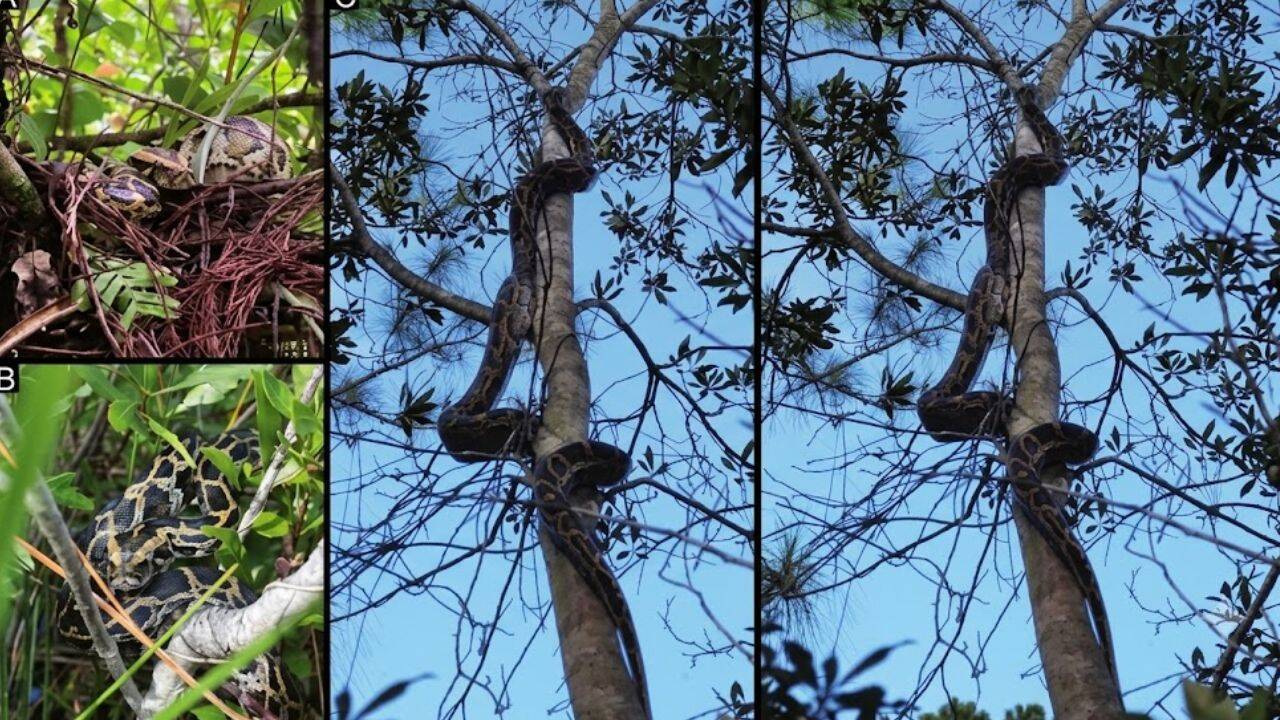
Researchers radio-tracked 188 adult and 168 juvenile Burmese Pythons in Big Cypress National Preserve from 2017 through 2024. They visually confirmed 4,186 python locations during tracking events, including 2,357 adult and 1,829 juvenile locations. Arboreal habitat was defined as aboveground woody vegetation such as trees or shrubs. The researchers observed 27 adults and 29 juveniles in arboreal habitat during 112 events, equal to 2.7% of all tracking occasions.Among adults, arboreal observations made up 1.9% of adult radio-tracking events, compared with 3.7% for juveniles. 14% of tracked adults and 17% of tracked juveniles were observed in arboreal habitat. Tree use occurred across both stages, although pythons varied in how often they used arboreal habitats.
PC: Journal of Herpetology
How did Burmese pythons use trees and shrubs
The snakes used trees and shrubs for several behaviours. Adult pythons were observed basking 39 times, resting three times, aggregating twice, and brooding eggs once in arboreal habitat. Juveniles were observed basking 39 times, resting 25 times, and moving between tree limbs three times. The highest recorded height was 8 m for an adult python and 10 m for a juvenile. One adult female was observed brooding eggs in a fallen, hollow cypress tree 2 m above the ground. A male was recorded basking 8 m above a sawgrass and willow marsh. Juveniles were seen on cypress trees, wax myrtles, and dahoon hollies. Arboreal habitat was used for basking, resting, movement, aggregation, and egg brooding during the study.
Seasonal changes influenced python use of arboreal habitat
Season and body size were associated with finding Burmese Pythons in arboreal habitat. Adult pythons were more likely to use trees during the cooler dry season, with arboreal habitat use highest in January. No adult pythons were found in arboreal habitat during June, July, or August. For an adult python of average weight, arboreal observation probability ranged from 0.002 in June to 0.012 in January. Juveniles also had higher probabilities during the dry season. June was the only month without juvenile arboreal observations. Weight had a weak negative effect for juveniles and a small negative effect for adults.
Tree species supported Burmese pythons of different body sizes
Adult pythons were observed most frequently in cypress species and coastal plain willows, while juvenile pythons were observed most frequently in cabbage palms and cypress species. The researchers found that Brazilian peppertrees and live oaks supported the heaviest pythons. Their model predicted average weights of 13,197 g for pythons associated with Brazilian peppertrees and 10,362 g for those associated with live oaks.It predicted that only pythons weighing less than 300 g would be found in pond apples, pop ashes, or saw palmettos. Pythons weighing between 3,266 g and 7,746 g were predicted in cypress species, coastal plain willows, wax myrtles, cabbage palms, and cocoplums. The study found arboreal use was relatively low overall, but it varied among individuals.
About The Author


