


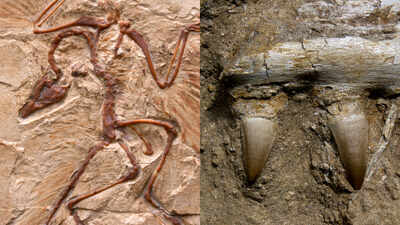
For millions of years, the evolution of flight has been the story of birds. But a remarkable fossil from southeastern China suggests some of the earliest birds may have preferred to keep their feet on the ground. The new species lived about 150 million years ago, and had surprisingly small wings for a bird, sharp teeth, and a powerful claw that would have made it well suited for life as a terrestrial hunter, according to an online report by Reuters.
A bird that may have preferred to run
The crow-sized species, named Yuezhuornis yangyuanensis, lived during the Jurassic Period and is among the earliest-known birds, Reuters reported. The find gives us a new look at how feathered dinosaurs gave rise to the birds we see today, suggesting that early members of the bird lineage might have experimented with a variety of ways to move around and survive.The fossil, which is almost complete, was discovered in Fujian Province in south-eastern China. The animal is thought to have weighed about 800 grams, or 1.8 pounds. It had fully developed wings but the size of the wings compared to the size of the body suggests it might not have been able to engage in prolonged powerful flight.Yuezhuornis probably depended on running for much of its activity, flying only when it had to. Its proportions are similar to those of modern ground-dwelling birds such as pheasants, giving clues as to how it might have moved through its prehistoric habitat, the report states.
An odd mix of bird and dinosaur
What is particularly interesting about the fossil is the combination of anatomical features it exhibits. Its skeleton had some very bird-like parts, like its slender skull bones and pelvis. Other features were far more similar to those of a predatory dinosaur.Its jaws were crammed with closely packed, serrated teeth, a characteristic more usually associated with carnivorous dinosaurs than modern birds. A long, bony tail added to its dinosaurian appearance, the report says.The animal also had a sickle-shaped claw on its flexible second toe, like the deadly claws of meat-eating dinosaurs such as Velociraptor and Deinonychus. This adaptation may have allowed it to catch or subdue prey on the ground, potentially putting it into competition with small predatory dinosaurs, the report continues.Its wings were especially telling. The researchers found it was about a third shorter than its legs, a stark contrast to the more balanced proportions of the early birds adapted for flight.
Rethinking the origin of flight
Archaeopteryx, discovered in Europe, has been a central figure in discussions of early bird evolution for decades. It also had bird-like and dinosaur-like traits, from roughly the same time period. But the better proportioned wings suggest a larger capacity for flight than those of Yuezhuornis.The new find raises questions about whether early birds took one evolutionary route. Researchers think the two species may have shared a common ancestor earlier in the Jurassic period, but Yuezhuornis could also be its own evolutionary experiment.Its limb proportions were most similar to those of birds adapted for terrestrial life, further supporting the terrestrial lifestyle hypothesis in comparison to 377 extant bird species.
An ever-changing story still in the making
The fossil, the report said, doesn’t answer exactly how flight evolved, but it challenges the assumption that the earliest birds were shaped largely by the demands of flying. Others may have developed other survival strategies. Others may have descended from flying ancestors and become more ground-dependent.Yuezhuornis is a reminder to scientists examining the origins of birds that evolution rarely takes a neat, predictable course. The earliest birds weren’t all variations on a flying theme. Some may have been clumsy fliers, efficient runners and fearsome hunters, showing a much more diverse prehistoric world than previously imagined.Images Courtesy: istock
About The Author


