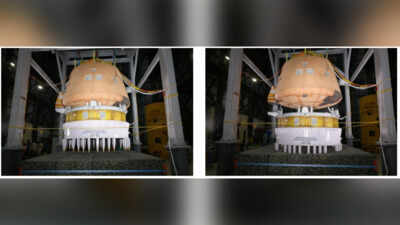
BENGALURU: Isro has successfully completed a series of Crew Module–Service Module (CM-SM) separation tests for the Gaganyaan human spaceflight programme, validating the system that will separate the crew capsule from its service module before re-entry into Earth’s atmosphere.“The tests were conducted using a specialised setup at the Vikram Sarabhai Space Centre (VSSC) in Thiruvananthapuram. The setup simulated the integrated CM-SM assembly and was equipped with extensive instrumentation to assess the separation process, including the severing of multiple electrical and fluid-service connections, known as umbilicals, between the two modules,” Isro said.The Gaganyaan Orbital Module consists of the Crew Module, which houses the crew, and the Service Module, which supports the spacecraft during its mission. The two are connected through a separation system and umbilical links, and function as a single integrated unit from launch through the on-orbit phase.Before the spacecraft begins its return to Earth, the Crew Module must separate from the Service Module. This involves multiple precisely sequenced events using pyrotechnic devices and jettisoning systems.Besides validating the overall design of the separation system, the tests demonstrated the robustness and shock-survivability of critical Crew Module subsystems.“These include avionics, inertial navigation systems, the thermal protection system in the aft and conical heat shields, and the deployable umbilical shield. Pyrotechnic devices associated with the Crew Module Uprighting System and the Thermal and Humidity Control System were also assessed,” Isro added.The results provide confidence in the functioning of the separation system ahead of Gaganyaan’s first uncrewed mission, G1, targeted for launch in 2026. The separation sequence is a critical stage of the mission, as the Crew Module must detach safely from the Service Module before atmospheric re-entry.
About The Author