


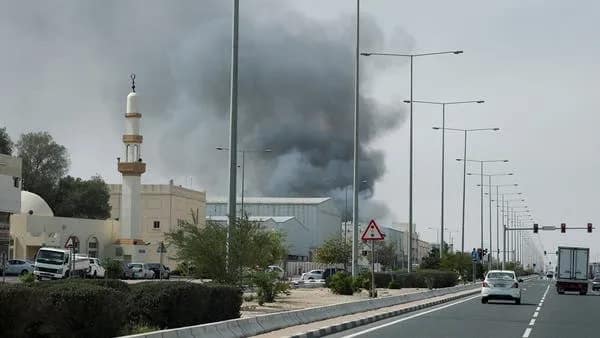
New Delhi, Mar 8: As the war in West Asia or the Middle East enters its second week, Iran’s internal political dynamics appear increasingly complex, with conflicting statements from senior leaders suggesting tensions within the country’s leadership following the death of Supreme Leader Ayatollah Ali Khamenei reports CNN. At the same time, the conflict continues to expand across the Gulf, with missile and drone attacks reported in several countries and a massive fire engulfing a tower in Kuwait City after a suspected strike.
Civilian facilities in Kuwait City have sustained damage after debris from intercepted drones fell on parts of the city, according to the Kuwait Armed Forces. An official spokesperson for the Ministry of Defence said in a statement posted on X and shared by the army that “some civilian facilities have sustained material damage as a result of debris and shrapnel falling from interception operations.”
The damage comes as Kuwait’s air defence systems continue efforts to intercept hostile drones amid rising tensions in the region. Videos circulating on social media showed a large fire engulfing a tower in Kuwait City, though authorities have not yet confirmed the extent of the damage or whether there were any casualties.
The mixed messaging from Tehran has become one of the most striking developments in the unfolding crisis. Iranian leaders delivered contrasting statements on Saturday, highlighting possible divisions within the ruling establishment as it navigates both an external war and an internal transition of power.
Earlier in the day, Iran’s President Masoud Pezeshkian issued a conciliatory message, apologising for Iranian strikes that had hit or threatened Gulf states hosting American military assets. His remarks were widely interpreted as an attempt to calm tensions with neighbouring Arab governments, many of which have been drawn into the conflict because of their strategic partnerships with the United States, reports CNN.
Facing criticism from influential factions within Iran’s political system, Pezeshkian quickly walked back his remarks, reflecting the intense pressure inside Tehran’s leadership circles. Later the same day, Iran’s senior security leader Ali Larijani delivered a televised address to the nation in which he struck a far more confrontational tone. Calling for unity among the Iranian public, Larijani dismissed speculation about leadership divisions but warned that the United States would face consequences for the conflict. He said US President Donald Trump “must pay the price” for the war, signalling that Tehran still intends to maintain a posture of resistance.
These shifting messages illustrate the competing pressures shaping decision-making in Tehran. Analysts say Iran’s political system has always been characterised by factional rivalries between ideological hardliners and more pragmatic elements within the government. At the same time, Iran’s political establishment is moving to address a major institutional question: the succession to the country’s supreme leadership. Reports indicate that the Assembly of Experts, the clerical body responsible for selecting Iran’s supreme leader, could announce a new leader within the coming days. Analysts also suggest that much of the country’s strategic decision-making has for years been shaped by the powerful Islamic Revolutionary Guard Corps (IRGC), which controls key military, intelligence, and economic institutions.
The IRGC is expected to play a decisive role not only in managing the ongoing war but also in shaping the selection of the next supreme leader and the broader direction of Iranian policy. For now, the war abroad in the Gulf countries and the political transition at home are unfolding simultaneously, placing Iran’s leadership under extraordinary strain. Whether Tehran ultimately adopts a more confrontational approach or seeks diplomatic off-ramps may depend largely on which faction within the country’s complex power structure gains the upper hand in the coming days.
About The Author


