


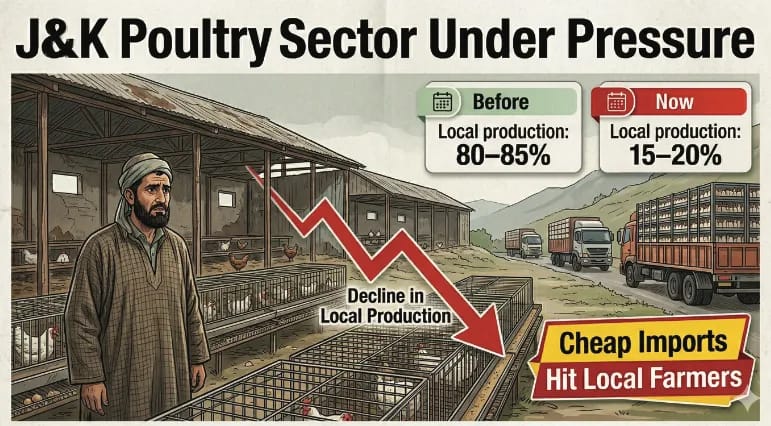
Srinagar, Mar 4: Jammu and Kashmir’s poultry industry, once close to self-reliant, is facing a severe downturn as local producers struggle to compete with a growing influx of cheaper poultry imports from other states.
Industry stakeholders say the crisis began after 2019 when the government scrapped toll tax at the Lakhanpur Toll Plaza following the reorganisation of the erstwhile state. Prior to that, a levy of Rs 9 per kilogram was imposed on adult birds imported into J&K, a measure aimed at protecting local farmers from external competition and offsetting higher production costs in the region.
With the removal of the levy, poultry producers say the market dynamics changed dramatically.
G M Bhat, president of the Kashmir Valley Poultry Farmers Association, said the decision opened the doors for large-scale suppliers from outside the Union Territory to dominate the market.
“After the abolition of the tax, poultry from other states started entering the local market at significantly lower prices,” Bhat said. “Our farmers cannot compete with producers who operate at a much larger scale and benefit from better infrastructure and lower costs.”
According to industry estimates, before 2019, nearly 80 to 85 percent of poultry consumption in J&K was met through local production.
That share, however, has now reportedly dropped sharply.
“Local production today meets barely 15 to 20 percent of the demand,” Bhat said, adding that many small and medium poultry units have either scaled down operations or shut completely due to sustained losses.
Farmers say the situation has worsened due to rising input costs. The prices of poultry feed, electricity and labour have increased steadily over the past few years, further squeezing already thin profit margins.
A poultry farmer from Shopian, who recently shut down his unit after years of operation, said the business had become financially unsustainable.
“The cost of feed and other essentials has risen sharply,” he said. “At the same time, the market is flooded with cheaper poultry from outside. We were forced to sell below our production cost, and continuing the business was no longer viable.”
The decline of the sector has also affected rural livelihoods, where poultry farming had long served as a dependable source of income and employment. Many farmers had invested heavily in poultry sheds, hatcheries and equipment, often with bank loans.
Industry representatives are now urging the government to step in with policy support to revive the sector. They are demanding measures such as protective levies on imports or financial incentives for local producers to help them compete in the market.
Farmers warn that without timely intervention, the region could become increasingly dependent on outside suppliers, putting further pressure on local entrepreneurs and weakening a sector that once played a key role in the rural economy.
About The Author