


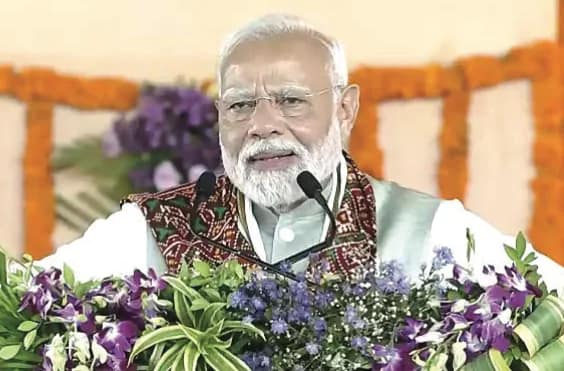
New Delhi, Mar 29: Amid a turbulent global backdrop, Prime Minister Narendra Modi struck a note of caution and resolve, framing the West Asia conflict as both a humanitarian concern and a test of India’s collective strength.
In his monthly ‘Mann Ki Baat’ address, PM Modi underscored the dual challenge posed by the ongoing war – its impact on millions of Indians in the Gulf and its ripple effects on global energy supplies – while asserting that India’s diplomatic ties and internal resilience position it to weather the crisis.
He called for unity, vigilance against misinformation, and an end to political opportunism, urging citizens to rely on official communication and confront the situation together as a national priority.
“This month of March has been full of turbulence globally. All of us remember that the entire world faced myriad problems for a long time on account of COVID. Indeed, all of us had expected that after emerging from the Corona crisis, the world would move forward on the path of renewed progress. However, situations of war and conflict have continuously kept arising in different parts of the world. Presently, a fierce war has been going on in our neighbourhood for a month. Millions of our family members, near and dear ones, live in these countries, especially working in the Gulf countries. I am deeply grateful to the Gulf countries, who are providing all kinds of assistance to more than 1 crore such Indians there,” the PM said.
He said that the region where the war was currently going on was a major centre of India’s energy needs.
“On account of that, a crisis is emerging around the world regarding petrol and diesel,” PM Modi said.
He said that India’s global relations; the support the country receives from various countries, and the strengths the country has built over the past decade had enabled India to bravely confront these circumstances.
“These certainly are challenging times. Today, through ‘Mann Ki Baat,’ I would once again urge all my countrymen that we must unitedly overcome this challenge. Those who are politicising even this issue should refrain from doing so. This is a matter concerning the interests of 140 crore countrymen; there is no place for self-serving politics,” the PM said. “Therefore, those who are spreading rumours are causing a major harm to the country. I would also appeal to all citizens to remain vigilant and not be misled by rumours. Trust only the continuous information provided by the government and take action based only on that. As always, I am confident that just as we have overcome past crises with the strength of our 140 crore countrymen; this time too, we will together emerge victorious from this difficult situation.”
He said India’s strength lies in its crores of people.
“Today, in ‘Mann Ki Baat,’ I want to tell you about an initiative that reflects the spirit of public participation among our countrymen. This initiative is the Gyan Bharatam Survey, which is related to our great culture and rich heritage,” PM Modi said. “Its objective is to collect information about manuscripts across the country. One way to participate in this survey is through the Gyan Bharatam App. If you have a manuscript or information about it, do share its image on the Gyan Bharatam App. Information related to each entry is being verified before it is recorded. I am glad that thousands of manuscripts have been shared so far. For example, Chao Nantisindh Lokang ji of Namsai, Arunachal Pradesh, has shared manuscripts in the Tai script. Bhai Amit Singh Rana of Amritsar has shared manuscripts in the Gurmukhi script. This is a script associated with our great Sikh tradition and the Punjabi language. Some organizations have provided manuscripts written on palm leaves. The Abhay Jain Library in Rajasthan has shared very old manuscripts inscribed on copper plates. The Hemis Monastery in Ladakh has provided information about valuable Tibetan manuscripts.”
He said that he had cited just a few examples and that this survey would continue until mid-June.
“I urge all of you to uncover and share aspects of your culture,” the PM said.
He said India was the “youngest” country in the world.
“When the strength of the country’s youth is involved in nation-building, it is of immense help. The organisation MY Bharat, is playing a major role in fulfilling this responsibility of nation-building. This organization is connecting the country’s youth with various positive activities. Recently, MY Bharat organized a budget quest. Its aim was to connect the youth across the country with the budget process and policymaking. Nearly 12 lakh youth from across the country participated in the quiz. After the quiz, approximately 160,000 participants were selected for the essay competition. I had the opportunity as well to read some of these essays. They demonstrate the eagerness of my young friends to contribute to the country’s development. Kotla Raghuveer Reddy from Suryapet, Telangana, Saurabh Baiswar from Barabanki, Uttar Pradesh and Sumit Kumar from Gopalganj, Bihar, have written on the topic related to farmer welfare,” PM Modi said. “Aanchal from Mohali, Punjab, and Om Prakash Rath from Kendrapara, Odisha, expressed their views on ways to advance women-led development. Pratham Barar from Yamunanagar, Haryana, has written that a green and clean India is the only path to a prosperous India. This reveals their deep thinking. Shankh Gupta from Delhi suggests that more efforts should be made to identify sports talent in rural areas. Our young friends have also shared their ideas on skill development and ease of doing business. I commend all the young people who are sharing their ideas. These ideas are crucial in taking the country forward.”
He said that this month had been full of excitement and enthusiasm for cricket fans across the country.
“When India achieved a historic victory in the T20 World Cup, a wave of joy swept across the country. We are all very proud of our team’s thumping success,” the PM said.
He said that he was happy to see that the country’s youth were now embracing sports that were not as popular before.
“Gulveer Singh, a talented athlete from Uttar Pradesh, has done wonders in one such sport. Just a few weeks ago, he created history by finishing third in the New York City Half Marathon. He became the first Indian athlete to complete a half marathon in under an hour. Squash player daughter Anahat Singh, won a major international title in the Squash on Fire Open. She achieved this success at just 17 years of age. With this, she has become the youngest Asian female player to make it to the top-20 in the PSA World Ranking. I also came to know about the Asmita Athletics League. In this, many sporting events were organized on the occasion of Women’s Day on the 8th of March. Around 2 lakh daughters participated in the league. It is good to see that the woman power of India is playing an important role in this sporting transformation taking place in the country,” PM Modi said. “I have always urged all of you to certainly pay attention to your fitness. Now less than 100 days are left for the International Yoga Day; the attraction towards yoga is also rising continuously all over the world. Almis ji is promoting yoga through his Arvind Yoga Centre in Djibouti, Africa. He also teaches yoga to people in many other places there.”
He said many had commented on Instagram Content Creator Yuvraj Dua’s post pertaining to his (PM’s) reply.
“He had requested me to ask his father to reduce his sugar intake. I am happy that my request has had a positive impact on his father. I would urge all of you to reduce your sugar intake also… and as I have said earlier, we also need to cut down on cooking oil by 10 percent. These small efforts will keep you away from obesity and lifestyle diseases,” the PM said.
He said that there was an old saying ‘Karat Karat Abhyas Ke, Jadmat Hot Sujan’ which means that the more we practice continuously, the more intellect we keep acquiring.
“People also learn best when there is active participation on their part. I have come to know about a unique initiative related to education in Bengaluru. A team here is running Prayog Institute of Education Research. This team has a special focus on research projects. This team is engaged in popularizing science education at the school level. They have launched an experiment called Anveshan, which provides students from 9th to 12th standard the opportunity to innovate in areas like Chemistry, Earth Science, and Wellness,” PM Modi said.
He said that this provides students with a very good research experience and a platform to publish their projects.
“During our ‘Pareeksha Pe Charcha’, some students told me that they wanted to study science but were also intimidated by it. The efforts of the Prayog team in this direction are commendable. This initiative gives students the opportunity to engage with science and demonstrate practical experience. When we try something firsthand, curiosity and interest are generated. Who knows, perhaps one of these young friends of mine might be a great scientist of the future,” the PM said.
He said that the Naga community was also making an effort to preserve the past and prepare for the future through education.
“The people of this community deeply respect their tribal traditions. They are proud of this and simultaneously also maintain a modern approach. The Naga tribes had a traditional system of Morung learning, in which elders would share traditional knowledge, history, and life skills with the youth through their experiences. Over time, this system has evolved into the Morung concept of education. Through this system, interest in children in subjects like mathematics and science is instilled,” PM Modi said.
He said that in this, elders in the community teach them life skills through stories, folk songs and traditional games.
“In this way, our Nagaland is advancing children’s education while preserving its cultural heritage. If you learn about such efforts in your area, please share them with me,” the PM said.
He said that summer had begun in many parts of the country, which means it was time to renew commitment to water conservation.
“Over the last 11 years, the ‘Jal Sanchay Abhiyan’ has created a lot of awareness among the people. Under this campaign, nearly 50 lakh Artificial Water Harvesting Structures have been created across the country. I am happy to see that community-level efforts are now underway in every village to address the water crisis. At some places, old ponds are being cleaned; at others, efforts are being made to conserve rainwater. Under the Amrit Sarovar Abhiyan as well, nearly 70,000 Amrit Sarovars have been made across the country. The cleaning of these lakes has also begun before the advent of the rainy season. Today, I would also like to share some inspiring examples with you. These examples demonstrate how widespread water conservation can be with public participation,” PM Modi said.
He said Wangmun village, located in the Jampui Hills of Tripura, was situated at an altitude of 3000 feet.
“This village had been facing a severe water crisis. During the summer, villagers would tread long distances for the sake of water. Finally, the villagers decided to conserve every drop of rain,” the PM said.
He said today, almost every household in Wangmun village has a rooftop rainwater harvesting system installed.
“The village, that was once struggling with water scarcity, has become an inspiring example of water conservation,” PM Modi said.
He said that a unique initiative was also observed in Korea district of Chhattisgarh.
“Farmers there worked on a simple yet effective idea. They made small recharge ponds and soak pits in their fields, allowing rainwater to remain in the fields and gradually seep into the ground. Today, more than 1,200 farmers in this area have adopted this model, and the groundwater level of the village has improved significantly,” the PM said.
He said that similarly, in Mudhigunta village in Telangana’s Mancherial district, people had come together to address the water problem.
“Around 400 families made soak pits at their homes and created a mass movement for water conservation. This has improved the village’s groundwater level and significantly reduced diseases caused by polluted water,” PM Modi said.
“Our fishermen brothers and sisters are not just warriors of the sea; they are also a strong foundation of a self-reliant India. Battling the waves of the sea even before dawn, they set out to strengthen their families and the country’s economy. The lives of these hardworking fishermen are being made easier in many ways today. Whether it’s port development or insurance for fishermen, many such initiatives are proving extremely helpful. We know that weather patterns greatly impact their activities at sea. Keeping this in mind, they are being fully supported through technology,” he said. “I am extremely happy that such efforts are not only enriching our fisheries sector; it is also instilling the spirit to innovate. Today, ever new innovations are taking place in the fields of fisheries and seaweed, and our fishermen are becoming self-reliant.”
The PM said that Sujata Bhuyan of Sambalpur, Odisha, was a homemaker, but she wanted to do something new and further help her family.
“So, a few years ago, she started fish farming in the Hirakud reservoir. The early days were not easy for her. Numerous challenges such as weather changes, arranging food for the fish and balancing household responsibilities were there, but her spirit remained unwavering. Within just two or three years, she transformed her endeavour into a thriving business. Today, her success has become a new ray of hope for the women of the community,” he said.
PM Modi said that the story of Havva Gulzar of Minicoy in Lakshadweep brings to the fore the incredible determination of women. “Actually, she used to run a fish processing unit. But she felt she could do even better with a good cold storage facility. Therefore, she decided to set up a cold storage unit. Today, this has become her strength. Now, she is able to do business with better planning,” he said. “Such efforts are being undertaken everywhere in the country, which are inspiring. Shivling Satappa Huddar of Belagavi chose a path different from traditional farming. For this, he created a pond farm.”
The PM said that he had also received training for this business.
“Now, he is earning a good income by selling fish from his pond. Whereas, looking at the demand for seaweed, many people have also adopted seaweed cultivation. They are also getting huge benefits from it. I once again commend all those associated with the fisheries sector. Their efforts to strengthen our economy are highly commendable,” he said.
PM Modi said that when society itself steps forward, even small efforts become the foundation of big change.
“Many such examples are emerging in different parts of our country which teach us that. Recently, an inspiring effort was witnessed in Varanasi, Uttar Pradesh. Over 251,000 saplings were planted there in a single hour, setting a new Guinness World Record,” he said. “The most remarkable aspect of this effort was the involvement of thousands of people. Students, youth, volunteer organizations, and various institutions all joined together to make this possible. This same form of public participation is also visible in the ‘Ek Ped Maa Ke Naam’ campaign. Under this campaign, millions of trees have been planted across the country.”
The PM said that a very inspiring effort had come to fore from Chizami village in Nagaland.
“The women of Chizami village are collectively preserving over 150 varieties of traditional seeds. These seeds are being preserved in a community seed bank, run by the village women themselves. These include rice, millet, maize, pulses, vegetables, and a variety of herbs. This is an effort that preserves knowledge, keeps traditions alive, and lays a strong foundation for future generations,” he said. “Today, when the world is facing challenges like climate change, such efforts show us that solutions are not always far away. Sometimes, our own traditional knowledge and community efforts offer us the strongest path forward.”
PM Modi said that if one visits any city, big or small, today, a change was noticiable.
“You will see solar panels installed on the rooftops of a large number of homes. Until a few years ago, this was only seen on a few homes. But today, the impact of the ‘PM Surya Ghar Muft Bijli Yojana’ is being observed in every corner of the country. This scheme has brought about a profound change in the life of Payal Munjpara of Surendranagar district, Gujarat,” he said. “She received training in solar power technology through the Surya Initiative and completed a four-month Solar PV technician course. She has now become a skilled solar technician. Payal is making a name for herself as a solar entrepreneur. She works on solar rooftop installations in nearby districts, earning thousands of rupees every month.”
The PM said that Arun Kumar from Meerut had now become an energy provider in his area.
“Recently, Arun Kumar participated in a program in Delhi and shared his experiences. He had shared that he is not only saving on his electricity bills but also selling his excess electricity,” he said. “Muralidhar from Jaipur has achieved similar success. Earlier, his farming was dependent on a diesel pump, which cost thousands of rupees every year. When he adopted a solar pump, his farming system transformed. Now, he no longer has to worry about fuel; irrigation is timely, and his annual income has also increased. Most importantly, his family is now living a better life with clean energy.”
PM Modi said that the benefits of the ‘PM Surya Ghar Muft Bijli Yojana’ were also being obtained in areas of the Northeast.
“In Tripura, there are many villages of the Riang tribe which faced electricity problems. Now, through solar mini-grids, their homes remain illuminated. Children there are now able to study even after dusk. People are able to charge their mobile phones, and the social life of villages has also changed,” he said. “There are countless such examples of the solar energy revolution in the country. Do join this revolution and connect others too.”
The PM said that every month he receives numerous messages from different parts of the country for ‘Mann Ki Baat’.
“These messages also reveal how enthusiastically people in remote areas listen to this program. When I read your suggestions, I feel that this is not just a programme; it has become a shared dialogue between all of us. Your thoughts, your experiences inspire us to continuously improve this programme,” he said. “Do keep sharing inspiring stories from your surroundings. Maybe a small effort of yours will bring a big change in someone else’s life; giving someone new courage to move forward – this very is the true power of radio.”
PM Modi said that it connects people in different corners of the country with one thought, one feeling, and one purpose.
About The Author


