


A NITI Aayog report has highlighted substantial post-harvest losses in Jammu and Kashmir’s horticulture sector and proposed a long-term roadmap to transform the industry by 2047.
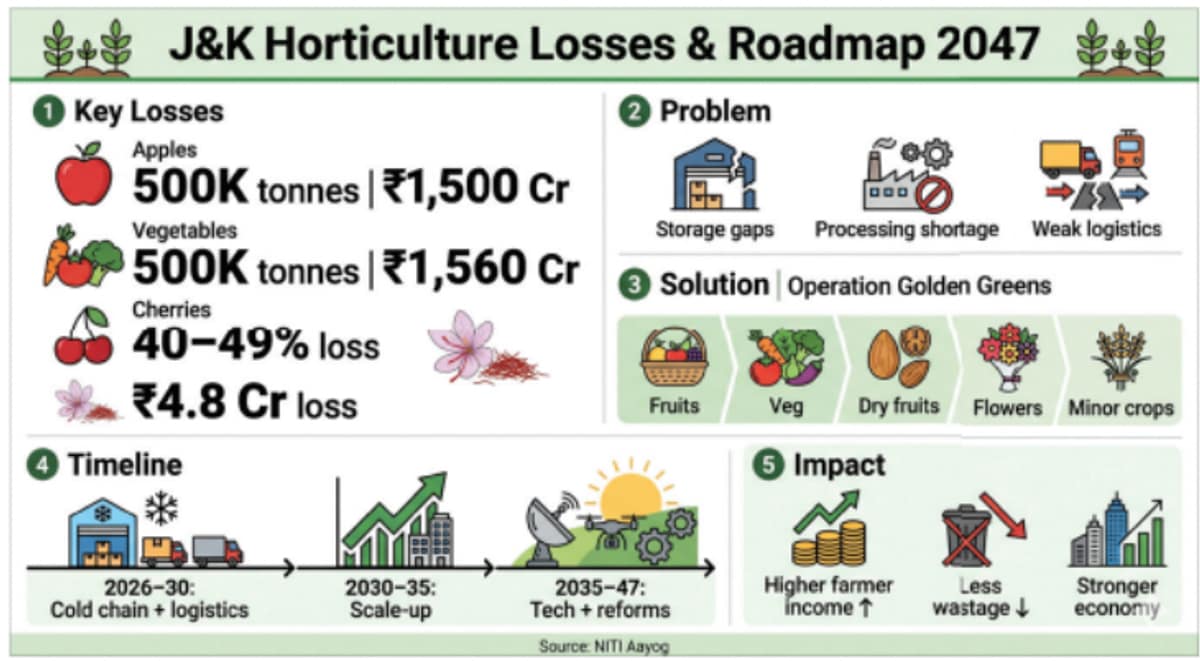
The report, titled “Roadmap for Horticulture Development in the UT of Jammu and Kashmir @ 2047”, estimates that apples and vegetables each suffer losses of around 500,000 tonnes annually, valued at ₹1,500 crore and ₹1,560 crore respectively.
Cherries record the highest proportional losses, ranging between 40% and 49%, while saffron, despite a minimal quantity loss of 0.48 tonnes, accounts for a value loss of about Rs 4.8 crore.
The findings underline structural gaps in storage, processing and supply chains in a sector that is a key pillar of the region’s economy and a major source of rural livelihoods.
The report calls for a strategic expansion of processing infrastructure to curb wastage, enhance value addition and meet changing market demand. It notes that improving post-harvest management could significantly boost farmer incomes and strengthen the Union Territory’s economic output.
To address these challenges, NITI Aayog has proposed a mission-based framework titled “Operation Golden Greens”, aimed at driving integrated horticulture development across the region.
The initiative envisions five sub-missions focusing on dry fruits, fresh fruits, vegetables, floriculture and minor crops. Each segment will be developed with targeted interventions aligned to its value chain and regional potential, while sharing common components such as infrastructure development, market linkages and technology adoption.
The roadmap outlines a phased implementation plan extending over two decades. Phase one, covering 2026 to 2030, will focus on short- and medium-term interventions, including strengthening cold-chain infrastructure, improving logistics and enhancing processing capacity. Subsequent phases — 2030 to 2035 and 2035 to 2047 — will aim at scaling up these interventions and integrating advanced technologies and institutional reforms.
Stakeholders say the phased approach is designed to allow flexibility in adapting to evolving priorities, technological advancements and administrative readiness.
Horticulture remains one of the most important sectors in Jammu and Kashmir, with crops such as apples, cherries and saffron contributing significantly to farm incomes and exports. However, inadequate storage facilities, limited processing units and logistical bottlenecks have long constrained the sector’s growth.
The report highlights the need to address these gaps to unlock the sector’s potential and calls for coordinated efforts among government agencies, private players and farmers for effective implementation.
About The Author