

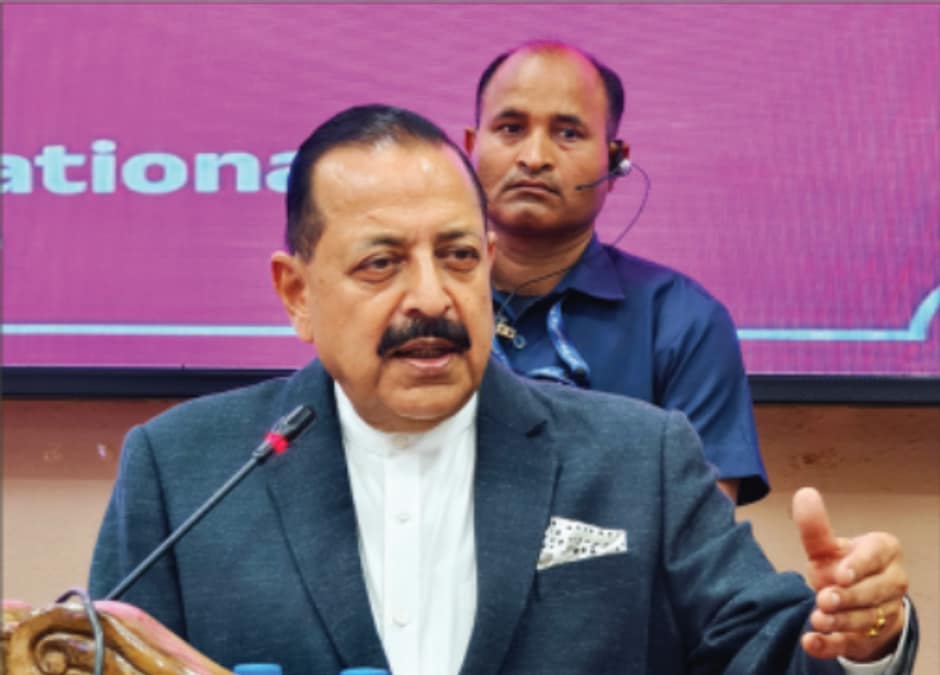
Union Minister Jitendra Singh on Sunday said the mainstreaming of Jammu and Kashmir under the leadership of Prime Minister Narendra Modi has led to a visible aspirational surge among women, marked by rising self-confidence, growing competitiveness and expanding leadership across sectors.
Addressing “Shakti Samwad”, an interactive meeting with State Women Commissions organised by the National Commission for Women at Sher-i-Kashmir International Conference Centre, the Union Minister said women in Jammu and Kashmir are increasingly emerging as equal stakeholders in India’s growth story by excelling in competitive examinations, startups, self-help groups, science, technology and public service.
The event was led by NCW Chairperson Vijaya Rahatkar and attended by senior officials, members of State Women Commissions and representatives from various States and Union Territories. The programme focused on institutional collaboration, women empowerment, grassroots outreach and sharing best practices for ensuring safety, dignity and equal opportunities for women across the country.
Dr Singh said the last decade had witnessed “democratisation of opportunities”, enabling women to move from participation to leadership roles across professions and institutions.
“The transformation calls for a corresponding change in societal mindset as women increasingly lead from the front in almost every sphere,” he said.
Highlighting the significance of holding the national-level interaction in Srinagar, the Minister said the initiative reflected the importance being accorded to Jammu and Kashmir and its women workforce.
He said the improving environment in the Union Territory had opened new avenues for women to reconnect with the national mainstream and participate fully in the developmental transformation underway across the region.
Referring to the abrogation of Article 370 and the expansion of welfare initiatives, Dr Singh said women in Jammu and Kashmir were now increasingly receiving the same opportunities and benefits available to women in the rest of the country.
He highlighted several flagship schemes launched by the Centre, including Ujjwala Yojana, Pradhan Mantri Awas Yojana, Mudra Yojana and the Lakhpati Didi programme, saying these initiatives had brought major socio-economic changes by improving ease of living, enhancing financial independence and strengthening self-confidence among women.
The Minister said the impact of these interventions was visible in the growing presence of women in competitive fields and leadership positions, including civil services, scientific research, engineering and space technology.
Citing examples of young girls from remote areas of Jammu and Kashmir succeeding in national-level examinations despite limited resources, Dr Singh said technology-driven access to education and information had enabled talented youth from far-flung regions to compete confidently at the national level.
He also highlighted initiatives of the Ministry of Science and Technology aimed at promoting women in STEM sectors, including Vigyan Jyoti and WISE-KIRAN programmes, which encourage girls and women to pursue careers in science, research and innovation.
Recalling Kashmir’s cultural legacy, Dr Singh referred to iconic women personalities such as Lal Ded and Habba Khatoon, saying they played a significant role in shaping and preserving the composite cultural ethos of the region.
He said the transformation witnessed in Jammu and Kashmir reflected the broader national vision of inclusive development and women-led progress.
“Women from the region are now moving forward with confidence and aspiration as active participants in India’s developmental journey towards Viksit Bharat 2047,” he said.
About The Author