


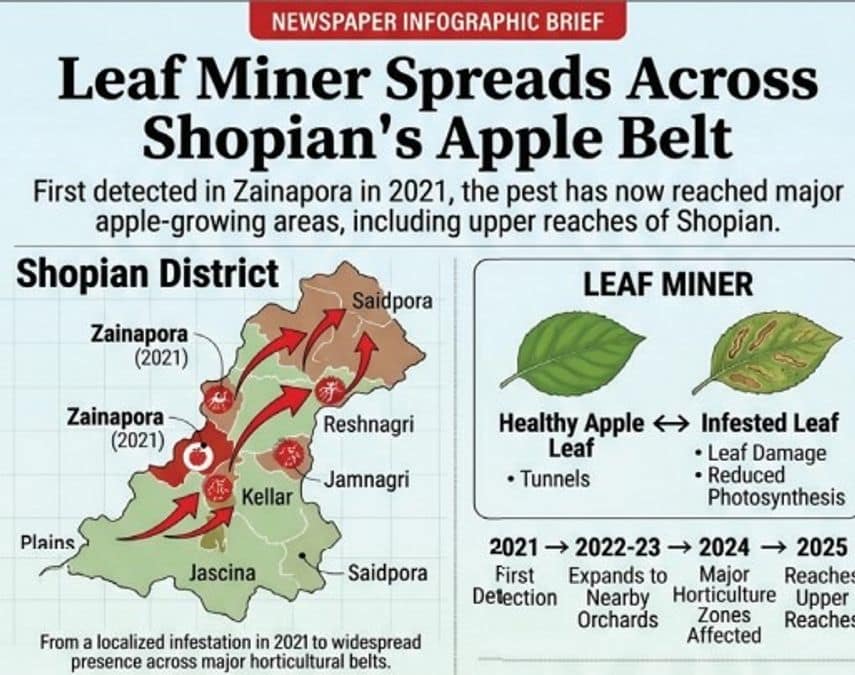
Shopian, Jun 7: A leaf miner infestation continues to spread across Shopian, Kashmir’s premier apple-producing district, raising concerns among orchardists over its potential impact on tree health and fruit production.
Initially reported in a few orchards in the district’s plains several years ago, the pest has now reached higher-altitude areas, including Kellar, Reshnagri, Jamnagri and Saidpora. Growers say the infestation has expanded rapidly over the past few seasons and is now visible across most major horticultural belts of the district.
“This year the pest has been spotted in upper reaches as well,” said Tariq Ahmad, an apple grower from Shopian. “Earlier, it was confined to a few villages in the plains, but now almost every orchard owner is noticing its presence.”
Mohammad Ashraf Wani, president of Fruit Mandi Shopian, said the pest began spreading to higher-altitude areas during its second cycle, increasing concerns among growers.
The pest was first reported from the Zainapora area in 2021 and has since steadily spread to neighbouring orchards and adjoining districts, alarming farmers who rely heavily on apple cultivation for their livelihoods.
Many growers suspect that imported rootstock and planting material brought into the Valley without adequate quarantine measures may have contributed to the spread of the infestation. According to farmers, the pest was first detected in orchards located near the Advanced Centre for Horticulture Development (ACHD) in Zainapora.
Leaf miner larvae feed inside plant leaves, creating winding tunnels or blotches known as mines. The damage reduces the plant’s ability to photosynthesise efficiently, affecting overall tree vigour. Infested leaves often develop silvery trails, become distorted and may dry prematurely.
“Over the last few years, leaf miner has emerged as a major concern for apple growers because healthy foliage is essential for fruit development and sustained productivity,” said a horticulture expert.
Dr Waseem Ahmad, Assistant Professor at SKUAST-Kashmir, said rising temperatures could accelerate the spread of the pest. He advised growers to apply recommended insecticides during the first week of June to help contain the infestation.
“It is a foreign pest. The introduction of infected bud wood and planting material is believed to have contributed to its spread,” he said.
Farmers have urged the Horticulture Department to conduct a detailed assessment of the infestation and formulate a comprehensive management strategy to prevent further losses.
“The imported rootstock must be properly quarantined before being distributed among farmers to ensure no new pests or diseases are introduced into the region,” growers said.
About The Author


