



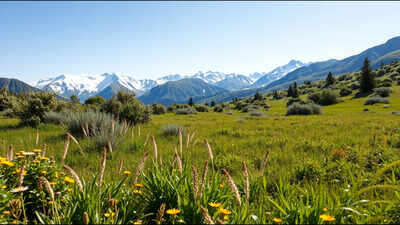
For 29 years, researchers artificially warmed a subalpine meadow at the Rocky Mountain Biological Laboratory in Gothic, Colorado, to examine how sustained temperature increases affect ecosystems above and below ground. The results, published in the Proceedings of the National Academy of Sciences in February 2026 in a study titled Experimental warming decouples plant-fungal symbiont interactions and leads to a more conservative ecosystem, showed that warming shifted the vegetation from a forb- and graminoid-dominated community towards one dominated by shrubs, while changing the fungal communities associated with plants and soil. Shrubs increased by 150% in warmed plots, while both forbs and grasses declined by about 28%. At the same time, arbuscular mycorrhizal fungal abundance and root colonisation declined, while saprotrophic fungi increased. The researchers concluded that warming had decoupled plant and fungal communities and moved the ecosystem towards a more conservative, shrub-dominated state.
Warming changed the meadow from herbaceous to shrub-dominated
The experiment began in the early 1990s at the Rocky Mountain Biological Laboratory, where researchers used heaters to maintain warmer conditions in experimental plots. Over the 29-year experiment, the warmed plots experienced soils approximately 2°C warmer than ambient plots, while snowmelt occurred 10 to 14 days earlier. When the researchers harvested the experiment in 2019, they found that warming had substantially altered the plant community. Shrubs increased by 150% in warmed plots, while the abundance of forbs and graminoids declined by approximately 28%.Aboveground plant biomass also increased by 64% under warming, while belowground plant biomass did not show a corresponding increase. The researchers interpreted this as a shift in resource allocation towards shoots rather than roots. The study described the resulting community as moving from a forb- and graminoid-dominated ecosystem towards an Artemisia-dominated shrub ecosystem.
The plants also became more conservative in how they used resources
The change in plant composition was accompanied by a shift in plant functional traits. The researchers found that the traits of the warmed plant community moved by about 20% towards more conservative values, rather than the more acquisitive strategy associated with the original herbaceous community. In ecological terms, acquisitive plants tend to invest in rapid resource acquisition and growth, while conservative strategies are associated with retaining resources and using them more slowly. The researchers interpreted the shift as evidence that warming was moving the meadow towards a more conservative resource-use strategy.The change was also reflected in the soil. Plant-available phosphorus increased under warming, while bulk soil enzyme activity decreased by 10%. The researchers suggested that the lower enzyme activity was likely related to the more resistant plant material produced by the increasingly shrub-dominated community. Importantly, 29 years of warming did not change the amount of soil organic matter measured in the experiment.
Mycorrhizal fungi declined as the plant community changed
The biggest belowground change involved fungi that normally form beneficial associations with plant roots. Arbuscular mycorrhizal fungi help plants obtain nutrients from soil in exchange for carbon from their hosts. The researchers found that the relative abundance of arbuscular mycorrhizal fungal sequence reads in soil was 48% lower in warmed plots. Microscopic measurements of individual plant roots showed a separate 17% decline in AM fungal colonisation.Septate root colonisation also declined, with the study reporting an overall reduction of 17% to 20% in the root-associated fungal measures examined under warming. At the same time, soil saprotrophic fungi, which are involved in decomposition, increased by approximately 10%. The researchers found that plant and mycorrhizal fungal communities were strongly associated under ambient conditions but became decoupled under warming. By contrast, the relationship between plants and saprotrophic fungi became stronger.
The researchers linked the fungal changes to the changing plant community
The study found that warming changed plant composition most strongly, followed by changes in fungal composition. The researchers therefore examined whether the underground changes were occurring alongside the transformation of the vegetation above ground. They found that the decline in forbs and graminoids was associated with the reduction in arbuscular mycorrhizal fungi. However, the authors explicitly noted that the experiment’s single sampling point could not establish whether the plant changes caused the fungal changes or whether the relationship worked in the opposite direction.What the researchers could show was that the two communities had become less closely coordinated under long-term warming. They described this as a decoupling of above- and belowground communities. The resulting ecosystem had higher plant-available phosphorus, lower mycorrhizal association and greater connections between plants and saprotrophic fungi. The authors interpreted these changes as evidence of a shift towards a more conservative nutrient and carbon economy.
Earlier snowmelt may add another layer to the problem
The 29-year warming experiment also produced earlier snowmelt, with warmed plots melting 10 to 14 days earlier than ambient plots. Separately, the research team has been studying how the timing of snowmelt affects plant-fungal interactions. In a 2023 experiment at the same research site, researchers advanced snowmelt by about two weeks in 5 plots. They found that mycorrhizal fungal growth advanced by about 1 week, while they did not observe a corresponding change in plant-root growth.
About The Author