

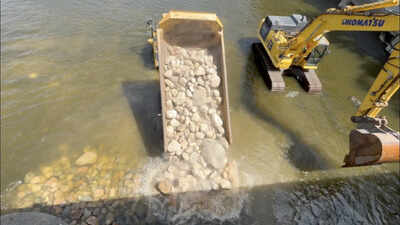
After nearly two decades of planning, crews are now working in the Grand River in Grand Rapids, Michigan, to bring back the rapids that gave the city its name. Rapids are sections of a river where water flows faster and more turbulently over rocks or uneven parts of the riverbed.The first phase of the restoration is focused on the Lower Reach, the section of the river between the Bridge Street Bridge and Fulton Street Bridge, according to Spectrum News. Construction began in the river on July 1, with crews working to remove four low-head dams from the downtown section. Once the dams are removed, they will be replaced with natural rock features, including boulder arches, riffles and habitat boulders.The first phase is expected to take about two years, with the Lower Reach work expected to be completed by October 2027. The restoration will cover 2,887 feet and 30 acres of river corridor. The project is designed to reshape the river for fish and wildlife while also creating new opportunities for people to access and use the water.Before construction began, mussels on the riverbed had to be relocated, including threatened or endangered species. The construction area was divided into a grid, and divers searched the riverbed to locate mussels. The stones carrying them were then moved to another part of the river. Species of particular concern were fitted with microchip implants so they could be tracked.
Rebuilding a river
The four low-head dams are being removed as part of the first phase. They will be replaced with structures designed to resemble features that would be found in a natural river.“This is an amazing day- 18 years in the making- to see equipment finally in the river, “In two years, we will see rapids back in Grand Rapids again,” said Matt Chapman, executive director of Grand Rapids Whitewater.The restoration uses a technique known as natural channel design. This involves building structures that look like features found in a natural river rather than structures that have been heavily engineered.“The state likes to use a stream restoration technique that’s called natural channel design. Essentially, you’re trying to build structures that look like structures you would find in a natural river that hasn’t been touched or manipulated,” Chapman said, as quoted by The Rapidian.One example is the installation of J-hook weirs. These are rock structures designed to protect river banks from erosion. Two J-hook weirs have already been installed near the Grand Rapids Public Museum.The structures are also intended to help people reach the river. Chapman said the water along the museum river edge moves very quickly. The museum has also completed a renovation of its riverfront, creating a setting where students can use the river for learning.“The biggest thing that they help is to facilitate some access, especially along the museum river edge, the water flows very quickly over there. They just completed a renovation of their riverfront, and they want students to be able to go down into the river, take water quality samples and use the river as a classroom,” Chapman said.
Creating passage for fish
Fish movement is another major part of the restoration plans. The project team worked closely with the Michigan Department of Natural Resources and its fisheries division while designing the restored river.The designers considered whether fish would be able to move through the new rapids and other river features. Chapman said the walleye was used as a benchmark for fish passage.The team looked at native species as well as fish that cannot jump over obstacles. “We really looked at some of the native species and some of the non-jumping species. We used the walleye as our surrogate species of ‘if an 18-inch walleye can get through, so can a lot of other fish species,’” Chapman said.The restored section will include features intended to improve aquatic habitat and fish passage for native Great Lakes species. These include lake sturgeon, river redhorse and the snuffbox mussel.The endangered snuffbox mussel is a particular focus of the project. To support the species, the restoration will include habitat for the common logperch. The mussel relies on the common logperch to transport its eggs.The restored rapids are also expected to attract more lake sturgeon. The species is the largest fish in the Great Lakes basin and spawns in rocky river beds.
Construction continues
Crews began the in-river work by installing turbidity curtains to capture sediment disturbed by equipment moving through the riverbed. They are also adding scour protection around the Gillette Bridge piers before installing a cofferdam.The cofferdam will isolate part of the river so crews can carry out construction of the first major feature, a boulder arch structure.“Everything that you see the crews doing in the river is very carefully coordinated to make sure we’re not causing more sediment or more disturbance to the river bottom,” Chapman said.Over the next two years, crews will remove the four dams and add natural river features. These will include a boulder arch structure, constructed riffles, scattered habitat boulders, bank vanes and emergent habitat features.The project is also expected to create new recreational opportunities. The restored rapids aim to provide river access for kayakers, paddle boarders and tubers.
Upper Reach restoration
The Sixth Street Dam currently serves as a barrier to sea lampreys, an invasive species. Because of this, removing or changing the dam will require a different approach.Chapman said Grand Rapids Whitewater is working with the Great Lakes Fishery Commission, a binational organisation with representatives from the United States and Canada, to design a new barrier for the lampreys.The Upper Reach restoration will begin after the Lower Reach work is completed.
About The Author