


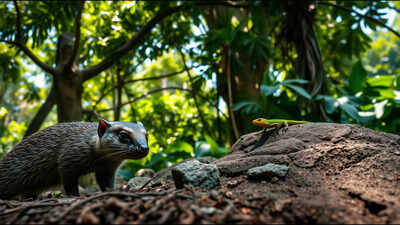
In 1872, British planter William Bancroft Espeut released 9 small Indian mongooses into his sugar fields in Jamaica after importing them from India to control rats. Within 10 years, botanist Daniel Morris reported that the animals were abundant across the island and had reached elevations of 5,000 feet. The introduction later became associated with declines in Jamaican birds and reptiles, while the mongoose itself became the subject of a much broader debate about biological control and the unintended consequences of introducing animals. Historian Matthew Holmes of the University of Stavanger examined the episode in a 2023 study published in The British Journal for the History of Science titled A plague of weasels and ticks: animal introduction, ecological disaster, and the balance of nature in Jamaica, 1870–1900. Later ecological research has provided direct evidence of mongoose predation on threatened Jamaican species, while genetic research suggests that Jamaica experienced multiple mongoose introductions from India rather than a population descended solely from Espeut’s original 9 animals.
Why Espeut brought mongooses to Jamaica
Espeut was a landholder and Fellow of the Linnaean Society who was struggling with rats on his Spring Garden Estate. His wife, Bessie Adela Jeannette Espeut, suggested using a mongoose after her own experience in Ceylon. In Espeut’s account, she had previously owned an Indian mongoose as a pet and had seen it kill rats. He subsequently asked the Jamaican government to import mongooses from India. Holmes records that 4 males and 5 females arrived in February 1872, and Espeut immediately released them into his sugar fields. Espeut later reported that evidence of reduced rat damage was clear within 6 months. Holmes argues that Espeut’s decision was based solely on his wife’s experience with her pet, rather than on evidence about how a population of wild mongooses would behave after release. The date also has a historical discrepancy. Holmes uses February 1872 on the basis of Espeut’s published account, while Espeut later gave American ornithologist William Earl Dodge Scott a different date, saying the animals had arrived in March 1873.The original 9 were not necessarily the only mongooses brought to Jamaica around this period. Holmes notes that several captive-bred mongooses were also sent from London around 1872, although those animals reportedly did not catch rats. Meanwhile, mongooses from Espeut’s estate were trapped and sold to other Jamaican planters, helping the animals become established elsewhere on the island. Modern genetic research provides another reason not to treat the first 9 animals as the sole founders of Jamaica’s mongoose population. A 2021 study in Biological Invasions titled “Dispersal history of a globally introduced carnivore, the small Indian mongoose Urva auropunctata, with an emphasis on the Caribbean region” analysed genetic data from 496 mongooses and found evidence consistent with multiple introductions into Jamaica from India. The molecular results also suggested that mongooses subsequently spread from Jamaica to Grenada and Puerto Rico, consistent with historical records.
What the mongoose did after spreading
The mongoose’s expansion changed the original calculation behind its introduction. Reports from Jamaica increasingly described an animal that ate more than rats. In a USDA report published in 1899, Theodore Sherman Palmer, assistant chief of the Biological Survey, recorded mongooses preying on young livestock, poultry, ground-nesting birds, eggs, reptiles and other animals. The reports reflected growing concern that the predator was affecting species that had not been the target of the original rat-control effort. Modern research has supplied stronger evidence for some of those historical concerns. In a 2011 study published in Biological Invasions titled “Conservation implications of small Indian mongoose (Herpestes auropunctatus) predation in a hotspot within a hotspot: The Hellshire Hills, Jamaica,” Delano S. Lewis, Rick van Veen and Byron S. Wilson examined the stomach contents of 217 mongooses. They found that invertebrates and lizards accounted for 93% of identified prey items. The researchers also found remains of threatened species, including the blue-tailed galliwasp.Another study focused on the critically endangered Jamaican rock iguana. In a 2017 paper in The Herpetological Journal titled “Predation of Jamaican rock iguana (Cyclura collei) nests by the invasive small Asian mongoose (Herpestes auropunctatus) and the conservation value of predator control,” Rick van Veen and Byron S. Wilson monitored iguana nests and used motion-activated cameras to document mongoose predation. They found high nest-predation pressure attributable to mongooses and a significant reduction in predation within an experimental mongoose-removal area. The IUCN Iguana Specialist Group reports that mongooses depredated every monitored nest outside the control zone.
Historical reports linked mongooses to disappearing birds
The impact on Jamaica’s birds was also documented by Outram Bangs and Frederick H. Kennard, who compiled a list of the island’s birds in 1920. They reported that many species they had previously encountered were no longer present and attributed many of the changes to the mongoose. Among the birds they discussed was the “blue mountain duck,” which Holmes identifies as probably referring to Pterodroma caribbaea, a name associated with the Jamaican petrel. Bangs and Kennard reported that the bird had been driven to extinction by the mongoose. They also wrote that the common or helmeted guineafowl had apparently been exterminated in the wild by the predator. Holmes notes that the guineafowl was a naturalised bird introduced to Jamaica, rather than a native Jamaican species.The limpkin, meanwhile, had become restricted to 1 location by 1910, with Bangs and Kennard suggesting that the mongoose had found the species easy prey and contributed to its near extinction. Their account also recorded an example of a species that appeared to adapt. The whistling tree-duck, which had initially declined, was reported to have changed its breeding habits in some way, probably keeping its young in places too wet for the mongoose to hunt, after which it appeared to be regaining its former abundance.
The disputed story about ticks
The mongoose was later drawn into another ecological explanation involving Jamaica’s growing tick problem. As birds and reptiles declined, some observers argued that the loss of animals that fed on insects had allowed ticks and other pests to increase. By the 1890s, the idea had developed into a broader claim that nature was restoring its own balance by allowing ticks to attack the mongoose.Holmes finds little evidence for that explanation. Robert Newstead, who investigated Jamaica’s tick problem in the early 20th century, found that mongooses appeared to be remarkably free from tick infestation. Holmes also notes that Jamaica’s expanding cattle industry and imported livestock offered a more plausible explanation for the growth of the tick population. A later study by Gordon B. Thompson likewise found very few ticks on mongooses. The idea nevertheless became influential because it offered a neat explanation for an ecological disaster. If the mongoose had disrupted the island’s wildlife and caused ticks to increase, then the supposed decline of the mongoose from tick infestations could be presented as nature correcting the disturbance. Holmes describes this as a post hoc rationalisation of the consequences of the introduction rather than an explanation established by evidence.
About The Author