

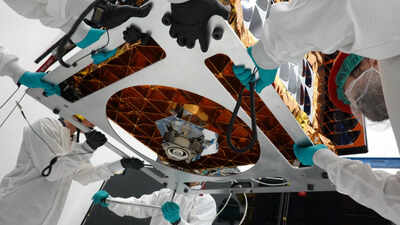
A spacecraft about the size of a washing machine is preparing to approach objects that are no longer working in Earth’s orbit. The mission, supported by NASA, will test whether a spacecraft can independently navigate towards inactive satellites and rocket bodies, examine their condition and move between different orbits. The technology could eventually help repair spacecraft or remove unwanted objects from space.The mission, called Small Spacecraft Propulsion and Inspection Capability (SSPICY), was launched on October 1 from Vandenberg Space Force Base in California. It involves a spacecraft named Otter, developed by US-based company Starfish Space. According to NASA, Otter will approach up to four inactive space objects of US origin in low Earth orbit, including satellites and rocket bodies.The inspections are expected to begin in early 2027. During this phase, Otter will travel to within hundreds of yards of each object and examine it without making physical contact. Much of the navigation will be handled by the spacecraft’s own software, with minimal assistance from controllers on Earth.The mission is not intended to repair satellites or remove space debris immediately. Instead, it will test several technologies together to determine whether they can support such operations in the future. NASA says this will be the first time these capabilities are demonstrated as an integrated system.
How will spacecraft inspect objects in orbit?
Approaching an inactive satellite is different from approaching one that is still operating. A spacecraft that is no longer functioning may be spinning or positioned in a way that makes it difficult for another spacecraft to approach safely.To carry out the inspections, Otter will use autonomous guidance and control software. This means the spacecraft will be able to make navigation decisions without waiting for instructions from ground controllers at every stage.Its computer vision system and sensors will help it observe nearby objects and determine how to approach them. The software will use this information to make navigation decisions in real time as Otter moves closer to its targets.During each inspection, the spacecraft will collect information about the object’s spin rate, orientation and surface condition. Spin rate refers to how quickly an object rotates, while orientation describes the direction in which it is positioned. Examining the surface will provide information about its physical condition.These observations are important for understanding how a future spacecraft might safely approach an object that is no longer under active control.
How will Otter travel between different objects?
The SSPICY mission will also demonstrate how a small spacecraft can move between objects travelling in different orbits.Otter is equipped with an electric propulsion system that will allow it to travel between inspection targets. The mission will test how this system works alongside other technologies needed for precise movement in space.Another important component is an articulating robotic boom. This movable structure will be used to test the positioning of the spacecraft’s thrusters, which provide the force needed to change its movement.By adjusting the direction in which the thrusters point, the spacecraft will test precise manoeuvring between different orbits.NASA says the combination of electric propulsion, autonomous navigation, sensors and the robotic boom is central to the demonstration. Although these technologies have different functions, the mission will examine how they perform together during a series of close approaches.
Why is NASA testing this technology?
The mission comes as increasing numbers of satellites are being launched into Earth’s orbit. Thousands of satellites are launched each year to support services such as communications, weather forecasting and navigation.However, satellites and rocket bodies can remain in orbit after they stop working. Objects that experience problems or are no longer in service may collide with one another or break apart.Such incidents can produce orbital debris, ranging from large fragments to much smaller particles. These objects create concerns for spacecraft operating in the same environment.NASA is therefore supporting technologies that could make it possible to inspect inactive objects before attempting more complicated operations.For SSPICY, the immediate objective is inspection rather than removal. Otter will not touch or dock with any of the four targets during the mission.However, the technologies being tested could eventually support spacecraft servicing and repairs. They could also help future missions remove unwanted objects by pulling them into Earth’s atmosphere for disposal.
Who is behind the SSPICY mission?
Starfish Space developed and operates the Otter 24C spacecraft being used for SSPICY. The company has also prepared the spacecraft for the technology demonstration at its facilities in Seattle.NASA’s Small Spacecraft and Distributed Systems programme, which operates under the agency’s Research and Technology Mission Directorate, is funding and managing the demonstration.The agency’s Small Business Innovation Research and Small Business Technology Transfer programmes also provided funding awards to Starfish Space during the early development of the spacecraft’s key technologies.The inspections planned for 2027 will help demonstrate whether these systems can work together during autonomous close approaches. While SSPICY will not carry out repairs or debris removal itself, the results could help develop future missions capable of performing those tasks in orbit.
About The Author