


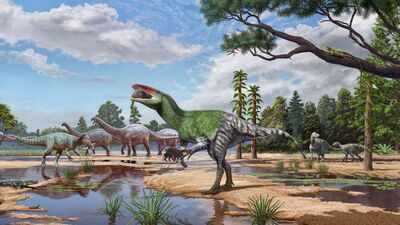
A fossil discovered on England’s Isle of Wight more than a century ago has revealed a previously unknown species of meat-eating dinosaur. The specimen, which entered the Natural History Museum’s collection in 1924, was recently identified as a member of a group of predators known for their unusually large claws. The discovery, announced on 14 October 2026, marks the first time a megaraptoran dinosaur has been identified in Europe. Researchers say the finding also offers important evidence about how these predators spread across ancient continents.
The Isle of Wight fossil revealed a new long-clawed dinosaur
According to the Natural History Museum, the newly identified dinosaur has been named Invictibellatrix amberina. It lived approximately 120 million years ago, during the Early Cretaceous period, when the area that is now southern England supported a diverse range of dinosaurs and other reptiles.The fossil was originally discovered by Reginald Walter Hooley, an amateur palaeontologist who collected specimens along the south-western coast of the Isle of Wight. The particular remains belonged to the back of a skull and were acquired by the Natural History Museum after Hooley’s death, as part of a collection containing more than 1,000 specimens.Despite spending decades in the museum’s collection, the fossil had not received the detailed scientific investigation needed to recognise its significance. Researchers have now shown that the small section of skull contains features that distinguish the animal from other known predatory dinosaurs.
What made this megaraptoran different from other predators
The newly identified dinosaur belonged to a group called megaraptorans, agile, 2-legged carnivores related to tyrannosaurs, including Tyrannosaurus rex. Unlike the familiar image of a powerful predator relying mainly on its jaws, megaraptorans had relatively slender heads and large forelimbs equipped with prominent, curved claws.The Natural History Museum estimates that Invictibellatrix amberina measured between 3 and 4 metres in length and stood slightly more than 1.5 metres tall. These dimensions make it comparable in overall size to a large tiger, although its body shape and hunting behaviour would have been very different from those of a modern mammal.Researchers believe the dinosaur may have had feathers, while its claws could have measured between 10 and 20 centimetres long. These features would have made it a formidable hunter despite its relatively modest size compared with some of its later relatives.According to the museum, its likely prey included small dinosaurs, lizards and mammals. It occupied a role in the food chain comparable to that of a modern hyena, feeding on smaller animals rather than dominating its ecosystem as the largest predator.The researchers also noted that the dinosaur could have posed a serious threat to a human because of its size and hunting capabilities. However, it was not the dominant predator of its own environment.
How did scientists establish that the fossil belonged to a new species
The research team investigated the fossil using computed tomography, commonly known as a CT scan. This allowed scientists to examine its internal structure and construct a 3D model of the skull fragment, including the space associated with the brain.The findings were reported in the journal Royal Society Open Science. According to the study, researchers compared the specimen with skulls and braincases from several groups of meat-eating dinosaurs, including tyrannosaurs, spinosaurs and other two-legged predators.The fossil contained a distinctive combination of anatomical characteristics. These included an oval opening where the spinal cord entered the brain and an unusual, hourglass-shaped crest.Neither feature alone was sufficient to establish the animal’s identity. Instead, the researchers assessed the combination of characteristics and used computer-based analyses to compare the specimen with other dinosaur groups.The analyses consistently placed the fossil within the megaraptoran family. This supported the conclusion that it represented a previously unknown species rather than an already identified predator.
What does the discovery reveal about the spread of megaraptorans
One of the most important findings concerns the geographical history of megaraptorans. Before the discovery, researchers had proposed that these dinosaurs originated in Asia before spreading to other parts of the world. However, the absence of confirmed European fossils left a significant gap in the evidence supporting that explanation.The identification of Invictibellatrix amberina provides evidence that megaraptorans lived in Europe during the Early Cretaceous. According to the Natural History Museum, the discovery supports the idea that these predators subsequently spread towards Gondwana, the ancient southern landmass that included present-day Africa, South America and Antarctica.Co-author Charlie Scherer explained that the new species provides evidence for a route through Europe, rather than a possible alternative involving island-hopping farther south.The researchers also used mathematical modelling to investigate how the distribution of megaraptorans changed over time. The results suggest that megaraptorans were widespread during the Early Cretaceous. However, by the Late Cretaceous, tens of millions of years later, they had probably disappeared from Laurasia, the northern landmass that included modern-day Europe.In the south, they continued to evolve into much larger predators. Some later megaraptorans developed claws measuring up to 35 centimetres, demonstrating how much the group varied in size over its evolutionary history.
Significance of the name
Professor Paul Barrett, the study’s senior author from the Natural History Museum, said the Isle of Wight continues to produce new dinosaur discoveries despite more than 200 years of fossil collecting.Invictibellatrix amberina is a particularly striking example. Its scientific name carries a message beyond its anatomical identity. Invictibellatrix means unconquered female warrior, while amberina refers both to amber found in the rocks. The researchers intended the name to express hope and strength for people facing bullying, discrimination, victimisation and oppression.
About The Author


