


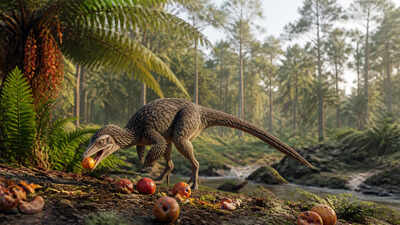
“In a savage and ever-changing world, some will rise and some will fall. But through it all, the dinosaurs will expand their empire and advance relentlessly to seize Earth’s final frontiers,” narrated Morgan Freeman in the 2026 Netflix miniseries: The Dinosaurs. Nearly 66 million years ago, the Earth as we know it, was transformed, shrouded in a cloud of smoke and debris that engulfed much of the life that had come to inhabit it. Yet, even as the life that Earth had known dissipated into thin air, the dinosaurs, among the mightiest wonders of the world’s wildlife, left behind a legacy that continues to evolve in the form of birds, the avian descendants that now encircle our planet.The world of dinosaurs has often been imagined through the sharp teeth of its predators and the enormous bodies of its plant-eating giants, but the diversity of life during the Cretaceous period, the final and the longest geological period of the Mesozoic era lasting between 145 million years ago to 66 million years ago. The period continues to reveal surprises that challenge what we thought we knew about these prehistoric animals. As a newly identified bird-like dinosaur, named Infernogallus jamesi has now lent researchers a glimpse into a rather different side of the dinosaur life, with evidence suggesting that it may have been specially adapted to eat fruit.
(Image credit: Canva)
Published in the journal Nature Communications, the study examines how the dinosaur’s skull and chewing muscles were organised, allowing scientists to reconstruct how it might have processed its food. The findings point towards a specialised herbivorous diet that likely included fleshy fruits, making Infernogallus one of the strongest candidates yet for a dinosaur adapted to fruit eating.
A little dinosaur with an unusual appetite
The name Infernogallus, which translates to “hell chicken”, offers an intriguing introduction to this creature. Its fossils were discovered in the Hell Creek Formation, a geological formation spread across parts of Montana, North Dakota, South Dakota and Wyoming in the United States.Unlike the imposing predators that tend to dominate our imagination of prehistoric life, Infernogallus jamesiwas a relatively small, feathered, two-legged dinosaur, weighing approximately 12 kilograms and comparable in size to a turkey. It belonged to a group of toothless, beaked dinosaurs known as caenagnathids, which are part of the oviraptorosaur lineage.
(Image credit: Canva)
Although its relatives have presented paleontologists with questions about their feeding habits, the unusually well-preserved remains of Infernogallus, including an almost complete skull, offered an opportunity to investigate these questions more closely. Understanding what an extinct animal ate is not always straightforward, particularly when direct evidence of its last meal is unavailable. In this case, however, the answer lay in the anatomy of its skull.
What its chewing muscles revealed
To understand how Infernogallus ate, the researchers used CT scans to examine the structure of its skull and reconstruct the arrangement of its jaw muscles. Rather than relying on its overall appearance, they investigated the mechanics that would have allowed the animal to bite and process food.
(Image credit: Canva)
The findings revealed an unusual arrangement of the muscles responsible for closing the jaw. Its palate, the bony structure forming the roof of the mouth, curved downwards into the oral cavity, changing the orientation of some of the muscles involved in chewing. This arrangement would have allowed the lower jaw to move backwards and forwards, helping the dinosaur process soft food within its mouth. Moreover, the researchers found that the arrangement in Infernogallus had a striking parallel in certain modern fruit-eating parrots, particularly the vulturine parrot, whose specialised anatomy helps it process fruit.
A prehistoric world where fruit mattered
The discovery also opens a window into the changing relationship between dinosaurs and flowering plants. During the Cretaceous period, flowering plants, known scientifically as angiosperms, were diversifying and becoming increasingly prominent. Their fruits provided new food resources, and the researchers suggest that this evolution of specialized feeding adaptations in dinosaurs may have developed alongside the increasing diversity and even abundance of fleshy fruits. The study points towards fruits with soft flesh surrounding a central seed or pit, similar in broad structure to those found in some modern stone fruits. The dinosaur’s jaw mechanics appear particularly suited to processing this kind of food. However, the evidence does not establish that it ate fruit exclusively. Other soft plant material may also have been a significant part of its diet.The rise and fall of a dynasty of dinosaurs that persevered for roughly 165–180 million years has not only left behind a legacy of a world that humans may never have witnessed, but one that we continue to bask in through the traces that exist around us. Through its discoveries, science brings us closer to this lost world, not only through fossilised bones, but by investigating the smaller anatomical details that reveal how these creatures lived.
About The Author


