


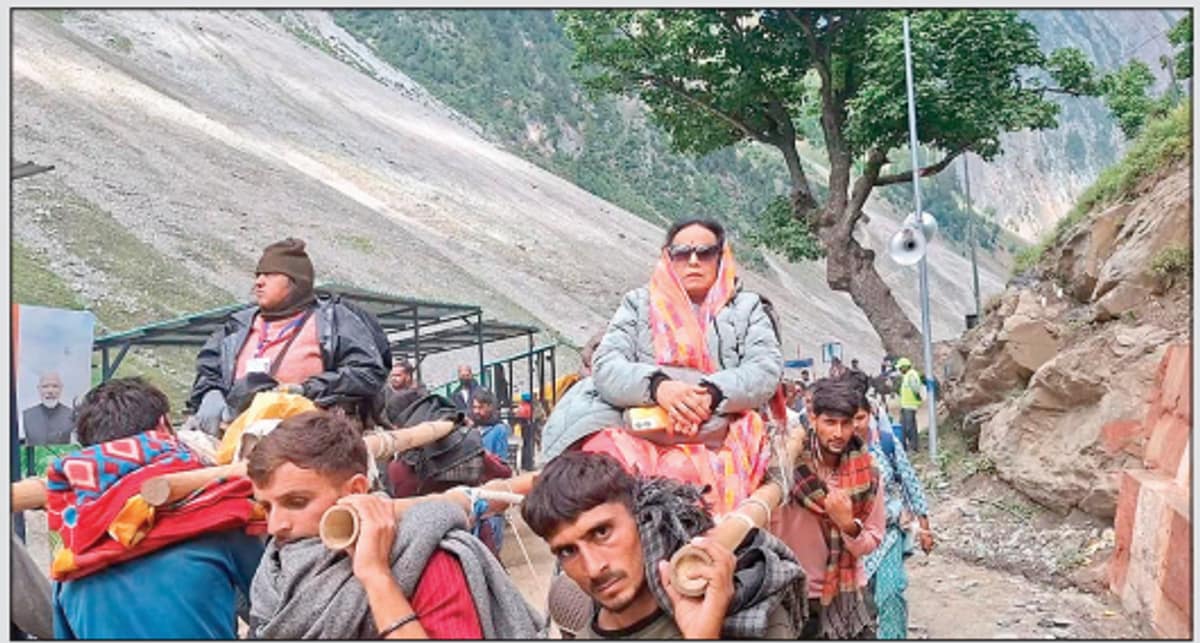
The annual Shri Amarnath Ji Yatra is progressing smoothly, with thousands of pilgrims undertaking the sacred journey to the 3,888-metre cave shrine amid elaborate security arrangements and extensive logistical support.
Beyond its religious significance, the pilgrimage continues to exemplify Kashmir’s long-standing tradition of communal harmony, where people from different faiths work together to ensure a safe and successful yatra.
The 38-day pilgrimage commenced on July 3 through two routes—the traditional 48-km Nunwan-Pahalgam track in south Kashmir’s Anantnag district and the shorter but steeper 14-km Baltal route in central Kashmir’s Ganderbal district.
Every summer, the Amarnath Yatra transforms into one of the Valley’s strongest symbols of communal coexistence. Sikh and Hindu organisations from different parts of the country operate free community kitchens (langars), while local Kashmiri Muslims run shops, tea stalls, tents and transport services. Security forces, disaster response teams, volunteers and residents work in close coordination to facilitate the pilgrimage.
For local pony owners and palanquin bearers, the yatra is not merely a source of livelihood but also an opportunity to serve the pilgrims.
Farooq Ahmad Khan, a pony owner who has been ferrying pilgrims to the holy cave for many years, said the safety of the devotees always remains his foremost concern.
“I am accustomed to these difficult mountain terrains, but the pilgrims are our guests. I thank God every time I safely drop them at the cave shrine and return to bring another batch,” Khan told Greater Kashmir.
The same sentiment is echoed by Liyaqat Ahmad, a palanquin bearer who, along with three colleagues, carries elderly and ailing pilgrims on his shoulders from Baltal to the holy cave and back—a round trip of nearly 32 kilometres.
“The oxygen level drops significantly because the cave is situated at around 13,000 feet above sea level. The weather changes without warning—from bright sunshine to rain or even snowfall. Despite all these challenges, we make every effort to ensure that every pilgrim completes the journey safely,” he said.
Baltal, one of the principal base camps, presents a vivid picture of Kashmir’s shared traditions. Hundreds of local Muslim families have set up kiosks, tents and refreshment stalls to cater to the needs of pilgrims, while dozens of langars established by organisations from outside Jammu and Kashmir provide free meals and essential services throughout the pilgrimage.
The Baltal route, though only 14 kilometres long, is steep and physically demanding. Passing through Domail, Barari Marg and Sangam before reaching the holy cave, the route witnesses thousands of pilgrims every day. While many undertake the trek on foot, a large number depend on ponies and palanquins operated primarily by local residents.
Throughout the journey, pony owners and palanquin bearers negotiate narrow mountain paths, slippery stretches, sudden rains and high-altitude conditions to transport pilgrims safely. Along the route, chants of “Bam Bam Bhole” and “Har Har Mahadev” mingle with repeated safety instructions from local service providers, who constantly advise pilgrims to walk close to the hillside and avoid the valley edge.
Tea stalls and makeshift shops along the route are adorned with images of the ice lingam, reflecting the reverence associated with the annual pilgrimage.
Every year, thousands of Kashmiri Muslims participate directly in the yatra by working as pony owners, palanquin bearers, labourers, tent operators and shopkeepers, besides providing food, accommodation and logistical assistance to pilgrims. Hundreds also establish seasonal businesses at Baltal and Pahalgam, making the pilgrimage an important source of livelihood for many local families.
Mohammad Akbar, a local service provider, said the people of Kashmir have always considered it their responsibility to ensure that pilgrims complete their journey without inconvenience.
“We have been serving Amarnath pilgrims for years. Irrespective of religion, we consider them our guests and do everything possible to ensure their safety and comfort throughout the pilgrimage,” he said.
Another service provider, Shabir Ahmad, said the yatra represents much more than seasonal employment.
“It certainly provides us with a livelihood, but more importantly, it gives us an opportunity to serve people belonging to another faith. That gives us immense satisfaction,” he said.
Pilgrims, too, praised the warmth and hospitality extended by local residents.
A group of devotees from Gujarat described the pilgrimage as a living example of communal harmony.
“This is perhaps the finest example of how people from different religions can live and work together peacefully. The hospitality of the local people has made our journey memorable,” they said.
Mukesh Singh, another pilgrim, said the Amarnath Yatra demonstrates the strength of interfaith harmony.
“The pilgrimage teaches us that humanity rises above all religious differences. The support extended by the people of Kashmir makes this journey truly special,” he said.
About The Author


