


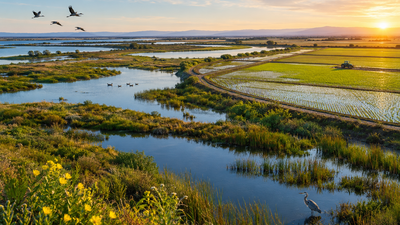
California is moving ahead with a major restoration project that will reshape about 2,800 acres of farmland on Webb Tract in the Sacramento-San Joaquin Delta into wetlands and upland habitat, alongside rice cultivation. According to the Metropolitan Water District of Southern California and the Sacramento-San Joaquin Delta Conservancy, the project is intended to address decades of land subsidence while reducing greenhouse gas emissions, storing carbon and creating habitat for wildlife. The approximately $28 million project is being supported by a $20.9 million grant from the Delta Conservancy, with Metropolitan covering the remaining cost.
Why Webb Tract is being transformed
Webb Tract is a Metropolitan-owned island in Contra Costa County, located within the Sacramento-San Joaquin Delta, a region that supports agriculture, communities and a major part of California’s water supply. But the landscape has also been affected by decades of conventional farming. For more than a century, much of the Delta’s farmland has been managed by draining the soil to grow crops. This has affected the peat soils beneath the islands. Once these organic-rich soils are drained and exposed to air, they can break down and cause the land surface to gradually sink, a process known as land subsidence.According to Metropolitan, some areas of the Delta have subsided to as much as 24 feet below sea level. On Webb Tract, the restoration strategy is therefore centred on putting water back onto the landscape rather than continuing to rely entirely on dry-soil farming. The project will restore approximately 2,800 acres of wetlands and upland habitat. At the same time, agricultural land on Webb Tract is being converted to rice cultivation, creating a landscape that combines farming with environmental restoration.
How wetlands and rice can help slow subsidence
The key to the project is keeping the peat soil wet. When peat remains waterlogged, it has less exposure to oxygen, which slows the decomposition of organic material. That can help prevent further loss of soil and, under suitable conditions, allow the land surface to gradually rebuild through the accumulation of organic material. Rice farming fits into this approach because rice is cultivated in wet conditions. Metropolitan has previously said it leased more than 2,100 acres of Webb Tract to agricultural partners for rice cultivation. The agency says rice cultivation can help slow or stop subsidence while allowing the land to remain in agricultural production.Metropolitan’s longer-term climate planning also identifies Webb Tract as an opportunity to test how wetland restoration and rice cultivation can reduce greenhouse gas emissions from subsided peat soils. Monitoring carried out before the project found that baseline emissions from the peat were higher than initially estimated, highlighting the potential climate benefits of changing how the land is managed.
Restoring habitat while storing carbon
The project is not only about protecting the land from sinking. Restoring wetlands is also expected to create habitat in an area where natural wetland landscapes have been extensively altered by agriculture and other development. Keeping portions of Webb Tract wet can provide habitat for migratory birds and other Delta species. The project is being designed as a multi-benefit landscape, combining wetlands, upland habitat and rice fields rather than returning the entire island to a single land use.Wetlands can also play a role in carbon storage. Waterlogged soils can retain organic carbon that would otherwise be released as greenhouse gases when peat is drained and exposed to oxygen. Metropolitan has said the restoration could generate carbon credits because of the project’s carbon-sequestration benefits. Those credits could potentially be used to offset the agency’s emissions or sold in the carbon market, with revenue helping support long-term management of the restored landscape.
A $28 million project with broader goals
The Webb Tract initiative has an estimated cost of about $28 million. The Sacramento-San Joaquin Delta Conservancy is providing a $20.9 million grant, while Metropolitan is funding the remainder. The project was developed with guidance from Indigenous and Delta communities, according to the announcement. The restoration is also connected to California’s Cutting the Green Tape initiative, which is intended to streamline environmental review and permitting for restoration projects that provide long-term benefits for climate resilience, biodiversity and sensitive species.The official announcement says the organisations will break ground and plant the first seeds for future native plants on Oct. 7, 2026. Officials expected to participate include California Natural Resources Agency Secretary Wade Crowfoot, Metropolitan General Manager Shivaji Deshmukh, California Department of Water Resources Director Tom Gibson, California Department of Fish and Wildlife Director Meghan Hertel and Delta Conservancy Executive Officer Campbell Ingram. The first planting will include Bay Miwok evening primrose, a native plant described by the project organisers as having deep connections to the Delta’s Indigenous communities.Ultimately, the Webb Tract project represents a shift from treating the Delta’s subsided agricultural islands solely as farmland toward managing them as landscapes that can serve several purposes at once. By combining wetlands with rice cultivation, the project aims to keep peat soils wet, slow or reverse subsidence, reduce greenhouse gas emissions, store carbon and expand habitat while retaining an agricultural role for the island.
About The Author


