

Kargil, July 3: In a significant development in the ongoing dialogue between the Ministry of Home Affairs (MHA), the Apex Body Leh (ABL) and the Kargil Democratic Alliance (KDA), representatives on Friday announced that all stakeholders had unanimously signed the minutes of the previous meeting after extensive deliberations, describing the discussions as “long, detailed and highly positive.”
Sources said that more than a month after talks between Ladakh groups and an MHA sub-committee in New Delhi, informal discussions were held on Friday in Leh between the ABL, KDA and senior MHA officials. The meeting primarily focused on finalising the minutes of the previous meeting and discussing other key issues.
Additional Secretary in the MHA, Prashant Sitaram Lokhande, led the talks. ABL member and environmentalist Sonam Wangchuk could not attend the meeting as he is in Delhi on a hunger strike at Jantar Mantar during a Citizens for Justice and Peace (CJP) protest.
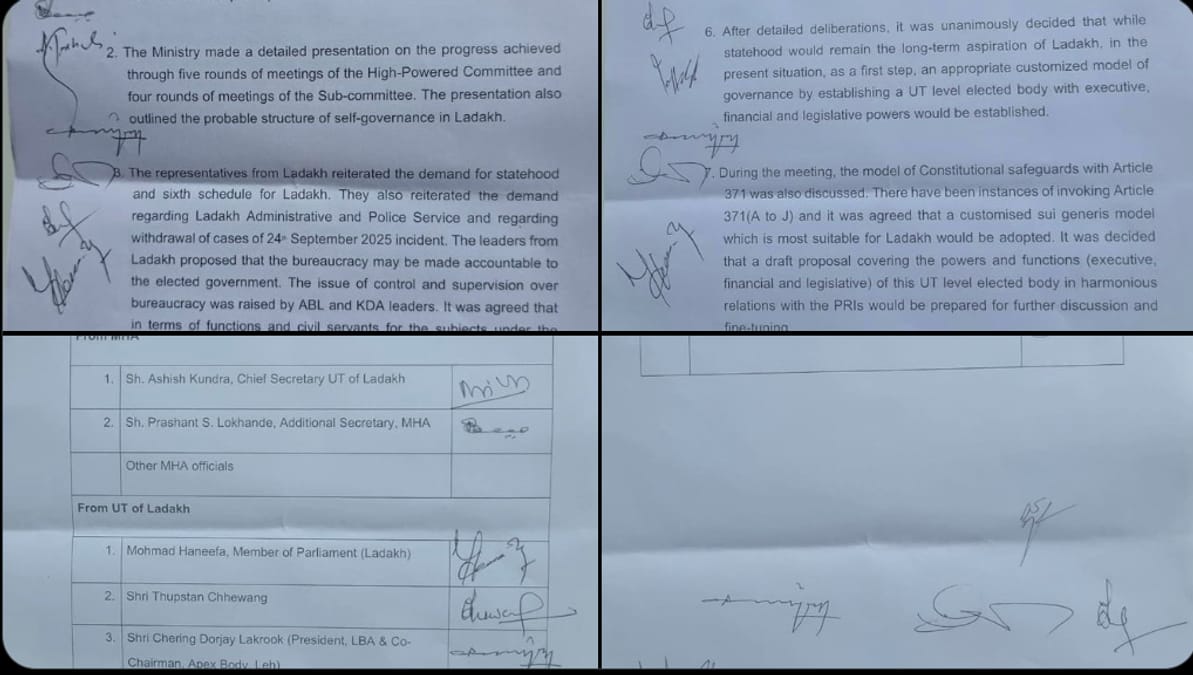
According to the minutes of the fifth meeting of the Sub-Committee of the High-Powered Committee (HPC) on Ladakh, held on May 22 at the Ministry of Home Affairs in New Delhi, the Ministry made a detailed presentation on the progress achieved through five rounds of HPC meetings and four rounds of Sub-Committee meetings. The presentation also outlined a proposed structure for self-governance in Ladakh.
Representatives from Ladakh reiterated their demands for statehood, inclusion under the Sixth Schedule, creation of the Ladakh Administrative Service (LAS) and Ladakh Police Service (LPS), and withdrawal of cases related to the September 24, 2025 incident. They also proposed that the bureaucracy be made accountable to an elected government.
The issue of administrative control over the bureaucracy was discussed at length. It was agreed that, for subjects under the jurisdiction of the proposed Union Territory-level elected body, control and supervision—including the Annual Performance Appraisal Reports (APARs)—would rest with the elected executive.
Further details will be finalised in future meetings under the Transaction of Business Rules.
Participants also acknowledged the government’s support to Ladakh in recent years through dialogue initiatives, domicile and reservation provisions, employment measures, infrastructure development, cultural recognition and administrative reforms.
It was agreed that the next logical step would be to further empower the Union Territory through a democratic institutional framework providing a political voice. While statehood would remain Ladakh’s long-term aspiration, all parties unanimously decided that, as an immediate step, a customised governance model establishing a Union Territory-level elected body with executive, financial and legislative powers should be created.
The meeting also discussed constitutional safeguards under Article 371. Referring to various provisions under Article 371A to 371J, both sides agreed that a customised, sui generis model best suited to Ladakh would be explored. It was decided that a draft proposal outlining the executive, financial and legislative powers of the proposed elected body, while ensuring harmonious relations with Panchayati Raj Institutions (PRIs), would be prepared for further discussion and refinement.
Addressing the media after the meeting in Leh, leaders of the Apex Body and KDA said the prolonged discussions had focused primarily on resolving contentious points in the meeting minutes. Following detailed negotiations, both sides reached a consensus, leading to the signing of the finalised minutes by all stakeholders.
The leaders said the Government of India had made considerable efforts to accommodate the concerns and aspirations of Ladakh’s representatives, resulting in an agreement they described as satisfactory.
One of the major developments relates to constitutional safeguards for Ladakh. Representatives said that while earlier discussions had centred on provisions similar to Article 371A, the government has now indicated that safeguards under Articles 371A to 371J could be considered if they provide stronger constitutional protection for Ladakh. This assurance has now been reflected in the agreed minutes, Apex Body Leh president Chering Dorjey said.
Another important issue concerning the Annual Performance Reports (APRs) of bureaucrats was also clarified. According to the representatives, the agreed minutes state that the APRs of officials will ultimately be finalised by the elected executive body once such a governance structure is established. The delegation urged the MHA to expedite formal negotiations so that the dialogue reaches a logical conclusion at the earliest.
Regarding the draft proposal for Ladakh’s governance structure, Apex Body leaders said their own draft has already been prepared, while the MHA informed them that its draft is still under preparation. The Apex Body said it would first hold consultations with the KDA and legal experts before finalising and submitting its proposal to the government.
Speaking about the overall atmosphere of the meeting, the representatives said they sensed a far more serious and constructive approach from the MHA than in previous interactions. They conveyed that Union Home Minister Amit Shah is keen to resolve Ladakh’s issues at the earliest and has directed officials to work towards an early and meaningful conclusion.
The leaders further stated that most of their concerns regarding constitutional safeguards, legislative powers and administrative issues had been addressed during the discussions. They said the government had agreed in principle that all bureaucrats in Ladakh would function under an elected executive authority once the proposed governance framework is established.
“The meeting also included discussions on the withdrawal of cases registered against more than 83 individuals detained during the protests of September 24. The government assured us that, following the withdrawal of cases against Sonam Wangchuk, similar action would be initiated for the remaining detainees,” KDA Co-chairman Asgar Karbalai said.
Another significant assurance concerned the creation of dedicated LAS and LPS cadres. The MHA reportedly said it is seriously considering establishing separate administrative and police services for Ladakh to strengthen local governance.
The leaders reiterated their long-standing demand for an elected executive with legislative and financial powers, stating that such a democratic institution should have the authority to legislate for the Union Territory, administer developmental funds and exercise administrative control over the bureaucracy.
Although no date has been fixed for the next round of formal talks, MHA officials assured the delegation that discussions would resume soon in keeping with the Home Minister’s commitment to resolving Ladakh’s demands.
Describing Friday’s interaction as one of the most productive meetings held so far, the Apex Body and KDA expressed optimism that the forthcoming draft discussions would pave the way for a democratic governance model that addresses Ladakh’s aspirations after years of sustained public struggle.
About The Author