


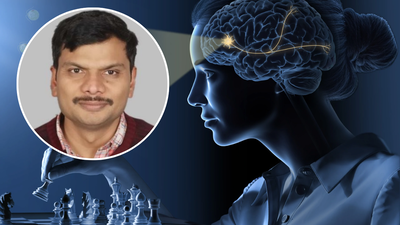
A question about how a microscopic organism finds sunlight led to research that would eventually help scientists control the activity of nerve cells using light. More than two decades later, the work has a connection to the 2026 Nobel Prize in Physiology or Medicine – and to an Indian scientist who helped identify the genes behind the discovery.Prof Suneel Kateriya of Jawaharlal Nehru University (JNU), New Delhi, was a doctoral student in the laboratory of Peter Hegemann in Germany from 2000 to 2004. Hegemann is one of the three scientists awarded this year’s Nobel Prize for discoveries concerning light-gated ion channels and optogenetics, alongside Georg Nagel and Karl Deisseroth.Kateriya’s contribution came during the early stages of research into channelrhodopsins, light-sensitive proteins that later became essential tools in optogenetics. His work involved identifying two DNA sequences in a single-celled green alga that encoded these proteins.
The question that started in an alga
The research began with a basic biological question: how does Chlamydomonas, a microscopic green alga found in freshwater environments, sense light and move towards favourable light conditions?The organism can respond to light despite having no nervous system. Scientists wanted to understand the mechanism that allowed it to detect light and translate that information into a response.Working in Hegemann’s laboratory, Kateriya used computational and molecular biology approaches to identify two genes associated with light-sensitive proteins in the alga. These proteins were subsequently identified as channelrhodopsins, which respond to light and help generate electrical signals in cells.Recalling his doctoral research in an interview with NDTV, Kateriya said: “I was a PhD student with Professor Peter Hegemann from 2000 to 2004. We were working on a very fundamental question, how this green alga swims in water and navigates towards sunlight. I was lucky enough to identify two DNA sequences and these DNA sequences were encoding a light sensitive protein.”The findings were reported in scientific papers published in 2002 and 2003. Kateriya was listed as a co-author on both studies, which formed part of the foundational research associated with the development of optogenetics.
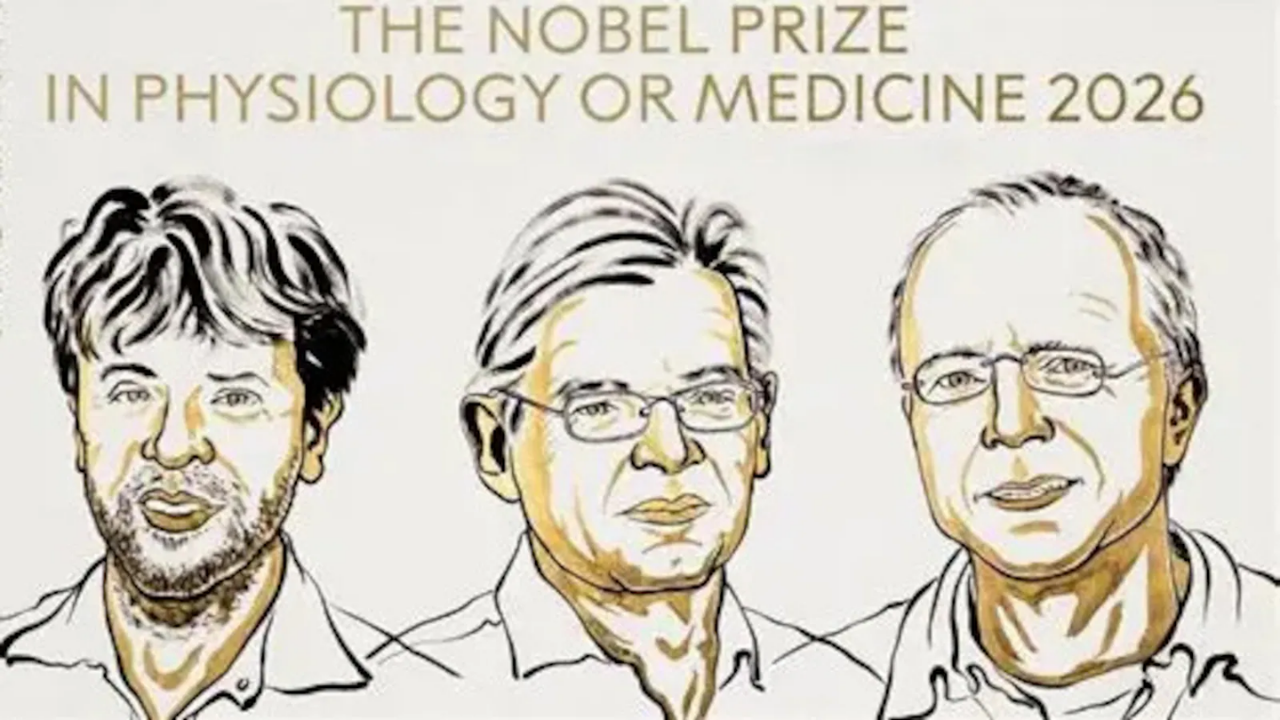
The 2026 Nobel Prize in Physiology or Medicine has been awarded to Karl Deisseroth, Peter Hegemann and Georg Nagel.
How light-sensitive proteins changed brain research
The significance of the research became clearer as scientists investigated how these proteins worked.Further experiments showed that channelrhodopsins function as light-gated channels in cell membranes. When exposed to light, they allow charged particles called ions to pass through the membrane, changing the cell’s electrical activity.This property offered researchers a way to control cells using light. Neuroscientist Karl Deisseroth and other researchers subsequently developed methods to introduce light-sensitive proteins into nerve cells and use pulses of light to activate them.The approach became known as optogenetics. It allows researchers to investigate the activity of selected neurons and neural circuits with a level of temporal precision that conventional methods often cannot provide.The technique has helped scientists study how particular groups of nerve cells contribute to processes such as memory, behaviour and other brain functions. It is also being investigated for potential applications in medicine, although research findings should not be confused with established treatments for human diseases.The 2026 Nobel Prize recognises the discoveries concerning light-gated ion channels and the development of optogenetics. Hegemann and Nagel helped establish the properties of channelrhodopsins, while Deisseroth demonstrated how light-sensitive proteins could be used to control nerve cells.Kateriya’s research forms part of the scientific work that helped make this development possible, rather than representing the entire discovery on its own.
A mentor, a collaboration and a continuing research journey
For Kateriya, the Nobel announcement also carries a personal significance because of his relationship with Hegemann, his doctoral supervisor.He recalled the influence his mentor had on his approach to science. “Peter Hegemann is an awesome mentor and a very good teacher. He used to teach me for hours and hours. I was lucky to have Peter Hegemann as a mentor. He is the one who made me love science. Not only a scientist, he is a very good human being,” he told NDTV. The professional association has continued well beyond Kateriya’s doctoral years. The two researchers have published more than 25 scientific papers together since Kateriya returned to India.Born in Kannauj, Uttar Pradesh, Kateriya studied at institutions in India, including Kanpur University, Banaras Hindu University and JNU, before pursuing research in Germany and later at Columbia University in the US.He now leads a laboratory at JNU’s School of Biotechnology, where his research includes optogenetics, the development of light-sensitive proteins, and studies of ciliopathies – diseases associated with defects in cellular structures called cilia.
Why fundamental research matters
Kateriya has been careful not to present the Nobel-winning work as the achievement of one individual. When asked whether he felt he should have received recognition himself, he said: “I won’t say that because I did contribute to the fundamental discovery. But whatever has been credited to my account, I am really content and satisfied. The Nobel Prize journey is not an individual journey. It is a major contribution from everybody.“His emphasis is on the collaborative nature of scientific discovery and the value of research that begins with basic questions, without an immediate application in mind. “Basic science is very important. Once you have basic science it will bring new discoveries. These new discoveries will give innovation. As long as we excel in good academics and good fundamental science, possibilities are there.”The connection between Kateriya’s doctoral research and the 2026 Nobel Prize illustrates how fundamental research can develop over years, with different scientists building on one another’s findings. What began as an effort to understand how a single-celled alga responds to sunlight ultimately helped provide researchers with a tool to investigate the electrical activity of the brain.
About The Author