


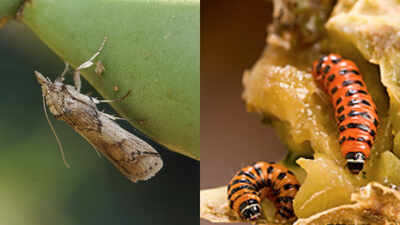
A pest once deliberately moved around the world to solve an agricultural problem has become a problem of its own. According to a report by the USDA’s principal scientific research agency ARS, the South American cactus moth was introduced to the Caribbean decades ago to control invasive prickly pear. After reaching Florida, it began spreading through the very cactus populations native to the southern United States and Mexico. Now, researchers with the U.S. Department of Agriculture’s Agricultural Research Service are working to stop its advance using a biological control method that turns the moth’s own reproductive cycle against it.
From pest control to ecological threat
According to the report, the story began with prickly pear, a cactus considered an invasive agricultural pest in Australia during the 19th century. The South American cactus moth was introduced there as a biological control agent, helping reduce the spread of the unwanted plants. The same strategy was later used in the Caribbean. In 1957, the moth was deliberately introduced to Nevis at the request of the local government to control invasive prickly pear. The moth subsequently spread to neighboring islands and eventually reached the Florida Keys in 1989. From there, it expanded along sections of the Atlantic and Gulf coasts. What had once been a useful tool for controlling prickly pear in places where the plant was invasive was now encountering native cactus populations.
A threat to native cactus
According to scientists, the South American cactus moth primarily attacks Opuntia species, commonly known as prickly pear cactus. It can also occasionally affect Nopalea, Cylindropuntia and Consolea species. The damage begins when female moths lay their eggs on the cactus. After hatching, the larvae feed together, boring into cactus pads and tunneling through their interiors. As the larvae hollow out the pads, the affected sections can eventually die, weakening or killing the plant.Prickly pear has ecological value beyond its appearance. The cacti provide habitat for wildlife and nesting animals, while their root systems can help limit erosion and their dense growth can provide wind protection. Some species are also cultivated as specialty food crops in the United States and Mexico.
Turning sterile moths into a control tool
Researchers are now fighting the invasive moth with a technique known as the sterile insect technique, or SIT. Entomologist James Carpenter of the ARS Crop Protection and Management Research Unit in Tifton, Georgia, is working with colleagues to mass-produce the moth on an artificial diet. Male moths are then exposed to radiation that makes them sterile before being released into areas containing wild populations. The sterile males can still mate with wild females, but the resulting offspring are unable to reproduce. Over time, repeated releases can reduce the number of fertile insects in the population. The work involves researchers from ARS facilities in Georgia and Florida, other USDA agencies and Florida A&M University.
Testing the strategy in the field
The research team is evaluating the approach at three locations: Dauphin Island in Alabama, Okaloosa Island in Florida and St. George Island in Florida. Each site is being managed differently to help researchers measure the effects of the treatment. Dauphin Island is receiving sterile moths alongside a sanitation program, while Okaloosa Island is undergoing sanitation alone. St. George Island serves as an untreated comparison site. Sanitation involves finding and removing cactus pads containing moth larvae or pupae, as well as eliminating egg sticks. On Dauphin Island, combining sanitation with sterile insect releases has already reduced the cactus moth population to levels that are nearly undetectable, concludes the online report.Images Courtesy: ARS, USDA
About The Author


