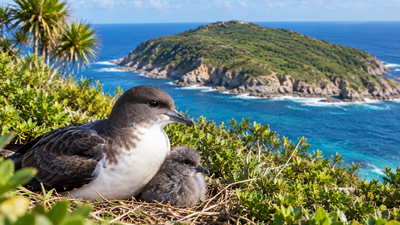
What do rabbits have to do with saving a rare seabird? On a small island off the coast of New South Wales, their presence was damaging the very habitat Gould’s petrels needed to survive. Getting rid of them became an important part of a much larger conservation effort. In 1997, conservationists successfully eradicated rabbits from Cabbage Tree Island as they worked to protect the seabird and its breeding grounds. According to the New South Wales National Parks and Wildlife Service, conservationists worked to restore Gould’s petrel habitat and establish a second breeding colony on nearby Boondelbah Island. By 2000, the island was home to more than 800 breeding pairs, producing over 400 young annually. The turnaround showed how removing an invasive species, alongside other conservation measures, could help a threatened seabird recover.
How rabbits became a problem for Gould’s petrel
Cabbage Tree Island, near Port Stephens in New South Wales, is an important breeding site for Gould’s petrel, a seabird native to Australia. But the island’s vegetation faced a problem after European rabbits were introduced in 1906. As the animals fed on plants and seedlings, they made it harder for the forest to regenerate. The loss of young vegetation was more than a problem for the island’s landscape. Cabbage tree palms and other plants formed part of the habitat that supported the petrels during their breeding season. When rabbits ate seedlings before they could mature, the island’s natural vegetation struggled to replace itself.The birds were already under pressure from other threats. Surveys carried out between 1989 and 1992 recorded an average of about 220 breeding pairs on Cabbage Tree Island. Annual production was low, with fewer than 50 young reported in the early 1990s. Pied currawongs preyed on the birds, while the sticky fruits of birdlime trees could trap petrels. With several problems affecting the colony at once, conservationists realised that protecting the bird would require more than one intervention. The programme addressed the threats to the birds while also tackling the damage being done to their habitat.
The operation that removed the rabbits
The rabbit eradication campaign reached its decisive stage in 1997. A research paper published in Biological Conservation in 2000 by David Priddel, Nicholas Carlile and Robert Wheeler documented how the operation unfolded. Rather than relying on a single method, the team used a sequence of measures to bring the rabbit population under control. Myxomatosis spread naturally across the island between May and July 1997, reducing the estimated population from around 250 rabbits to 100.Rabbit haemorrhagic disease was released in August 1997 and reduced the rabbit population by a further 55%. In September, conservationists used aerial baiting to deal with the remaining animals. The bait contained brodifacoum, an anticoagulant poison. The team also tracked rabbits fitted with monitoring devices to assess the effectiveness of the campaign. Within 13 days of the baiting operation, the remaining rabbits had been eliminated. Checks over the following six months found no survivors. The operation did have unintended consequences. Researchers recorded the deaths of two buff-banded rails and one pied currawong. Even so, the removal of rabbits eliminated a major source of damage to the island’s vegetation and gave conservationists a better chance of restoring the breeding habitat.
By 2000, the numbers told a different story
The improvement in the petrel colony was substantial. By 2000, Cabbage Tree Island had more than 800 breeding pairs, and the birds were producing over 400 young each year. This was a marked change from the low breeding numbers recorded in the early 1990s. Removing rabbits helped ease pressure on the vegetation, but it was part of a broader recovery programme. Conservationists were also managing predators and addressing hazards associated with birdlime trees. Together, these efforts helped create more favourable conditions for the birds to breed.Still, a growing colony did not mean the species was completely out of danger. Having a large share of the population concentrated on one small island left it vulnerable to events such as severe storms, fires and the arrival of new predators. That concern led to another important step: establishing a second breeding colony.
Why conservationists moved chicks to another island
The New South Wales National Parks and Wildlife Service worked to establish a new colony on nearby Boondelbah Island. The idea was to give Gould’s petrels another breeding location, reducing the risks associated with depending so heavily on a single island. Artificial nest boxes were installed to provide suitable places for the birds to settle. Chicks were then transferred from Cabbage Tree Island as part of the programme.In 1999, 100 chicks were moved to Boondelbah Island, and 95% successfully fledged. A further 100 chicks were transferred in 2000, and all fledged successfully. These results helped demonstrate that the birds could be encouraged to establish themselves at another site. The project went on to establish a breeding colony on Boondelbah Island. Gould’s petrels have also been recorded breeding on Barunguba Montague Island, where monitoring identified up to 77 marked nest sites in 2021, including 17 nests with chicks.
A recovery that still needs protection
In 2009, the NSW government changed Gould’s petrel’s conservation status from endangered to vulnerable. Although its population had improved, its limited breeding distribution meant that continued conservation work remained important. The rabbit eradication on Cabbage Tree Island offers a useful lesson in wildlife protection. Saving the petrel involved looking beyond the bird itself and addressing the conditions that were making survival difficult. Removing rabbits helped protect the island’s vegetation, while predator management and the establishment of another breeding colony strengthened the wider recovery effort.The colony’s recovery to more than 800 breeding pairs showed what targeted conservation could achieve. It also underlined why the work could not stop there: protecting a recovering species means safeguarding both its habitat and the places where future generations can breed.
About The Author