

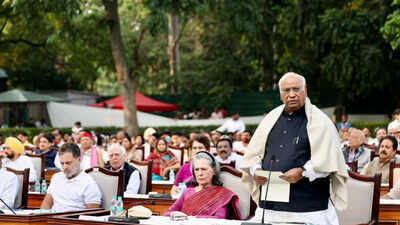
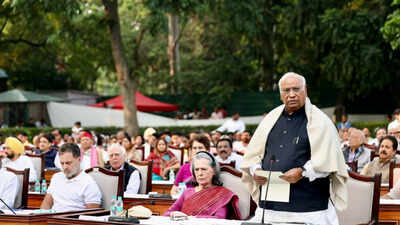
NEW DELHI: The opposition on Saturday unanimously passed a “resolution” to remove Chief Election Commissioner Gyanesh Kumar over allegations of irregularities in the Special Intensive Revision of electoral rolls during a “mock Parliament” organised at Congress president Mallikarjun Kharge’s residence.Former Lok Sabha Speaker Meira Kumar presided over the proceedings, with several MPs and activists supporting the demand for the CEC’s removal.Kharge moved the resolution seeking Kumar’s removal, accusing him of centralising control over electoral rolls and acting at the behest of Prime Minister Narendra Modi and Union home minister Amit Shah. Kharge also said that SIR was initiated to remove voters opposed to Bharatiya Janata Party.“The proposal we are bringing today is to safeguard the dignity of a constitutional institution. We have no personal enmity with the CEC. Our intention is that the Election Commission should function impartially in keeping with the spirit of the Constitution,” Kharge said.“The trust of the common man in it should remain intact. No one sitting in Delhi should be able to wrongly delete the voting rights of weaker sections, women, and youth using a computer,” he added.Meanwhile, leader of opposition in Lok Sabha Rahul Gandhi delivered the closing remarks of the proceedings, describing them as the opposition’s political weapon targeting CEC Gyanesh Kumar, PM Modi and Amit Shah.“This looks like a meeting of Lok Sabha MPs, Rajya Sabha MPs, and common citizens. But actually, this is a political weapon,” Rahul said.In the “mock Parliament” at Kharge’s residence, the opposition sailed through the resolution with a voice vote. But while the numbers may have been on its side there, would the same motion stand a chance in the real Parliament?
What will it take to remove CEC Gyanesh Kumar for real
The removal of a CEC is deliberately difficult.Article 324(5) of the Constitution states that the Chief Election Commissioner can be removed from office only “in like manner and on the like grounds as a judge of the Supreme Court.”“The other Election Commissioners shall not be removed from office except on the recommendation of the Chief Election Commissioner,” it further says.
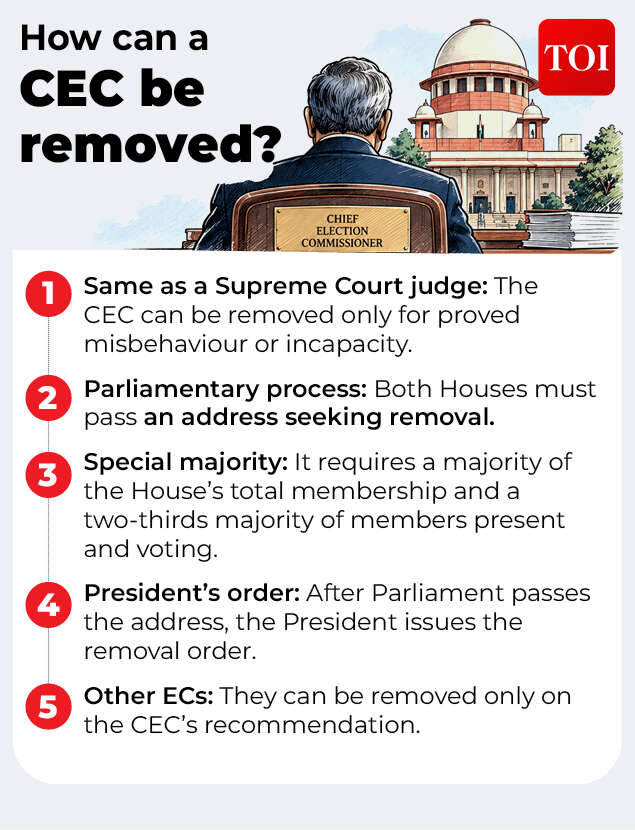
The CEC can be removed by the same procedure as a Supreme Court judge and requires a majority vote from both the Houses.
Article 124(4) of the Constitution, which lays down the procedure for removing a Supreme Court judge, states that a judge can be removed only by an order of the President following an address by each House of Parliament.Such an address must be supported by a majority of the total membership of that House and by a majority of at least two-thirds of members present and voting, in the same session, on the ground of proved misbehaviour or incapacity.The process begins with a notice of motion in either House of Parliament alleging misbehaviour or incapacity. The notice must be signed by at least 100 MPs in the Lok Sabha or 50 MPs in the Rajya Sabha.The presiding officer of the concerned House can admit or refuse the motion after considering the material and information available. If the motion is admitted, an inquiry is conducted into the charges by a committee constituted for the purpose.
Share your thoughts in the comments
Be respectful · TOI community guidelines
If the charges are established, the motion must be passed by a majority of the total membership of each House and by a two-thirds majority of members present and voting in both Houses.Once both Houses pass the motion in accordance with these requirements, an address is made to the President, who then issues the order removing the CEC.The President’s role at this stage is constitutional and formal once Parliament has passed the required address.Interestingly, this is not the first time when the opposition is gearing up for introducing a resolution seeking CEC’s removal.On April 7, Lok Sabha Speaker Om Birla and Rajya Sabha Chairperson CP Radhakrishnan had rejected opposition notice, which was signed by 130 Lok Sabha members, 63 Rajya Sabha members, seeking the CEC’s removal over alleged partisanship and arbitrariness in the Special Intensive Revision (SIR) of electoral rolls.