


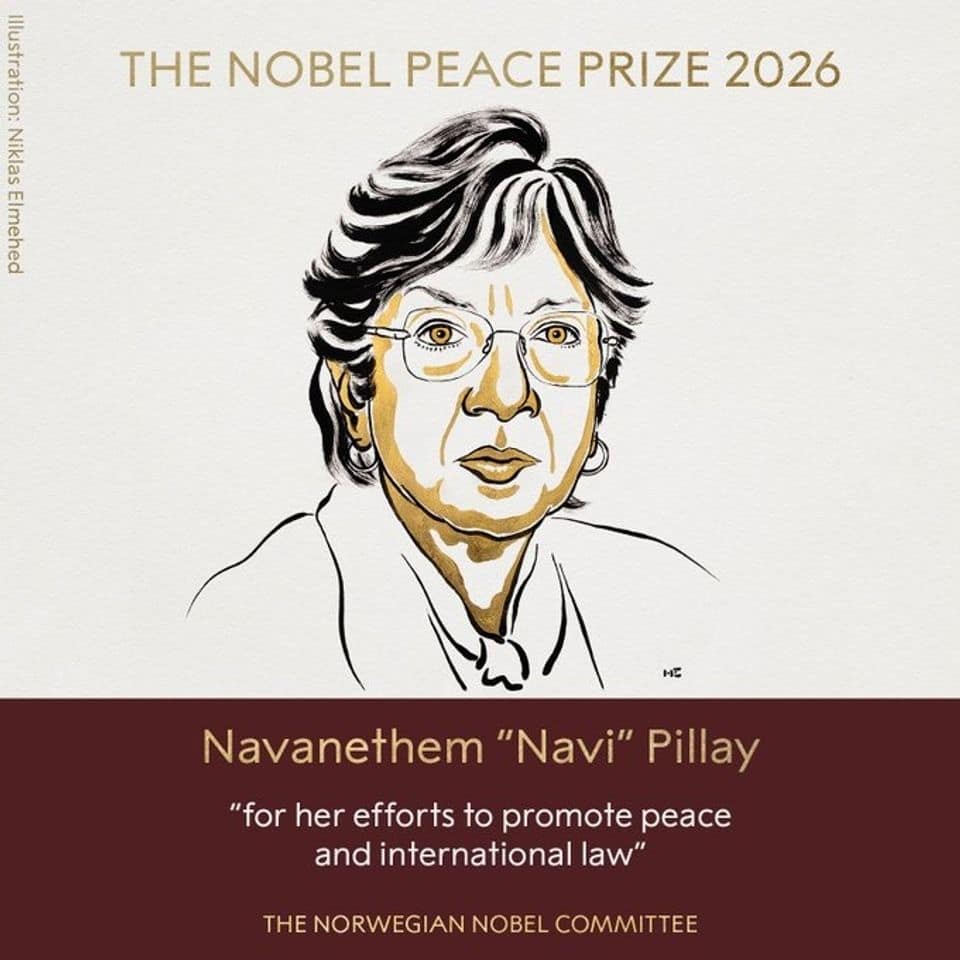
Oslo, Oct 9: South African jurist of Indian origin Navanethem “Navi” Pillay, a former UN human rights chief whose work helped shape international law on genocide and sexual violence, won the 2026 Nobel Peace Prize on Friday for her efforts to promote peace and international law.
The 85-year-old jurist, who grew up under apartheid and went on to hold senior positions in South Africa’s judiciary and international legal institutions, dedicated the award to survivors of international crimes and those defending international justice, saying their “compassion and courage continue to ensure that impunity will not be allowed to reign”.
“We are living through an era when international law and human rights are under significant political attack,” Pillay said, pointing in particular to attacks on the International Criminal Court (ICC).
One of her most recent roles was chairing the UN Independent International Commission of Inquiry on the Occupied Palestinian Territory. In September 2025, the commission concluded that Israeli authorities and security forces had committed and were continuing to commit genocide against Palestinians in Gaza.
The commission also concluded that Israeli President Isaac Herzog, Prime Minister Benjamin Netanyahu and then Defence Minister Yoav Gallant had incited genocide. Israel rejected the findings. The conclusions were those of an investigative body, not a final ruling by an international court.
In separate remarks following the Nobel announcement, Pillay referred to the Gaza report as her most recent work, saying it had named what was happening there as genocide.
Pillay is also serving as a judge in a case at the International Court of Justice (ICJ) in which The Gambia has accused Myanmar of violating the Genocide Convention. She was selected by The Gambia to sit in the proceedings.
Pillay learnt of the Nobel award while attending a forum in Nuremberg, Germany, where Nazi leaders were tried after World War II. She said it was fitting that the announcement came while she was in Courtroom 600, where the trials were held.
Warning that efforts to weaken international criminal justice threatened to undo progress made since the Nuremberg trials, the jurist said on Friday: “They risk returning us to a world in which power rather than law determines whose suffering matters.”
In a message to political leaders, Pillay said they had a legal obligation to protect human rights and refrain from war.
“My message to leaders, political leaders, is that you are under legal obligation,” she said. “No matter what other obligation you have morally, you have a legal obligation to protect human rights and refrain from war.”
She urged countries to uphold the principles of the UN Charter and their obligations under international law, adding: “That is an obligation I call upon every state to fulfill.”
Born in Durban on September 23, 1941, to Indian parents of Tamil descent, Pillay grew up in a poor family under apartheid.
According to a biographical profile published by the Institute for African Women in Law, her father was a bus driver who worked multiple jobs to support the family, while her mother looked after their eight children.
Despite financial hardship, her parents placed a strong emphasis on education and insisted that their daughters, like their sons, should be educated.
Pillay studied at the University of Natal, graduating with a Bachelor of Arts degree in 1963 and a law degree in 1965. She later earned postgraduate law degrees at Harvard University, including a doctorate in juridical science in 1988.
In 1967, she became the first woman of colour to establish a law practice in South Africa’s Natal Province, according to the Institute for African Women in Law.
She spent decades defending anti-apartheid activists and political detainees, including leaders such as Nelson Mandela, and drawing attention to torture and solitary confinement.
In 1973, she helped secure political prisoners’ right to legal counsel, according to South African History Online.
Her work also exposed the racial barriers within South Africa’s legal system. A Harvard Law School profile noted that, as a lawyer, she had not been allowed to enter a judge’s chambers.
Pillay was involved in efforts to enshrine equality in South Africa’s Constitution. As a member of the Women’s National Coalition, she contributed to a campaign that helped secure a constitutional equality clause prohibiting discrimination.
In an interview with South African History Online, she described how women from different political, racial and religious backgrounds worked together to advance equality and protect women’s rights.
In 1995, a year after South Africa’s first democratic elections, Pillay became the first woman of colour to serve as an acting judge on the country’s High Court.
That same year, she was elected to the International Criminal Tribunal for Rwanda, established to prosecute those responsible for genocide and other serious crimes committed during the 1994 genocide in Rwanda. She served as a judge until 2003 and was the tribunal’s president from 1999 to 2003.
One of the most consequential chapters of her judicial career was her work as one of the judges in the tribunal’s landmark case against Jean-Paul Akayesu, the former mayor of Taba commune, who was convicted of genocide, crimes against humanity and direct and public incitement to commit genocide.
The tribunal’s 1998 judgment recognised that rape and sexual violence could constitute acts of genocide when committed with the specific intent required under the Genocide Convention. It also recognised rape as a crime against humanity in the circumstances established in the case.
Akayesu’s conviction for direct and public incitement to commit genocide also established an important precedent in international criminal law.
The Norwegian Nobel Committee credited Pillay with playing a significant role in the legal development concerning sexual violence.
Speaking after the Nobel announcement, Pillay said she was proud that the tribunal had recognised sexual violence as an international crime. She described it as “outrageous” that sexual violence against women and children in conflict had been treated as “collateral damage or as reward for the hard fighting soldiers”.
Pillay subsequently served as a judge at the International Criminal Court from 2003 to 2008, including on its Appeals Chamber, and as the UN High Commissioner for Human Rights from 2008 to 2014.
She also co-founded Equality Now in 1992 alongside Jessica Neuwirth and Feryal Gharahi. The international women’s rights organisation works to advance women’s rights and challenge discriminatory laws and practices.
The Norwegian Nobel Committee said the award recognised Pillay’s efforts to promote peace and international law, highlighting her role in ensuring that war crimes, crimes against humanity and genocide are prosecuted.
The committee described her as “a person who, with exceptional courage and integrity, has led the way towards a more comprehensive legal order”. It said she had been instrumental in ensuring that “war crimes, crimes against humanity and genocide are prosecuted”.
It also praised her commitment to universal legal principles and said she had helped hold states and national leaders accountable while bringing hope to victims of violence and conflict.
“Peace requires justice,” the committee said, arguing that a legal system in which war criminals are held accountable and victims of abuse see justice served is a precondition for a peaceful world.
South African President Cyril Ramaphosa congratulated Pillay on behalf of the nation, describing the award as a tribute to her courage, integrity and lifelong commitment to justice.
“Justice Pillay’s crowning as winner of the Nobel Prize allows us to celebrate the progressive contributions she has made to strengthen peace, uphold human dignity and bring hope in South Africa and to peoples globally,” Ramaphosa said in a statement issued by his office.
He said she had “served humanity with principle and the belief that the world can and should be a better place”.
European Commission President Ursula von der Leyen also congratulated Pillay, praising her lifelong commitment to justice, peace and human dignity in a post on X.
“Few have devoted their lives to justice, peace and human dignity like she did,” von der Leyen said. “From the violence of apartheid in South Africa to the horrors of the Rwandan genocide, she has confronted some of humanity’s darkest chapters. She has looked the brutality of injustice in the eye and never looked away.”
The Nobel Peace Prize was first awarded in 1901. The 2026 award marks its 125th anniversary.
About The Author