


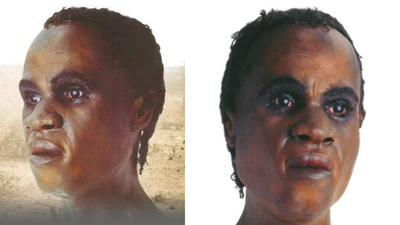
Every person alive today carries a mitochondrial genome that came from their mother, who received it from hers, and so on back through hundreds of thousands of years. Follow that chain far enough, and every line meets in one woman who lived in Africa about 200,000 years ago. Scientists call her Mitochondrial Eve. She was not the first modern woman, and she did not live alone, yet her maternal line is the only one that continued without a break to the present day. Her story gets confused with Lucy, an older fossil, and with ideas about skin colour worth untangling.
How Mitochondrial genomes pass from mothers to children
Humanising History, a nonprofit, describes Mitochondrial Eve as a common mother to us all, a woman whose genetic code, held in the strands of DNA inside mitochondria, passed down the maternal line without interruption for generation after generation. The 2010 study ‘Alternatives to the Wright-Fisher model: The robustness of mitochondrial Eve dating’ explains the mechanism, because each person’s mitochondrial genome is inherited from their mother; every mitochondrial lineage is maternal. Mitochondrial Eve was not the first modern woman ever born, and she was not the only woman alive in her time. She was the only woman whose offspring survived in every generation long enough to produce the next, which is why her lineage runs unbroken to everyone alive today.
Dating Mitochondrial Eve: How statistical analysis placed her about 200,000 years ago
The 200,000-year figure comes from a study in the journal Theoretical Population Biology that notes that methods for calculating the time to coalescence, the point where lineages meet in a common ancestor, depend on the population model, and that models assuming deterministic change in population size may not suit populations that evolve randomly. The authors applied their results to estimate the age of Mitochondrial Eve, defined as the root of modern human mitochondrial variation, using DNA from humans and Neanderthal fossils. The examination confirms she lived about 200,000 years ago, and that models allowing random population size gave similar estimates, while some models assume a fixed population size, ignoring that human numbers have grown exponentially for at least several thousand generations.
Where Mitochondrial Eve lived: The Great Rift Valley , Makgadikgadi salt flats and what is not known
Humanising History says scientists do not know the exact place where Mitochondrial Eve spent her life, though nearly all agree that she and other anatomically modern humans of her time lived in Africa. The post cites Henry Louis Gates, featured in the Public Broadcasting Service series Africa’s Great Civilisations, who places her in the Great Rift Valley on the eastern side of the continent, where numerous skulls have been found, including one named Idaltu, meaning firstborn, which may date to the same period. The post also points to another study, suggesting she lived in the Kalahari Desert in present-day Botswana, in the Makgadikgadi area, now one of the largest salt flats in the world but a fertile oasis according to climate models of 200,000 years ago. Many regions could have been her home.
Mitochondrial Eve was not Lucy: A modern human from Africa versus a 3.2 million-year-old fossil
Humanising History warns readers not to confuse Mitochondrial Eve with Lucy, a fossil unearthed in Ethiopia in the 1970s. Lucy, represented by about 40 per cent of a skeleton estimated at 3.2 million years old, was named after the Beatles song the team kept playing at the site. She is considered an Australopithecine rather than a modern human. She stood about one metre tall, had an ape-like face and a brain about one-third the size of a human brain, and is valued as evidence that ape-like creatures walked on two feet millions of years ago. Whether she directly influenced the lineage leading to modern humans is unclear. The post adds that human evolution looks less like a straight line than like the branches of a tree, and suggests the two are often conflated because Mitochondrial Eve receives less attention.
Skin rich in melanin and the first migrations out of Africa: What the evidence suggests about humans
Because Mitochondrial Eve lived in Africa, she was exposed to high levels of ultraviolet radiation, which requires skin to produce high levels of pigment, so her skin was very likely rich in melanin, or deep brown. Though nobody knows what she looked like, they rely on the documented link between ultraviolet radiation and skin colour. If all humans of her time lived across Africa, it adds, most would have had similarly melanin-rich skin. Some humans left Africa at least 60,000 years ago, and possibly earlier; as they met new environments, such as the extreme cold of northern Europe, their skin produced less melanin, which is how human skin variation began. Every person today has about the same number of melanocytes, the cells that produce melanin, but bodies have adapted to produce a range.
About The Author


