


Jammu, Oct 25: Union Minister of State in PMO Dr Jitendra Singh on Sunday asserted that post 2014, the people living along the International Border (and the Line of Actual Control) got 4 percent reservation, witnessed network of road connectivity up to zero line and improved communication infrastructure.
He was addressing the gathering after inaugurating an ‘Easy Business Unit’ of J&K Bank at village Chakra in Hiranagar, Kathua, to facilitate access to banking services for the local population. The facility is aimed at bringing banking services closer to residents and enabling convenient access to financial transactions, government welfare schemes and digital banking facilities.
Dr Jitendra said that the border areas of Jammu and Kashmir had come a long way on the path of development since 2014. Recalling the challenges faced by residents earlier, he said that several areas suffered from inadequate road connectivity, lack of mobile communication infrastructure and limited access to basic amenities.
The union minister said that the development approach under Prime Minister Narendra Modi sought to ensure that people received the benefits of development irrespective of their geographical location or political choices. He said that the focus had been on regional equity and democratisation of opportunities, ensuring that development reached people in border areas as well as those living in more accessible regions.
Highlighting improvements in border infrastructure, Dr Jitendra said that road connectivity was strengthened in areas that earlier remained difficult to access. “Roads now extend up to the zero line in several stretches along the international border, facilitating movement and improving access for residents and security personnel,” he said.
He also referred to the installation of mobile towers using technology suited to the requirements of border areas, including directed-signal systems designed with security considerations. “These measures have helped improve communication infrastructure in areas where connectivity was previously limited,” the union minister said.
Dr Jitendra also highlighted the construction of bunkers in border areas in accordance with prescribed security standards to protect residents during cross-border firing. He said that improved infrastructure and security arrangements contributed to greater confidence among border residents and helped address the circumstances that earlier compelled families to migrate. He described the development of border areas as an important example of efforts to improve living conditions and strengthen public confidence in governance.
On financial inclusion, the union minister said that banking services became essential in a period when citizens increasingly depended on technology and digital platforms for financial transactions and access to government services. He said that the expansion of banking infrastructure and the implementation of inclusive financial policies under Prime Minister Narendra Modi contributed to a change in public attitudes towards formal banking, digital transactions and entrepreneurship.
Under the Pradhan Mantri Jan Dhan Yojana (PMJDY), more than 59 Cr bank accounts were opened across the country, enabling people to access formal banking services and receive government benefits directly into their accounts under Direct Benefit Transfers (DBT), he pointed out.
Dr Jitendra also highlighted the role of the Pradhan Mantri Mudra Yojana in providing collateral-free loans to eligible micro and small entrepreneurs, helping them establish or expand their businesses. These initiatives, he said, supported self-employment and improved access to institutional finance.
He also referred to the PM Vishwakarma scheme, which supported artisans and craftspeople engaged in traditional occupations through skill training, toolkit incentives, digital transaction incentives and access to collateral-free credit. He said that such initiatives were intended to strengthen traditional livelihoods, improve skills and create better economic opportunities.
The union minister highlighted the expansion of Jammu and Kashmir Bank’s branch network in the Udhampur-Kathua-Doda parliamentary constituency. In Kathua, the number of branches has increased from 31 in 2014 to a projected 55, with 13 new branches added over the last 12 years and 11 in the pipeline.
In Udhampur, the network has expanded from 26 to a projected 38 branches, with 10 new branches made functional and two in the pipeline. In Doda, the number of branches has increased from 53 to a projected 92, with 31 new branches operationalised and eight in the pipeline, he said adding that the expansion was aimed at improving access to banking services, facilitating DBT and supporting the implementation of government welfare and livelihood schemes.
Referring to major infrastructure projects, Dr Jitendra said that improvements in connectivity had been a priority despite the challenging terrain and geographical conditions of Jammu and Kashmir. He referred to initiatives such as the Vande Bharat rail service and the development of express corridors, which were expected to improve connectivity, reduce travel time and strengthen economic linkages.
The union minister also referred to the development of sports infrastructure, including an international-level stadium associated with the Board of Control for Cricket in India (BCCI) and named after former union Finance Minister Arun Jaitley. Dr Jitendra highlighted the importance of sports facilities in providing young people with opportunities to pursue their interests and participate in organised sporting activities.
He emphasised that transparent policies and effective delivery of public services were essential for building trust between citizens and the government. He said that people increasingly expected tangible results in the form of roads, connectivity, educational facilities, financial services and other development works and that governance must respond to these expectations through timely and accountable implementation.
The union minister said that the development initiatives undertaken over the past 12 years reflected the emphasis placed by Prime Minister Narendra Modi on inclusive growth and regional equity. He said that the objective was to ensure that residents of border areas received opportunities and public services comparable to those available elsewhere and that development should reach every household without discrimination.
MLA Rajiv Jasrotia, Deputy Commissioner Kathua Rajesh Sharma and Divisional Head, Jammu and Kashmir Bank, Ashok Gupta also spoke on the occasion.
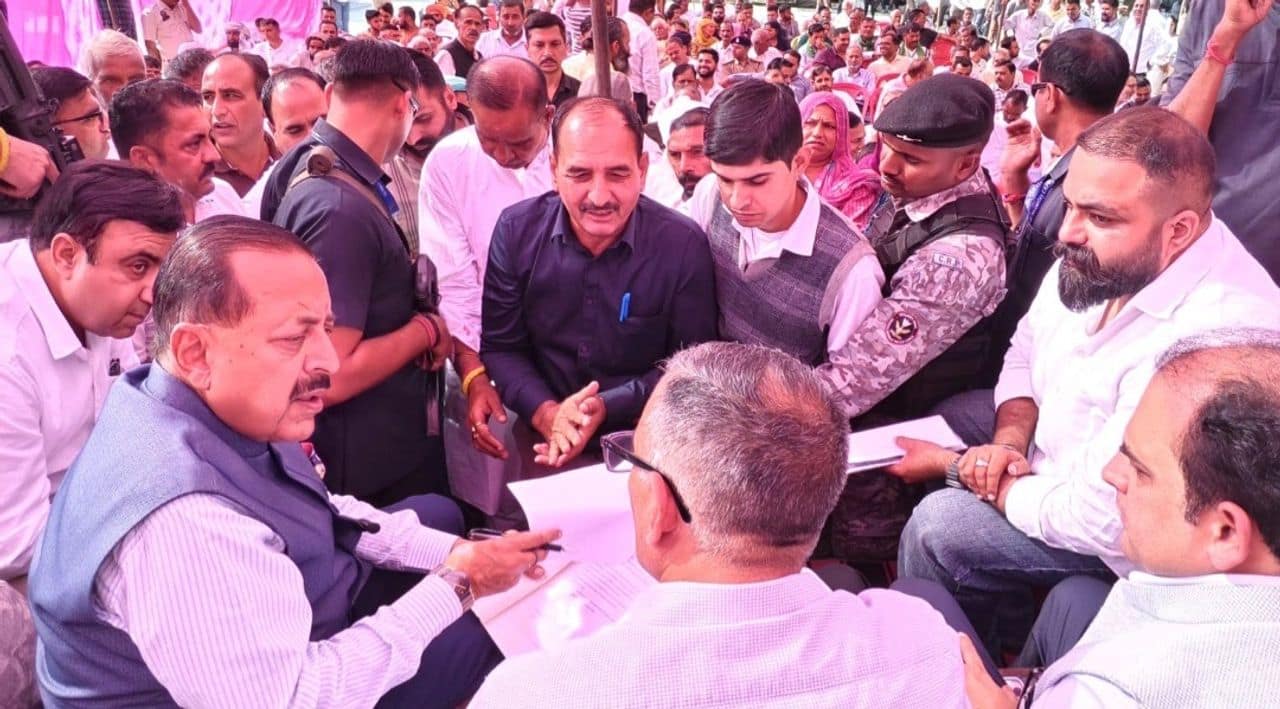
Dr Jitendra, who is also the Union Minister of State (independent charge) for Science and Technology and Earth Sciences besides being the MoS in the Prime Minister’s Office, Personnel, Public Grievances and Pensions, Atomic Energy and Space, also held a public darbar at village Chakra in Hiranagar of Kathua district, to interact directly with local residents and address their grievances and developmental concerns.
During the public darbar, several issues were resolved on the spot. The union minister interacted with local residents and public representatives and took up issues concerning local development, public infrastructure and delivery of essential services. He directed the concerned authorities to examine the issues raised and pursue appropriate follow-up for their timely resolution.
Dr Jitendra emphasised that direct interaction with the public enabled the administration to better understand local requirements and respond effectively to concerns of citizens. He stressed the need for coordination among departments to ensure time-bound redressal of genuine grievances and improve the delivery of public services.
The union minister reiterated that public outreach programmes provided an important platform for reviewing developmental requirements, identifying gaps in service delivery and ensuring that people’s concerns receive due attention from the administration.
The public darbar was attended by senior officers of the district administration, public representatives and officials from various departments, among others. The interaction provided an opportunity for residents to bring their concerns directly to the minister and the concerned authorities.
The public darbar forms part of the union minister’s continued public outreach initiative in his Udhampur-Doda-Kathua parliamentary constituency, aimed at strengthening direct engagement with people and facilitating the resolution of local issues through coordinated action by the concerned authorities.
Deputy Commissioner Kathua Rajesh Sharma led the team of senior officers representing different departments.
Among the local leaders, BJP Kathua district president Updesh Andotra, district general secretaries Rajesh Mehta and Ravinder Sharma, former MLA Kuldip Raj besides others were present.
About The Author


