


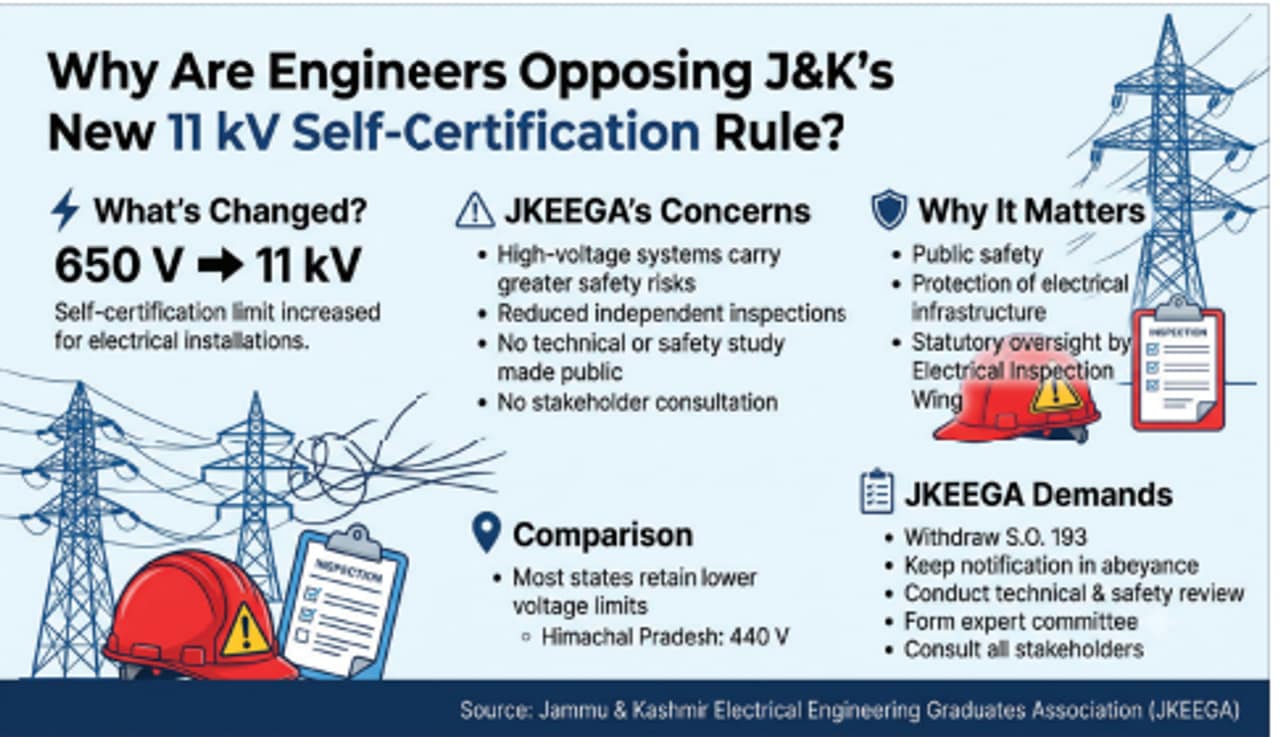

The Jammu and Kashmir Electrical Engineering Graduates Association (JKEEGA) has sought the immediate withdrawal of S.O. 193 of 2026, contending that the government’s decision to enhance the notified voltage limit for self-certification of electrical installations from 650 volts to 11 kV could compromise public safety, weaken statutory oversight, and undermine the role of the Electrical Inspection Wing.
The association has also called for the notification to be kept in abeyance until a comprehensive technical, legal, and safety review is undertaken.
In a detailed representation addressed to the Additional Chief Secretary, Power Development Department, JKEEGA stated that the recently issued notification, which implements provisions under the Central Electricity Authority (Measures Relating to Safety and Electric Supply) Regulations, 2023, appears to have been issued without a comprehensive technical impact assessment, structured stakeholder consultation, or any demonstrable evaluation of the safety implications associated with permitting self-certification of electrical installations up to 11 kV.
The association said the issue was deliberated extensively during separate meetings of its Guidance Councils in Kashmir and Jammu, chaired by General Secretary Er. Pirzada Hidayatullah and President Er. Sachin Tickoo, respectively. Following detailed technical discussions, both councils unanimously adopted resolutions opposing S.O. 193 and resolved to seek its immediate withdrawal and a comprehensive review. Copies of the resolutions have also been submitted to the government for consideration.
According to the representation, electrical installations operating at 11 kV constitute high-voltage systems that involve significantly greater risks to human life, public property, and the integrity and reliability of the electricity network. JKEEGA argued that such installations require rigorous and independent statutory scrutiny by the Electrical Inspection Wing to ensure compliance with prescribed safety standards. It cautioned that extending the scope of self-certification to 11 kV would substantially reduce independent statutory oversight and weaken the safeguards envisaged under the Electricity Act, 2003, and the CEA Safety Regulations, 2023.
The engineering body further maintained that no material has been placed in the public domain to indicate that the enhancement of the notified voltage threshold from 650 volts to 11 kV was preceded by any comprehensive technical feasibility study, safety audit, risk assessment, or comparative analysis of regulatory practices followed by other states. It said a policy decision having far-reaching implications for public safety and regulatory governance should have been preceded by a transparent consultative process involving all stakeholders, including the Electrical Inspection Wing, Kashmir Power Distribution Corporation Limited (KPDCL), Jammu Power Distribution Corporation Limited (JPDCL), Jammu and Kashmir Power Transmission Corporation Limited (JKPTCL), engineering associations, technical experts, and consumer representatives.
JKEEGA also expressed concern over the practical implications of the notification, observing that certification of high-voltage installations under the revised framework would largely depend upon Chartered Engineers possessing the prescribed qualifications and experience. Given the limited availability of such professionals in the Union Territory, the association apprehended that statutory certification may become concentrated in the hands of only a few individuals, leading to avoidable administrative, technical, and ethical concerns while simultaneously diminishing the institutional role of the Electrical Inspection Wing.
While acknowledging that improving the ease of doing business is a legitimate policy objective, the association asserted that it cannot override the paramount considerations of public safety, statutory oversight, and regulatory accountability, particularly in matters involving high-voltage electrical infrastructure.
The representation also highlighted a comparative review of the regulatory framework adopted by several states, including Uttar Pradesh, Punjab, Karnataka, Tamil Nadu, Kerala, Haryana, Uttarakhand, Gujarat, West Bengal, Bihar, and Chhattisgarh. According to JKEEGA, these states have exercised caution while implementing the discretion available under the CEA Regulations and have retained comparatively lower notified voltage thresholds to ensure continued independent statutory oversight over high-tension electrical installations. The association further pointed out that neighbouring Himachal Pradesh, which has topographical and climatic conditions similar to Jammu and Kashmir, has retained the notified voltage threshold at 440 volts, demonstrating that the CEA Regulations do not prescribe a uniform national threshold of 11 kV.
In its representation, JKEEGA urged the government to immediately withdraw S.O. 193 of 2026, suspend its implementation pending a comprehensive technical, legal, and safety review, and constitute a high-level committee comprising representatives from the Power Development Department, Electrical Inspection Wing, KPDCL, JPDCL, JKPTCL, JKEEGA, technical experts, and other stakeholders to examine the implications of the notification. It also sought a comparative assessment of the regulatory frameworks followed in other states before introducing any policy that substantially expands the scope of self-certification. Furthermore, the association requested that any future policy concerning electrical safety and statutory inspection be formulated only after meaningful consultation with all stakeholders and due consideration of technical, legal, and public safety aspects.
Reiterating its support for reforms in the power sector, JKEEGA stated that it remains firmly committed to constructive and progressive changes. However, it maintained that such reforms must be founded on sound technical principles, stakeholder participation, statutory compliance, and the paramount consideration of public safety. The association appealed to the government to initiate a transparent, inclusive, and technically informed consultative process to evolve a balanced and consensus-based policy.
The association expressed hope that the concerns raised by the engineering fraternity would receive due consideration. However, it warned that if the notification continues in its present form without meaningful stakeholder consultation, JKEEGA would be constrained to register its protest through all lawful, peaceful, and democratic means available under law in order to safeguard public safety, preserve the statutory role of the Electrical Inspection Wing, and protect the legitimate interests of the engineering fraternity. Copies of the representation have also been forwarded to the Advisor to the Chief Minister and the Chief Secretary of the Union Territory.
About The Author


