


Explosive volcanic eruptions often come with intense electrical activity, known as volcanogenic lightning. The team analysed 16 eruptions with a Volcanic Explosivity Index (VEI) of 4 or above between 2010 and 2024. They used detections from the World-Wide Lightning Location Network and precipitation estimates from the Global Precipitation Measurement mission. According to the study published in Earth and Planetary Physics, titled ‘Implications from lightning detection on the dynamic evolution of volcanogenic lightning due to major volcanic eruptions’, the results showed that lightning generally peaked 0.5 to 2.0 hours after the first registration of volcanic lightning, with an average delay of approximately 1.1 hours. The authors also reported that eruptions with larger ash dispersal areas produced longer-lasting electrical activity.
What did scientists discover about lightning from 16 major volcanic eruptions
The researchers focused on explosive eruptions with a VEI of 4 or higher, because such events typically produce sustained eruption plumes, extensive ash clouds and significant electrical activity. Eruptions were selected mainly from the Smithsonian Institution’s Global Volcanism Program. 18 eruptions of VEI 4 or above since 2010 were mapped, all located at the boundary zones of three major plates, mostly along the Pacific Rim. Oceanic volcanoes, including those on islands or the seabed, accounted for about 55 per cent of them. The analysis narrowed to 16 eruptions because the World-Wide Lightning Location Network did not detect noticeable lightning for two of them, Eyjafjallajökull in 2010 and Sheveluch in 2023, both at high latitudes. The network locates lightning from very low-frequency or low-frequency radio signals, with a location accuracy typically within 10 km. Its detection efficiency has been relatively steady since a 2010 upgrade but still varies with region, network configuration and lightning features. Duration was measured in 15-minute windows, beginning one hour before each eruption.
Why did volcanic lightning peak 1.1 hours after major eruptions
Peak lightning activity lagged the main eruption by a time ranging mainly from 0.5 to 2.0 hours, with a mean lag of approximately 1.1 hours. The authors describe this as delayed electrification linked to plume expansion and charge build-up. They also report that the duration of volcanic lightning varied from trivial to slightly longer than one day, typically within 12 hours.The study explains the delay in terms of the eruption’s early stage. According to the authors, the initial phase is dominated by a rapid magmatic pyroclastic eruption, when charge separation efficiency is low even though the collision frequency between particles is very high. As the plume continues to rise, they write, volcanic gases are fully released and ionised. These gases combine with collisional charging of particles to build an electric field sufficient for dielectric breakdown.
Why did wider ash plumes sustain volcanic lightning for longer
The duration of lightning activity was generally longer for eruptions with a large area of lightning activity, such as Cordón Caulle and Ulawun, and shorter for those with a small area, such as Raikoke. The authors report that the spatial extent of lightning also varied broadly, with half of the 16 eruptions (8) comparable to typical mesoscale convective systems. They conclude that ash dispersal controls “the persistence of electrification”. In their explanation, the broader the spread of the plume, the wider the distribution of charged particles and the longer particle collisions and charge separation continue.The area of lightning activity was calculated by combining a convex hull method with DBSCAN clustering. The paper sets eps at 0.1 and min_samples at 10 for eruptions of VEI 5 or above, and 0.05 and 5 for those below VEI 5. To test these settings, the authors varied both parameters within 20 per cent of their baseline values. They report that the calculated area of the core lightning regions varied within 15 per cent and that the relative order of magnitude among eruptions stayed stable.
Why did the Hunga Tonga eruption produce two peaks in lightning activity
According to the authors, the Taal eruption in the Philippines began at about 06:40 UTC on 12 January 2020, and its plume reached roughly 17 km above sea level within about two hours. Lightning gradually intensified and then slowly weakened, lasting approximately 13 hours against an overall eruption duration of about 14 hours. Most detected lightning lay to the northeast of the volcano, with the main zone passing almost over Manila. The Hunga Tonga eruption of 15 January 2022 began at about 04:00 UTC, and the paper reports that its lightning reached a maximum within one hour. A second peak followed about four hours after the first, and the two outbreaks showed a nearly circular spatial distribution.The authors also linked the lightning to rainfall using Global Precipitation Measurement data. In both cases, they found a positive correlation between precipitation and lightning during the intensifying phase and a negative correlation after the lightning peak, which they attribute to precipitation-driven scavenging of charged particles. They report that the lightning enhancement rate rose with the Volcanic Explosivity Index. The method is most effective for explosive eruptions that produce substantial ash plumes, typically VEI 4 or above. Lightning signals may be weak or absent for phreatic or low-intensity eruptions, and the authors say real-time lightning data should be combined with observations such as satellite imagery and meteorological radar.
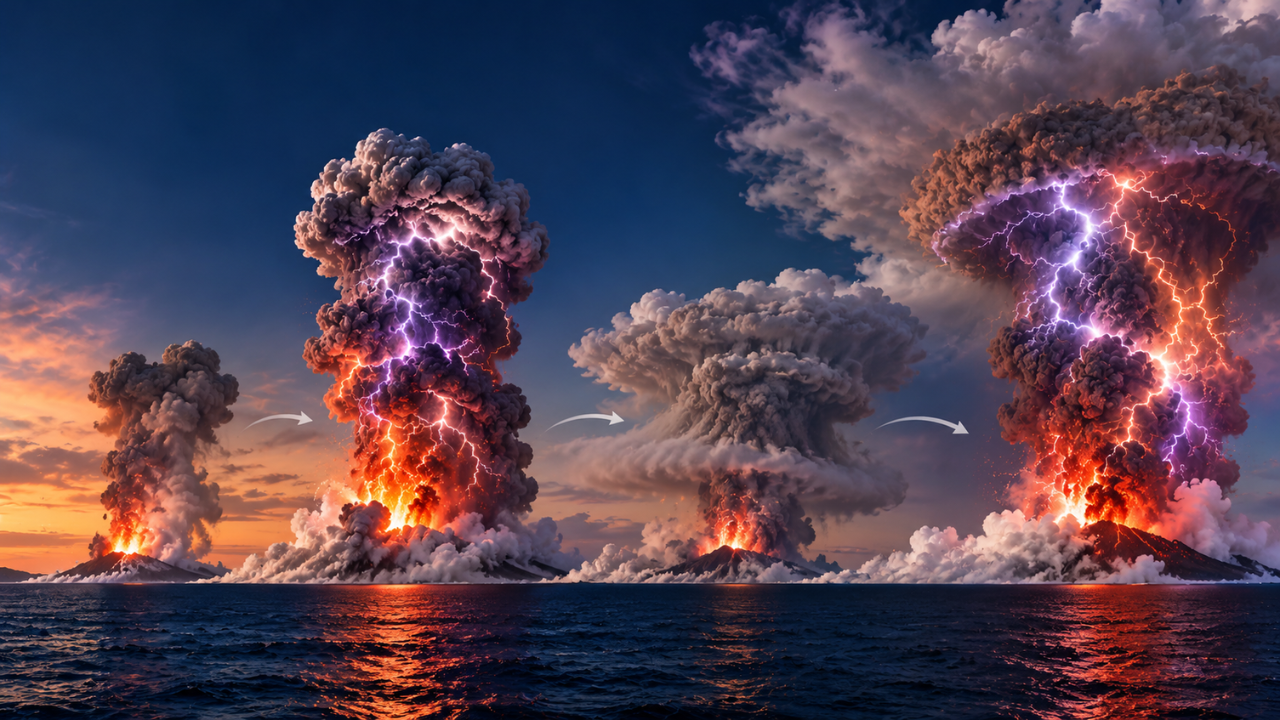
Image AI generated
About The Author


