

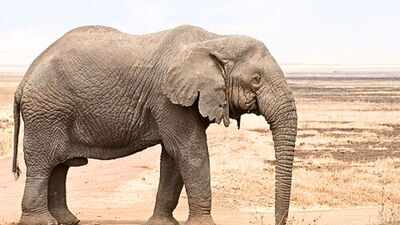
African elephants may use visual clues to judge the amount of food available before choosing where to feed, but their ability appears strongest at close range. Researchers tested four semi-tame adult African elephants by showing them circles printed on canvases. The circles represented different tree canopy sizes and leaf densities, allowing the researchers to test whether elephants could distinguish differences in food quantity.According to research published in Animal Cognition titled ‘Do African elephants use visual cues of food quantity when making foraging decisions?’, elephants could tell the difference between larger circles and higher densities when they were up to 5 metres away. Beyond 5 metres, they could no longer tell the differences apart. The findings indicate that elephants may use both sight and smell when choosing food within a small area.
How do African elephants judge food quantity before feeding
The study tested whether African elephants could use visual cues linked to food quantity when making foraging decisions. Researchers conducted a series of visual choice experiments with four semi-tame adult African elephants. The experiments used solid black circles printed on canvases, measuring either 1 metre or 0.7 metres in diameter, to test whether the elephants could distinguish differences in size.In another set of experiments, the elephants chose between different levels of shading: 25%, 50% and 100%. These differences were used to test whether the elephants could distinguish different levels of density. Before the experiments began, the elephants were trained to select the larger circle and the greater density when given a choice between two options.
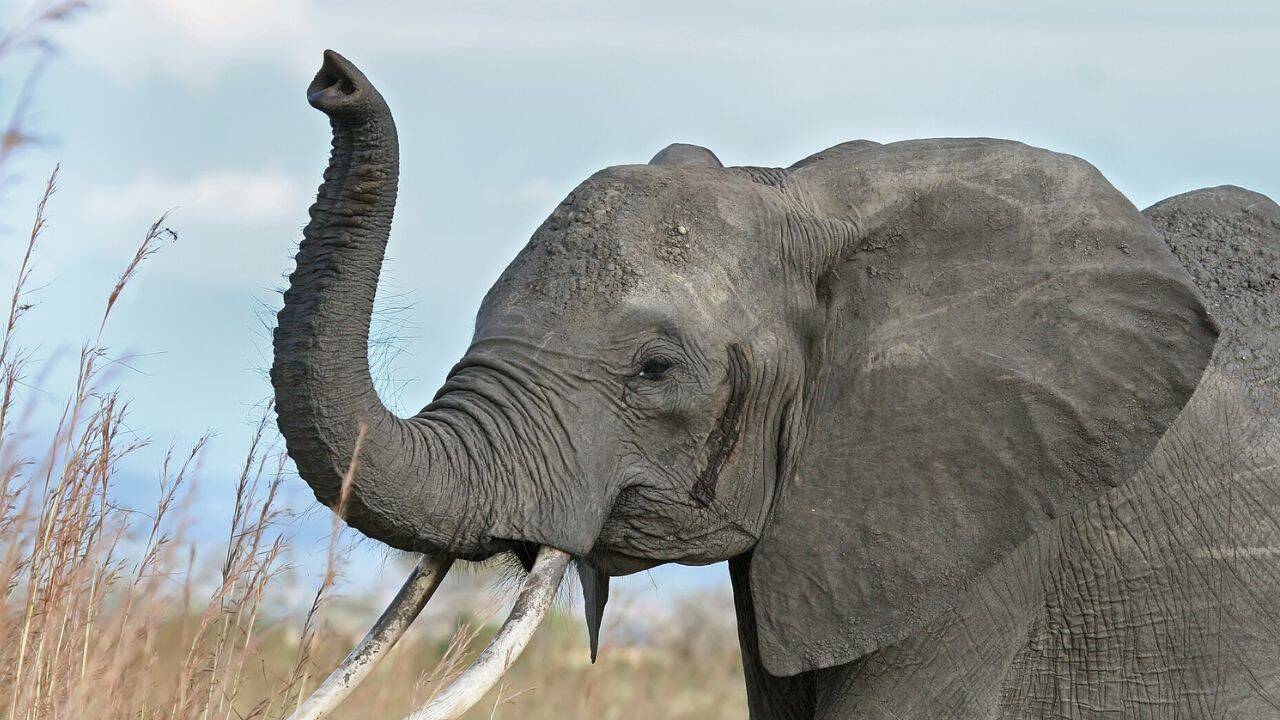
PC: Wikipedia
African elephants use visual cues to judge food quantity
The results showed that the elephants could distinguish differences in both circle size and density up to a distance of 5 metres. Beyond 5 metres, at 10, 20, 40 and 80 metres, they could no longer distinguish these differences. This pattern indicates that the elephants’ ability to use visual information was limited to shorter distances.The findings indicate that visual cues may help elephants make foraging decisions within food patches, where they are close to potential food sources. When food patches are more than 5 metres apart, elephants may rely mainly on olfactory cues to guide their choices.
How do African elephants judge the amount of food available
The researchers noted that African elephants are ecosystem engineers because their feeding can have major effects on the landscape. Understanding how they choose and where to feed can help explain the spatial and temporal patterns of these effects. Earlier studies had already suggested that elephants use smell and leaf colour when making foraging choices between individual plants and food patches.However, it was not clear how much elephants rely on visual information about the amount of food available, including features such as tree canopy size and leaf density. The study was designed to examine whether elephants use visual cues when making both smaller-scale and larger-scale foraging decisions.
What helps African elephants choose between individual plants and food patches
The findings indicate that visual cues may play a role in African elephants’ foraging decisions over small spatial scales, such as within food patches. The researchers noted that these decisions could be influenced by both visual and olfactory cues. Previous research has shown that elephants may use olfactory cues and leaf colour when choosing between individual plants and patches.The study adds evidence that visual cues related to food quantity, such as canopy size and leaf density, may also influence their choices at shorter distances. However, beyond 5 metres, the researchers suggest that elephants likely rely primarily on olfactory cues when making decisions between patches.
About The Author