


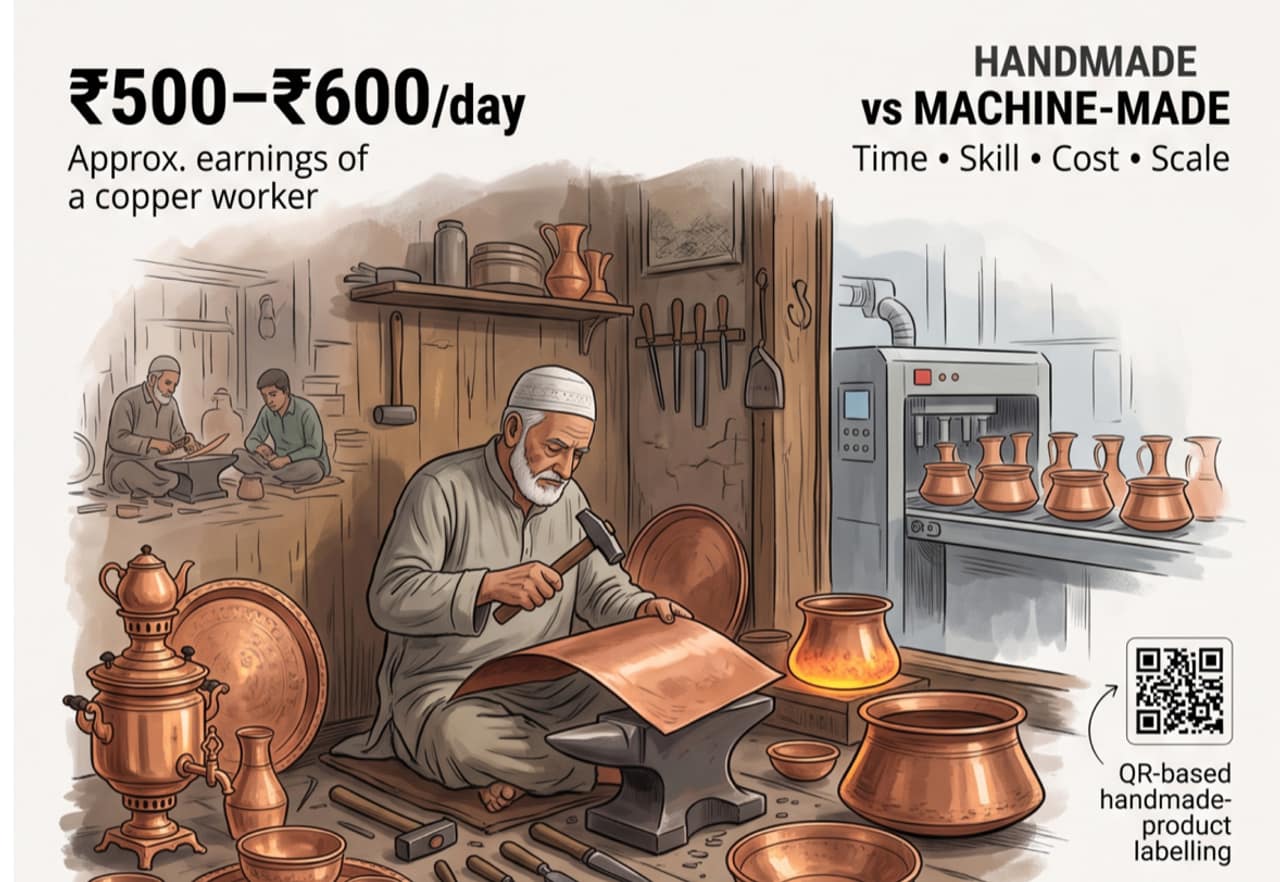

In the heritage markets of Srinagar, the sound of a hammer hitting copper has been part of the city’s character for generations. In Zaina Kadal, Aali Kadal, Khanyar and other parts of Shehr-e-Khaas, craftsmen still sit in small workshops, shaping copper sheets into samovars, trays, bowls, deghs and other utensils.
But the trade is no longer what it used to be.
Traditional copperware is facing growing competition from machine-made products, and those working in the industry say the impact is being felt most by the people who depend on their hands and tools to make a living.
Jan Mohammad, Chairman of the Copper Association Kashmir, said the issue should not be viewed only through production or market figures.
“Copperware is facing an onslaught from machine-made copperware. Beyond statistics, there is a story of copper workers whose earnings and jobs have reduced,” he said.
According to Jan Mohammad, a copper worker earns around Rs 500 to Rs 600 a day. For many artisans, however, even this modest income is becoming increasingly difficult to sustain as demand for handmade products comes under pressure from cheaper and faster machine-made alternatives.
The problem is particularly serious because copperwork is not a single occupation. It supports a chain of specialised craftsmen. There is the Khar, who shapes and works the metal, the Naqash, who does the engraving, the Zarcod, who works on gilding, the Roshangar, who polishes the finished article, and the Charakgar, who carries out finishing work.
For generations, these skills have been passed from one family member to another.
Nazir Ahmad, a fourth-generation coppersmith from Srinagar, is among those who learnt the craft in this traditional way. He says his first lessons came from watching his father and grandfather at work.
“I learned by watching my father and grandfather work,” he says.
For craftsmen like Shabir, copperwork is not simply a job. It is a skill acquired over years, often beginning with small tasks in the workshop before an apprentice gradually learns to handle the tools and master the craft.
The tools themselves are part of that tradition. Hammers, stakes and anvils, along with chisels, punches, files and other implements, are used to shape and finish the copper. The work is slow and requires considerable manual effort.
That is also where handmade copperware finds itself at a disadvantage.
A machine can produce articles faster and in larger numbers. A craftsman, by contrast, needs time to shape, smooth, engrave and finish every piece. For an artisan whose income depends on daily production, the difference can directly affect earnings.
Jan Mohammad said consumers also need to be able to distinguish between handmade and machine-made products. He referred to QR-based labelling for handmade products as one possible way of helping buyers identify genuine handcrafted copperware.
He also pointed to the legal and policy measures taken against machine-made copperware, saying the J&K Assembly Act has banned machine-made copperware. The industry, however, believes enforcement and proper identification of products are crucial if such measures are to translate into benefits for traditional artisans.
There is also a difference in the way the two products are perceived by craftsmen.
Asked about handmade and machine-made copperware, Jan Mohammad said handmade products are considered more durable, while machine-made copperware is comparatively soft and more prone to breaking. The claim reflects the trade’s longstanding argument that the value of handmade copperware lies not only in its appearance but also in the workmanship that goes into it.
For Kashmir, copperware has always had a place beyond the marketplace.
The samovar remains closely associated with Kashmiri hospitality. Copper trays, bowls and other utensils are used during weddings, religious occasions and family gatherings. Decorative pieces, meanwhile, continue to be valued for their engraving and traditional designs.
Household copper utensils are also traditionally subjected to Kalai, the process of coating them with tin, which gives them a distinctive appearance and finish.
Yet cultural demand has not necessarily translated into secure livelihoods for the artisans.
The trade is also struggling to attract young workers. The work is physically demanding, workshops can be hot and dusty, and the earnings are not always enough to persuade younger people to choose copperwork over other occupations.
As a result, an important part of the traditional skill base is slowly becoming thinner.
The concern, therefore, is not simply that fewer copper articles are being sold. It is that fewer people may remain who know how to make them.
In Khanyar, where families have traditionally been associated with the craft, this change is particularly significant. What was once a common family occupation is increasingly becoming a specialised trade practised by a shrinking number of craftsmen.
The copper industry’s struggle is consequently about two things at once: the survival of a traditional Kashmiri craft and the survival of the livelihoods attached to it.
The Department of Handicrafts and Handloom, Jammu and Kashmir, has introduced QR-based labels for traditional copperware to help consumers verify the authenticity of handmade products and distinguish them from machine-made copies. The initiative is aimed at protecting Kashmir’s traditional copper craft, improving traceability and ensuring that genuine artisans receive recognition for their workmanship. The QR labels can also help buyers identify products that meet the department’s prescribed standards, strengthening confidence in authentic Kashmiri handicrafts.
About The Author


