


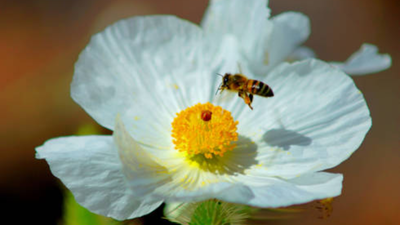
US biologists searching the Mojave Desert have discovered six previously unknown population groups of the Mojave poppy bee, giving scientists a broader picture of the tiny insect’s distribution and helping the US Fish and Wildlife Service conclude that the species does not currently require protection under the Endangered Species Act, the agency said in an October 2, 2026 report.The discovery followed surveys conducted in 2023 and 2024 by the US Fish and Wildlife Service, the US Department of Agriculture’s Agricultural Research Service and other partners. The newly gathered evidence, combined with existing scientific and commercial information, helped officials assess threats to the bee and determine that it does not meet the federal definitions of threatened or endangered.
A bee built around a few desert flowers
The Mojave poppy bee (Perdita meconis) is a small, solitary, ground-nesting bee found in the eastern Mojave Desert. Unlike generalist pollinators that can feed on many types of flowers, the species is a specialist associated with a small group of poppy plants.The US Fish and Wildlife Service said individual bees live for only days to a few weeks, while their survival is closely tied to the availability and flowering of their host plants. These include the Las Vegas bear poppy and several species of prickly poppy.USDA research describes the bee as a rare species restricted to the eastern Mojave Desert. Its host plants often occur in specialised gypsum-rich soils, which are scattered across the region. The bee is also remarkably small. USDA researchers said males average only 5 to 7 millimetres in length. Its tiny size is one reason the species can be difficult to locate during field surveys.
Biologists went looking where records were old
Scientists had reason to be concerned about the bee before the latest survey. Historic records showed the species across parts of California, Nevada, Arizona and Utah, but researchers had not recently surveyed some of those locations. The US Fish and Wildlife Service said its survey strategy therefore prioritised historic locations where the bee or its host plants had not been checked for many years.“We prioritised historic locations where surveys had not been done for many years,” Corey Kallstrom, a wildlife biologist with the US Fish and Wildlife Service’s Southern Nevada Fish and Wildlife Office, said. He said the approach was designed to address places where the bee and its host plants may have been overlooked. U.S. Fish and Wildlife ServiceThe effort produced a significant result. Between 2023 and 2024, survey teams led by USDA’s Pollinating Insects Research Unit identified six previously unknown population groups within the bee’s historical range. The findings expanded scientists’ understanding of where the insect survives and provided additional evidence about the resilience of its populations. U
One population disappeared, but six were found
The findings were not uniformly positive. The Fish and Wildlife Service said researchers also documented the loss of one population group in Utah. Earlier USDA research had similarly found that the bee remained present at many historic locations but appeared to have disappeared from southwestern Utah.Research at Utah State University had already shown how difficult the species can be to detect. A 2023 master’s thesis examining the bee and the Las Vegas bear poppy found small numbers of Mojave poppy bees at three sites in 2020, but none were detected at those sites the following year despite systematic sampling through the flowering season. Surveys in 2022 found single individuals at two of those locations. The same research documented substantial fluctuations in the Las Vegas bear poppy’s populations, highlighting how conditions can change from one year to another in the desert.
The bee can wait out bad conditions
One unusual feature of the Mojave poppy bee may help explain its ability to survive the desert’s boom-and-bust conditions.USDA researchers found evidence that the insect can remain underground in an immature state for at least three years, apparently allowing it to wait for more favourable conditions and the return of suitable host plants. The phenomenon is known as diapause. That adaptation is important because the poppy plants themselves can be short-lived and their populations fluctuate with environmental conditions.The bee’s dependence on these plants, however, also creates a vulnerability. Scientists have identified threats including urban development, mining, habitat fragmentation, trampling and changing precipitation patterns that can affect the plants on which the bee depends.
Scientists also decoded its genome
The recent population discovery follows another major research effort involving the species. In 2024, USDA’s Agricultural Research Service and university partners announced the development of a near chromosome-level reference genome for the Mojave poppy bee. Researchers said the genetic map could help scientists investigate the bee’s ability to cope with drought, its specialised relationship with host plants and possible genetic signs of population decline. The genome was produced from a single male specimen collected in the field. Researchers said obtaining high-quality DNA was notable because the specimen had not been preserved under ideal conditions.
Why it will not be listed as endangered
The latest surveys were conducted partly because the Fish and Wildlife Service was evaluating whether the bee warranted protection under the Endangered Species Act. An agency peer-review plan published earlier in 2026 said the species-status assessment was intended to determine whether the Mojave poppy bee warranted listing as threatened or endangered. After considering the new population information and other available scientific and commercial data, the agency concluded that the species does not currently meet the definition of threatened or endangered and therefore does not need to be federally listed.That decision does not mean the Mojave poppy bee is considered risk-free. The Fish and Wildlife Service continues to classify conservation work for unlisted species at risk as an important part of its approach, noting that collecting information and taking proactive conservation measures can help prevent species from reaching the point where federal protection becomes necessary.
About The Author