


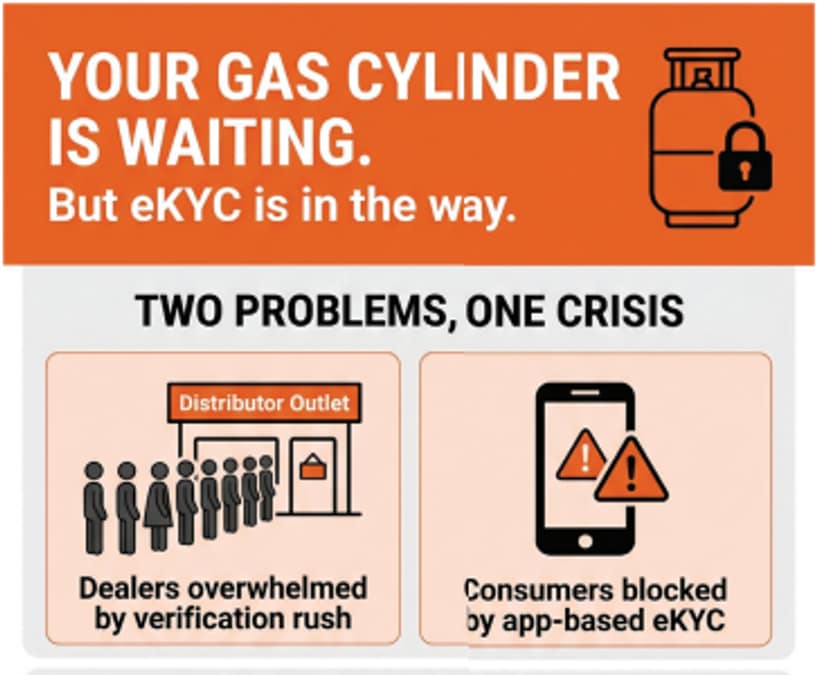
LPG consumers across the Kashmir Valley are facing mounting difficulties in getting their cylinders refilled as the government’s mandatory eKYC verification requirement has triggered long queues at distributor outlets and thrown up a series of technical and accessibility hurdles for ordinary households.
The problems are being felt on two fronts. At distribution centres, dealers are overwhelmed by a sudden rush of consumers scrambling to complete the verification process before their next refill. At the same time, a significant number of consumers are struggling to complete self-eKYC on their own, citing smartphone access, app permissions and privacy concerns as major obstacles.
Abdul Rashid, a resident of the city, said the process was unnecessarily complicated for a routine gas connection.
“I have an LPG connection that my family has held for years. Now I am being told I have to download two separate apps on my phone and go through a multi-step process just to get a refill. These apps ask for a range of phone permissions including access to the camera and location, which raises serious privacy concerns,” he said. “Why should getting a cooking gas cylinder require me to hand over access to my phone?”
The burden is falling disproportionately on women, particularly homemakers in lower-income households who are the primary users of domestic LPG connections. Naseema Bano, who holds a Pradhan Mantri Ujjwala Yojana connection meant for economically weaker sections, said the digital requirement was effectively excluding people like her from accessing a basic necessity. “I do not have a smartphone. I cannot afford one. The Ujjwala scheme was supposed to help families like mine. If eKYC through an app is now mandatory, what are we supposed to do?” she asked.
Her concern reflects a broader access gap. Smartphone penetration in rural and semi-urban pockets of the Valley remains uneven, and many Ujjwala beneficiaries, who are predominantly women from low-income households, are among those least equipped to navigate app-based verification.
Adding to the confusion is a separate problem with the One Time Password system that is meant to ensure verified delivery of cylinders. Under current guidelines, consumers are required to share an OTP with the delivery person at the time of receiving their cylinder. However, several consumers have reported receiving automated messages confirming delivery of gas that was never actually delivered, and without their OTP ever having been shared.
Tariq Hussain, a consumer from the Rainawari area, described a troubling experience. “I received an OTP on my phone, which I deliberately did not share because I had not yet received my cylinder. But within minutes I got a message saying the gas had been delivered. No one came to my door. The cylinder never arrived,” he said. He added that when he contacted his distributor, he was told the message was system-generated and that his booking would only be processed after eKYC was completed.
A distributor in the city, who did not wish to be named, confirmed that the automated messages were being generated by the booking system and were not a reflection of actual delivery. “The system sends out computer-generated messages at the time of booking. Actual delivery and billing only happen after eKYC is done. But this is causing a lot of unnecessary panic among consumers,” he said.
Some consumers have also suggested that the sudden push for eKYC compliance may be linked to supply-side pressures on Oil Marketing Companies following disruptions in the Middle East, though officials have not confirmed any such connection.
About The Author