

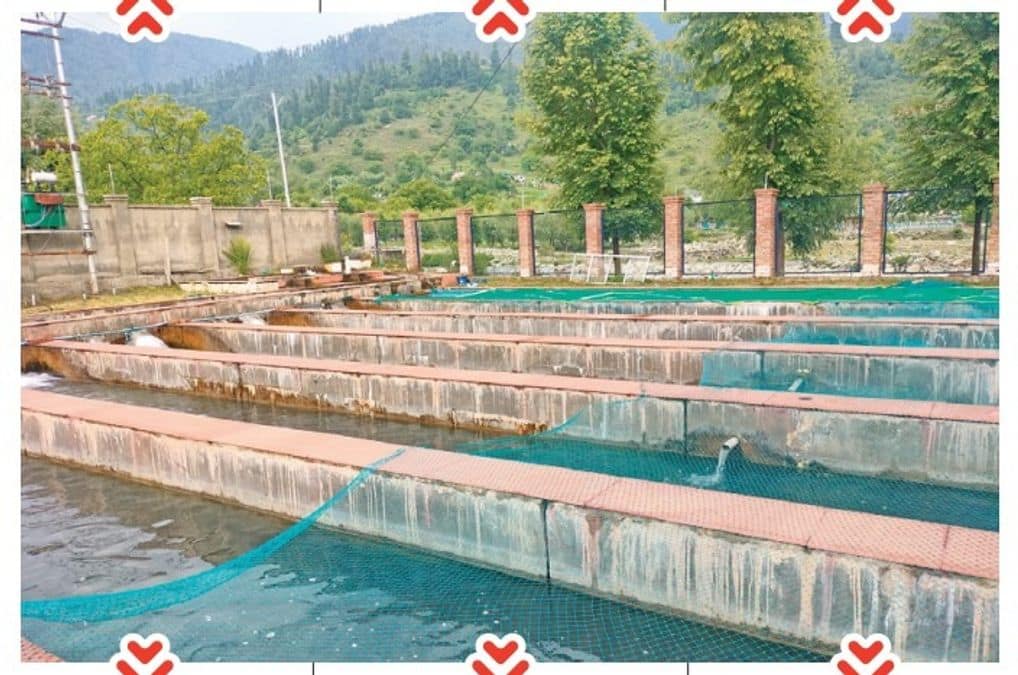
Kokernag, June 17: One of Asia’s largest trout farms at Kokernag in south Kashmir’s Anantnag district produced over 60 lakh trout eggs, 20 lakh fish seed and around 100 metric tonnes of rainbow trout last season, generating more than Rs 2.7 crore in revenue while anchoring the region’s expanding cold-water fisheries economy.
Spread across 20 hectares, the Trout Farm-cum-Hatchery was established in 1984 with assistance from the European Economic Community and technical support from consultants from Scotland.
Today, it functions as the Valley’s largest trout seed production centre, supplying government farms and hundreds of private farms.
“The seed from this hatchery is distributed to most private fish farms and even government-run farms of Kashmir,” said Sajad Ahmad Dar, Chief Project Officer (CPO) at the farm.
Dar said Kokernag remains the principal source of trout seed in the Valley despite the establishment of hatcheries at Achabal, Panzath-Qazigund, Pandach in Srinagar, Narbal in Budgam, Chatlam in Pulwama, Trigam in Bandipora, Ganderbal and many more.
Before Kokernag became operational, Harwan-Dachigam on the outskirts of Srinagar served as the region’s main trout hatchery.
In Kashmir, the first trout ova-comprising 10,000 eggs-arrived from the United Kingdom in 1899 but the entire consignment perished.A second batch from Scotland a year later succeeded, with about 1000 fry transferred to Panzagam-Dachigam (Harwan), while the remainder were reared at a private carpet factory in Baghi Dilawar Khan in downtown Srinagar.
The Harwan facility, established in 1901 by British officer Frank Mitchell, laid the foundation for trout culture in Kashmir.
“The maximum seed, however, goes from Kokernag,” Dar said.
The farm maintains a dedicated broodstock of rainbow trout used for breeding between October and February, when mature fish are selected for seed production.
Dar said the facility produces its own broodstock to ensure uninterrupted supply.
“We have our own brooders and get eggs and white milt from them. We rear rainbow trout for commercial purposes as is done elsewhere in the world,” he said.
According to Aaqib Ahmad, a supervisor at the farm, male rainbow trout generally reach maturity in two to three years, while females take three to four years to spawn.
“Some brood fish weigh four to five kilograms. It takes around 5 years for rainbow trout to attain that size,” he said.
“Once their breeding cycle ends, brood fish are removed from the programme and sold through the farm’s sale unit,” Aaqib said.
Breeding begins with stripping, a process in which eggs from mature females and milt from males are collected and fertilised manually.
“The eggs and milt are collected separately and mixed for fertilisation. The fertilised eggs are then incubated in hatchery trays supplied with continuous cold spring water,” Aaqib said.
He said incubation lasts about a month, depending on water temperature.
Dar said the farm produced nearly 60 lakh fertilised eggs, or green ova, during the last breeding season.
“Out of nearly 60 lakh green ova, about 15 lakh survive as fry due to winter water conditions and environmental factors,” he said.
Once hatched, the fry are reared in nursery tanks before being shifted to raceways, where they develop into seed and fingerlings supplied to government and private farms.
Bashir Ahmad, Project Officer (PO) at the farm, said production depends on strict monitoring and skilled handling.
“We know which fish is ready for stripping. Keeping the hatcheries clean and harvesting eggs is a demanding process. The fry and fish have to be monitored and fed regularly at different stages of growth,” he said.
Officials said trout production at the farm has nearly doubled over the past 5 years, driven by government schemes and the introduction of modern aquaculture technologies, including Recirculating Aquaculture Systems (RAS), bio-floc units, and improved hatchery practices.
The hatchery has also emerged as a major revenue-generating unit for the Fisheries Department.
According to officials, about 4.40 lakh trout eggs were sold last season to buyers in Tamil Nadu, Uttarakhand, and Ladakh, generating nearly Rs 12 lakh in revenue.
Seed sales contributed another Rs 50 lakh during the previous financial year.
The largest share of income comes from the sale of market-size rainbow trout through the farm’s sales outlet.
Overall revenue from the farm crossed Rs 2.7 crore last year.
The growth of Kokernag mirrors the expansion of trout farming across Jammu and Kashmir.
Official figures show production rising from 298 tonnes in 2015-16 to 2650 tonnes in 2024-25, making the Union Territory India’s leading trout-producing region.
Private participation has expanded sharply, with trout-rearing units increasing from 388 to 1649 over the same period.
More than 800 private farms now operate across Kashmir, including 68 in the Kokernag area.
Many depend on seed supplied by the Kokernag hatchery.
“We procure seed and feed from Kokernag and depend on it for stocking our raceways. The quality of seed is good and survival rates are better,” said Ajaz Ahmad Khan, a trout farmer from Telwani-Achabal.
Khan said he operates three raceways and earns around Rs 12 lakh annually.
“Once the fish attain table size, customers come directly to the farm. Trout farming has become a reliable source of income for many families,” he said.
Alongside commercial production, the Fisheries Department is working to restore brown trout to Kashmir’s cold-water ecosystems after more than a century.
Shabir Ahmad, Assistant Director Fisheries Anantnag said brown trout has been reintroduced into streams and upper reaches around Kokernag under a broader conservation programme.
About three lakh eyed brown trout ova imported from Denmark were successfully reared and released last year into more than 40 streams and 12 lakes across Kashmir.
“The objective is to revive brown trout in water bodies where it historically existed and strengthen aquatic biodiversity,” Ahmad said.
He said the programme also aims to revive angling tourism in Kashmir, once known globally as a premier trout fishing destination.
“Brown trout found in high-altitude streams and lakes requires skill and patience to catch. Increasing its population will help strengthen Kashmir’s reputation as an angling destination,” said Reyaz Ahmad, an angler from Pahalgam.
Fisheries officials said stocking and restoration efforts will continue across selected water bodies, while Kokernag remains the central hub of trout seed production supporting Kashmir’s expanding aquaculture sector.
About The Author