

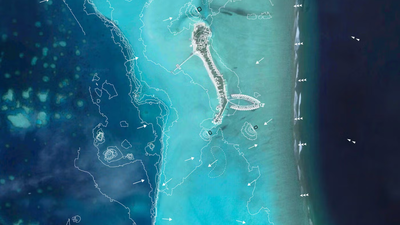
A 300-foot beach on a tiny island in the Maldives was slowly eroding away. In order to solve the problem, a Marriott resort on the island experimented with something different. Instead of dredging sand, they used an artificial reef designed by Massachusetts Institute of Technology researchers to repair the beach.Coastal Assembly, a startup that spun out of the MIT research at the end of 2025, and raised $4.4 million in a rounding of funding this year is now scaling up. The company uses AI to analyse satellite and ocean current data at a shoreline, then plans the layout of custom concrete blocks that can help the sand accumulate naturally via ocean waves.“We take 10 years of data, and we say, where do we predict the critical areas of erosion will be in the coming months to year?” said Skylar Tibbits, a professor in MIT’s architecture department who runs the university’s Self-Assembly Lab, a research group that explores how materials and environments can transform themselves, to Fast Company. “And that tells me where the best place is to intervene—what’s the part that is most critical, where we should focus our time, effort, and money.”In the case of the Maldives, the team installed 54 strategically placed blocks made from marine-grade concrete and local aggregate roughly 150 feet offshore. By dissipating wave energy, the blocks help redirect sand back to the beach that was previously lost, and also help keep the sand in place. The researchers track changes over time, and can adjust the blocks if needed.The research started by chance, when Tibbits happened to visit a sandbar in the Maldives that had emerged naturally in only a month. “It was like, wait, what do you mean, this island formed in a month? We started to understand that we could tap into this process, and then it became a question of how you promote that to happen,” he said.According to Tibbits, the traditional coastal protection methods don’t work well. Dredging sand harms coral reefs and only works temporarily, as the sand can quickly wash away. “It’s a continual process,” he said. “One of the resorts we visited is pumping sand 365 days… It’s the sort of thing that everyone does as a Band-Aid.”Building seawalls is expensive, and also isn’t necessarily very effective. As Tibbits pointed out, in a fight with nature, nature tends to win. And a seawall can end up accelerating erosion on other beaches nearby, or even unintentionally increasing erosion at the beach it was built to protect.It took Tibbits and his team nearly a decade to find an approach that worked, as they moved from simulations to 10 real-world deployments in the Maldives. Each design is custom, from how the structures are arranged to their height and depth. “It’s not one-size-fits-all because every beach has a different bathymetry [underwater landscape],” Tibbits explained. “It has different wave conditions. There are always different complex parameters that make each beach unique.”Each structure is also cast with a unique shape so the reef looks more natural than human-made. The artificial reefs, like natural reefs, also help protect coastlines during storms. Within six months, the depth of the beach grew by 90 feet. And two years later, it has doubled in size. Moreover, the reef is filled with new coral and marine life, from fish to sea anemones.Coastal Assembly is expanding its work in the Maldives and beginning to work in other locations in need of coastal protection, including Boston and Miami. Cities are recognising that traditional approaches, like seawalls, aren’t the best answer. “You’re seeing a big shift around the world, Tibbits said, “from hard edges to much softer, more flexible, dynamic edges.”
About The Author