


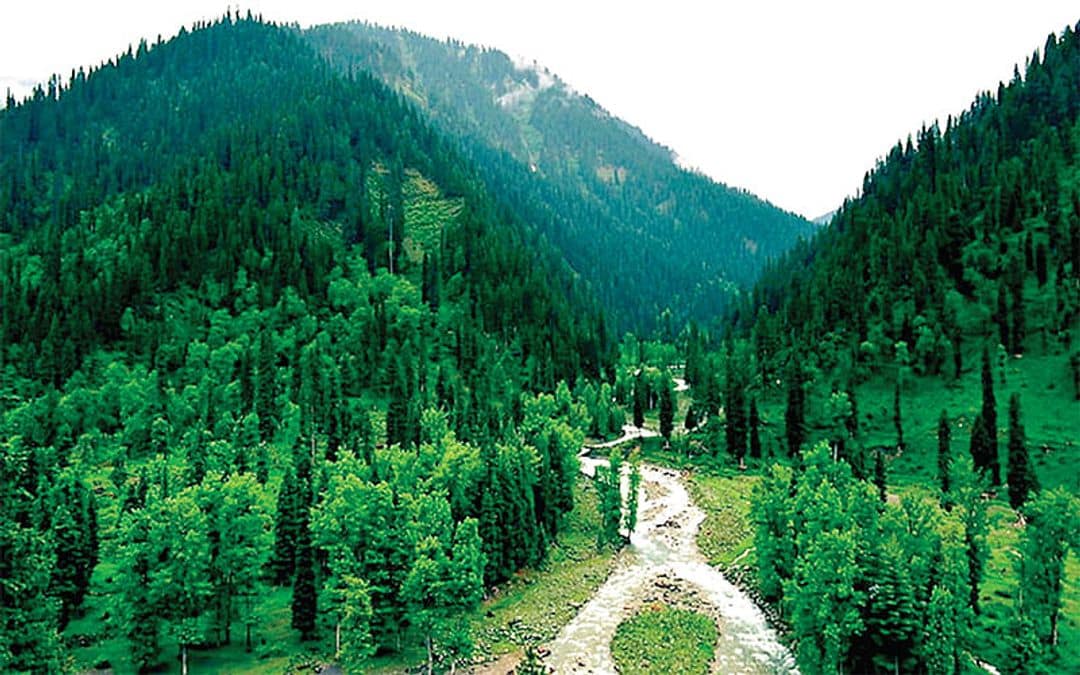
Srinagar, Aug 2: Frequent wild animal attacks in Rajwar in north Kashmir’s Kupwara district have renewed demands to declare its dense forests a wildlife sanctuary, with residents linking the growing human-wildlife conflict to increased human activity and habitat disturbance following construction of the Handwara-Bangus valley road. Three residents of Wader-Balla village have been attacked by bears within a week, with two farmers injured last week and another resident attacked Friday evening as this story was being filed.
Three bear attacks in a week
Manzoor Ahmad Mir, 44, and Abdul Aziz Sheikh, 45, were attacked by a bear last week while heading to their maize fields in Wader-Balla village.
Mir suffered serious injuries to his face and leg, while Sheikh sustained injuries to his face, shoulder and leg.
Both remained hospitalised for nearly seven days.
“The bear caught us unawares. It was a narrow escape for us,” the farmers said. Friday evening, as this story was being filed, another Wader-Balla resident, Muhammad Hamza Mir, 36, was attacked by a bear while returning home on the roadside. He was badly bruised and shifted to a local hospital.
The attack triggered panic in the village, with residents moving to safer places. The recent attacks add to a longer pattern of human-wildlife conflict in the area. Official data records 128 such incidents in Rajwar between 2017 and February 2025, leaving four people dead and nine injured.
Wildlife authorities also received 136 SOS calls during the period.
Locals say several more people have been injured in wildlife encounters since February 2025, though updated official figures were not immediately available. Road construction raises habitat concernsResidents link the frequent encounters to increased human activity in the forest, particularly after construction of the 35.5-kilometre Handwara-Bangus valley road began in 2017.Built by the Public Works Department (PWD), the road passes through dense Rajwar forests in the Langate Forest Division, covering several forest compartments between 2 and 26 and forming habitat for diverse wildlife. It runs parallel to the existing Handwara-Zachaldara-Bangus road.
“The human activity following the construction of the road disturbed the habitat of these wild animals and they started coming down into residential areas,” said Muhammad Akbar Lone, a local resident who has assisted the Wildlife Protection Department in capturing wild animals. Lone said he had helped the department capture at least 19 wild animals, including a bear recently. “The situation here is quite alarming. The area needs to be declared a wildlife sanctuary to prevent such attacks,” he said.
Activist and lawyer Rasiq Rasool, who challenged the road project before the National Green Tribunal (NGT), said the road was unnecessary as Bangus Valley was already connected through three other routes.“There was no need for this road as three existing roads already lead to Bangus; the Handwara-Bangus road via Mawar, maintained by BRO, another Handwara-Bangus road via Chowkibal, and the Handwara-Zachaldara-Bangus road,” Rasool said. He said the road also passes through a landslide-prone area and called for greater protection of the forest.
“To preserve the biodiversity of these dense forests, declaring it as a wildlife sanctuary was necessary,” Rasool said. Wildlife Protection Warden, North Kashmir, Suhail Intesar, said there was no proposal at present to declare the area a wildlife sanctuary. Road project before NGT since 2024 The road project has been before the NGT since Rasool filed Case No. 163 of 2024 in February 2024, alleging hill cutting, mining and large-scale tree felling during construction without the required forest and environmental clearances.
He also raised concerns over the project’s impact on biodiversity and wildlife. The tribunal directed the Forest, Mining and Public Works departments to deposit compensatory afforestation (CA) charges and respond to the allegations. The charges were later deposited, Rasool said, but the allegations remain unanswered. At the latest hearing in July, the J&K government again sought an adjournment. The tribunal granted a final opportunity and listed the matter for September 29, 2026. “By way of the last indulgence, the adjournment at the instance of UT of J&K is granted and the hearing is listed on 29/9/2026,” the NGT order said.
Centre seeks priority investigation
Separately, locals and Rasool approached the Union Ministry of Environment, Forest and Climate Change (MoEFCC) in May regarding the environmental concerns via a written communication.
The Ministry said protection, conservation and management of wildlife, including mitigation measures, was primarily the responsibility of the State/UT government.
“In this context, it is requested to investigate the matter on priority and to take appropriate action,” the Ministry said, adding that a specific reply should be furnished to the applicant under intimation to the ministry.
RTI records rare, endangered species
An RTI response issued last year by the office of the CPIO, Principal Chief Conservator of Forests, J&K, provides official details about the forest land and wildlife habitat involved in the road project.
Issued in connection with the transfer of forest land to the PWD for Handwara-Bangus Phase-I, the response records the presence of “certain rare and endangered species,” including the Himalayan black bear, leopard, jackal, Himalayan deer and Himalayan snowcock (Jungle Fowl).
Asked whether the area formed part of any national park, wildlife sanctuary, natural reserve or biosphere reserve, the department replied: “No.”
The response said 14 hectares of forest land were required for the road, with forest land involved along 28 kilometres of the 35.5-kilometre alignment across demarcated forest compartments 2, 3, 3B, 3A, 5C, 10, 12, 13, 14, 16, 11, 24, 25, and 26.
Wildlife records show 22 animals were captured during the period covered by the data, while one was killed by authorities and two died accidentally.
Nine animals were captured in 2024-25, the highest number recorded during the period.
However, locals say many more have been captured in the area over the past two and half years, though updated official data wasn’t available.
About The Author


