


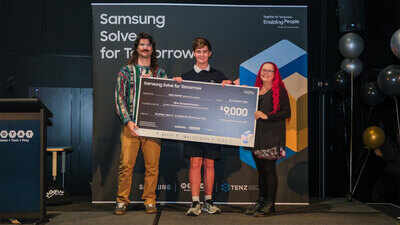
A communication challenge faced by a family member became the starting point for an award-winning technology project by a New Zealand schoolboy. Jack Harker, a Year 11 student at ACG Parnell College in Auckland, developed Parley, a communication tool designed to help people who struggle to speak participate in real-time conversations. The idea came from his uncle, who has cerebral palsy and whose experiences helped shape the project.Harker’s invention won the Years 11-13 category of Samsung Solve for Tomorrow New Zealand 2026, a nationwide competition recognising student innovations that address real-world challenges. What makes the project particularly personal is the involvement of the person who inspired it. His uncle helped develop Parley by testing the tool and providing feedback, allowing Harker to refine its features in response to his needs.
His uncle’s experience inspired the idea
The development of Parley began with Harker’s understanding of the communication difficulties experienced by his uncle. People who struggle to speak can face barriers when trying to express themselves and participate in everyday conversations. Harker set out to develop a tool that could help address this challenge.Rather than relying only on his own understanding of the problem, he involved his uncle in the development process. His feedback helped Harker assess the tool and make changes to its features.The organisers have described Parley as a communication tool that enables people who struggle to speak to take part in real-time conversations. However, the publicly available information does not detail its technical working, including whether it uses text-to-speech technology, artificial intelligence, symbols or other communication methods.Harker’s approach of involving the intended user in testing was an important part of the project’s development. It also gave him an opportunity to refine the invention around the communication needs it was designed to address.
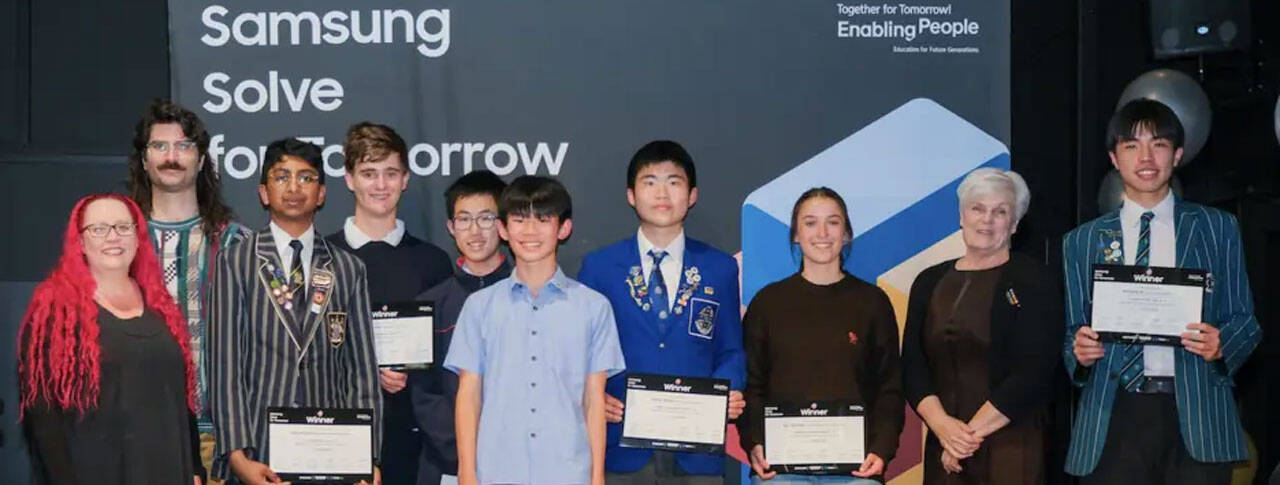
2026 Samsung Solve for Tomorrow winners
Second consecutive year of recognition
The 2026 award is not Harker’s first success in the Samsung Solve for Tomorrow competition. In 2025, he won the junior category with Sail Race Tracker, a low-cost live race-tracking system developed for youth sailing.That project used long-range radio devices and a web-based dashboard to allow coaches to analyse races and spectators to follow sailing fleets in real time. His latest recognition comes in the senior category, with a project focused on accessibility and communication.Harker shared the top honours with Gabriel Anthony, a Year 10 student from Whitby Collegiate in Porirua, who won the Years 7-10 category for Real Mahi. His tool tracks how a piece of writing is created, including typing, pasting and editing, providing teachers with information to help assess the authenticity of student work in the context of generative artificial intelligence.Other recognised projects included BrainKey, a prototype exploring the use of brainwaves as passwords, and a Taproot Weed Removal Robot designed to remove weeds from lawns. Three additional projects received highly commended recognition.
Competition encourages students to solve real-world problems
Samsung Solve for Tomorrow is organised in New Zealand in partnership with the Museum of Transport and Technology (MOTAT) and Technology Education New Zealand (TENZ). Now in its sixth year, the competition invites students from Years 7 to 13 to identify problems affecting their communities and develop solutions using science, technology, engineering, arts and mathematics (STEAM).The 2026 competition has a total prize pool of NZ$24,000 in cash and Samsung technology, shared among seven winners and highly commended entrants. Teachers and schools associated with the projects also receive a share.Julie Baker, Head of Education at MOTAT, said the competition was particularly close this year, with only a few points separating the top entries. She highlighted the importance of identifying a genuine need and demonstrating how ideas had been tested and improved through real-world feedback.For Harker, Parley brings together a family experience, practical problem-solving and technology. His uncle’s involvement in testing and refining the tool also made the development process closely connected to the people it aims to support.