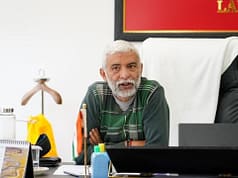



Leh, Oct 22: The Ladakh administration has defended cancelling land allotment to Sonam Wangchuk’s institute, citing the activist’s “disregard for the law”, and said the allotment automatically lapsed due to unpaid dues and an unexecuted lease deed.
In an affidavit filed in the High Court of Jammu and Kashmir and Ladakh, the administration maintained that the 40-year lease allotment covering 1,076 kanals and 1 marla of land at Phyang Thang had “lapsed by operation of law” on May 5, 2019, due to the Himalayan Institute of Alternative Learning (HIAL)’s failure to execute a lease deed or deposit mandatory land premiums within the stipulated one-year period.
The affidavit running into 136 pages was filed by Leh Deputy Commissioner and CEO of LAHDC, Romil Singh Donk, in response to HIAL’s writ petition challenging the August 21, 2025, cancellation order of leased land to the institute.
The affidavit said the writ petition is “misconceived, devoid of merit, and barred by delay and laches” and made it clear that the original allotment order issued on May 5, 2018, was conditional and explicitly stated that the lease would be deemed cancelled if the allottee failed to execute the deed within a year.
The administration asserted that HIAL never deposited a single rupee towards land premium or ground rent and failed to secure formal possession through the Tehsildar as mandated.
Furthermore, the Higher Education Department of UT Ladakh certified in October 2026 that HIAL is not a recognised university, nor are its courses affiliated with the University of Ladakh or other statutory bodies, violating the core objective of setting up an alternative university.
Bringing other context before the court, the affidavit highlighted the past conduct of HIAL’s founder Wangchuk and his organisation, the Students’ Educational and Cultural Movement of Ladakh (SECMOL), and said that SECMOL has occupied 124 kanals of state land at Phey for over three decades without formal allotment or payment of an assessed Rs 80 lakh premium.
The affidavit also references the violent protests in Leh in September 2025, which led to Union Home Ministry’s intervention, the cancellation of SECMOL’s FCRA registration, and Wangchuk’s brief detention under the National Security Act prior to its revocation in March 2026, as part of a consistent pattern of public order disruptions.
When approached for comments, HIAL CEO Gitanjali Angmo denied the claims made by the Ladakh administration in its affidavit.
Citing a September 25, 2025 order by the Home Ministry cancelling SECMOL’s FCRA registration, the affidavit said it was done due to multiple statutory violations which included accepting foreign funds from a Swedish donor to study the sovereignty of the nation deemed prejudicial to national interest.
It said that local residents, the Phyang Welfare Society and village Nambardars have repeatedly petitioned authorities since 2018, alleging broken promises regarding the university project, unauthorised diversion of ancient irrigation streams for “Ice Stupa” experiments, and an alleged illegal encroachment of an additional 174 kanals beyond the boundary wall.
The affidavit said the villagers complained that HIAL deceived them with false promises of a world-class university, blocked ancient pasture lands, and repeatedly diverted centuries-old natural irrigation streams for Ice Stupa projects, causing severe water shortage for local farmers.
Urging the high court to dismiss the petition, the administration highlighted the antecedents of Wangchuk and SECMOL and submitted that the organisation and the petitioner are merely vehicles through which Wangchuk has repeatedly sought to hold public land on his own terms.
The affidavit also said that HIAL had made false statements under oath in its petition by claiming it sent repeated reminders during the first year and deposited all requisite dues.
It annexed official records showing zero written communications between May 2018 and March 2020, zero payments deposited, and suppressed letters written by HIAL in June 2020 seeking a complete waiver of both premium and ground rent, a request that was never granted.
Tracing official records dating back to 2006, the affidavit pointed out a series of administrative actions and warnings issued against Wangchuk and SECMOL and recalled a October 2006 communication by the then district magistrate of Leh, which recorded that Wangchuk openly threatened the Hill Council and district administration during a council meeting, prompting officials to recommend surveillance and preventive detention.
The affidavit further detailed orders from March 2007, where the DM imposed a complete ban on public gatherings, speeches, and the circulation of provocative VCDs by SECMOL, noting that the organisation was running large-scale anti-establishment propaganda threatening public tranquillity and unauthorisedly collecting funds from the public.
Official reports from the chief education officer in April 2007 also recorded that Wangchuk had unauthorisedly occupied 200 kanals of land under the guise of educational programmes and disrupted the smooth functioning of the education department.
The administration submitted that this pattern of holding public land without paying state dues continued over the years, including at SECMOL’s Phey campus, and has culminated in the present situation where 1,076 kanals of state land have been held for over six years without a valid lease or payment of premium and ground rent.
Linking these past events to broader law and order concerns, the affidavit said that agitations led and incited by Wangchuk in recent years ended with the office of the Chief Executive Councillor of the very Hill Council that originally allotted the land being set on fire.
The administration maintained that a litigant with such a record does not approach the court with clean hands and is not entitled to discretionary or equitable relief.
Dismissing the awards, guest visits, and international recognitions cited by Wangchuk in his petition, the administration said that personal eminence and accolades are wholly irrelevant to the legal question of lease compliance.
It asserted that no recognition, however distinguished, serves as a substitute for fulfilling statutory allotment conditions, stating that the activist’s reliance on such honours is merely an attempt to divert attention from an admitted legal default.
Emphasising the Public Trust Doctrine, the UT administration argued that public land is held in trust for the populace and cannot be treated as private largesse and urged the court to dismiss the petition with costs and suggested that the reclaimed land be allocated to reputed national institutions such as a Sainik School, Eklavya Model Residential School, or Sindhu Central University.
The affidavit also highlighted speeches by Wangchuk inciting a mob during a hunger strike on September 24, 2025, which led to the burning of political party offices, torching of police vehicles, and injuries to over 30 security personnel.
About The Author