


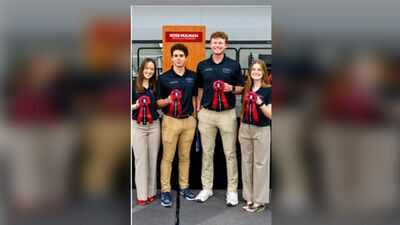
Four biology and biomedical engineering students at Rose-Hulman Institute of Technology developed PneumaNode, a small sensor patch designed to continuously monitor the vital signs of babies in neonatal intensive care units (NICUs). The device was created as part of their senior design capstone project after medical device startup ResperCare LLC approached the institute with a request to address the monitoring needs of intensive care patients.According to Rose-Hulman Institute of Technology, PneumaNode uses sensors to collect information about a baby’s heart rate, blood oxygen levels, temperature, and respiratory sounds. The system sends the collected data wirelessly for real-time analysis. The students presented their project at the annual Rose Show on May 6, 2026, where it received a Red Ribbon Department Award.
Four Rose-Hulman students developed PneumaNode for NICU patients
The team behind PneumaNode comprised Tommaso Calviello, Alyssa McGauley, Connor O’Connell and Katie Choi, who were studying biology and biomedical engineering. Their senior design capstone project addressed the need for continuous monitoring in intensive care units, where patients require regular assessments of vital signs and lung function.The project was brought to the institute by ResperCare LLC, an Indiana-based medical device startup. The company approached Rose-Hulman after intensive care unit nurses from IU Health sought help with a monitoring problem. ResperCare asked the students to design a device capable of continuously monitoring patients with the same level of accuracy as bedside nurses, with a specific focus on babies in neonatal intensive care units.
PneumaNode uses sensors to collect babies’ vital signs
PneumaNode is a small, stick-on sensor patch designed to monitor a baby’s vital signs continuously. Its components include a microelectromechanical systems (MEMS) microphone that listens to breathing and respiratory sounds, alongside a light-based photoplethysmography (PPG) sensor that measures heart rate and blood oxygen levels.A small ESP32-S3 computer inside the patch collects and processes the data. The sensors, wires, microcontroller, and battery connect through a custom printed circuit board (PCB). The device brings together information about heart rate, oxygen saturation (SpO2), temperature, and respiratory sounds. Its ESP32 microcontroller processes the collected information before transmitting it wirelessly using Bluetooth Low Energy for real-time analysis. The system is designed to help clinicians monitor babies without performing as many manual checks.
The device aims to reduce nursing workload and improve monitoring
Patients admitted to intensive care units require regular checks of blood pressure, heart rate, respiratory rate, and lung function. These assessments can interrupt sleep, cause discomfort, and require nurses to spend substantial time carrying out routine monitoring tasks.PneumaNode was designed to address these challenges by collecting vital-sign information continuously through a sensor patch. The device is intended to reduce clinicians’ workload and improve diagnostic consistency by making patient information available for real-time analysis. Assistant Professor Adel Alhalawani, one of the project’s faculty advisers, praised the team’s technical work, collaboration, willingness to accept feedback, and commitment to improving patient care.
PneumaNode team receives recognition at the 2026 Rose Show
Team TACK presented PneumaNode at Rose-Hulman Institute of Technology’s annual Rose Show on May 6, 2026, where the project won a Red Ribbon Department Award. The event featured nearly 130 students presenting capstone, design, studio, and research projects.Biomedical engineering student Connor O’Connell, who also minored in data science, was excited that the students were responsible for the design process. The students entered their senior year with a signed provisional patent application and gained experience with the intellectual property and legal aspects of biomedical product development.
About The Author


