



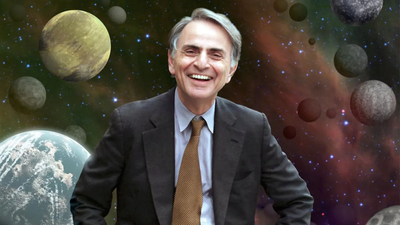
Carl Sagan, the celebrated astronomer, author and science communicator, helped millions of people understand the universe through his books, lectures and television programmes. His quote, “Science is a way of thinking much more than it is a body of knowledge,” highlights an important idea: science is not simply about memorising facts. It is about asking questions, examining evidence and remaining open to new discoveries. Sagan believed that scientific thinking could help people approach the world with curiosity, reason and intellectual humility. His words remain relevant in an age of rapid scientific progress, misinformation and growing interest in space exploration. The quote encourages readers to see science as a method for understanding reality rather than merely a collection of established information.
Quote of the day by Carl Sagan
“Science is a way of thinking much more than it is a body of knowledge”Sagan’s statement explains that science is not simply a collection of facts, theories and discoveries. Instead, it is a systematic way of exploring the world and understanding how nature works. Scientific knowledge is important, but the process through which that knowledge is developed is equally significant.The quote is associated with Sagan’s essay Can We Know the Universe? Reflections on a Grain of Salt, published in his book Broca’s Brain: Reflections on the Romance of Science in 1979. In the essay, Sagan discusses the value of scientific inquiry and humanity’s efforts to understand the universe.His words suggest that knowing scientific facts is only one part of learning. A person must also understand how those facts were established, what evidence supports them and whether new discoveries could change existing explanations.
Science as a way of thinking
Scientific thinking involves curiosity, observation, questioning and the careful examination of evidence. It requires people to avoid accepting claims simply because they sound convincing or come from an influential source.Scientists commonly develop hypotheses to explain observations. They then test these hypotheses through experiments, measurements or further research. The results are analysed and compared with existing knowledge. If the evidence does not support the original idea, the hypothesis may be revised or rejected.This process demonstrates why science is not a fixed system of unquestionable answers. Scientific explanations can change when stronger evidence becomes available. Such changes do not necessarily represent failure. Instead, they reflect the ability of science to correct mistakes and improve understanding.
The importance of questioning established ideas
Many important scientific discoveries began with questions about ideas that were widely accepted at the time. Scientists have repeatedly challenged earlier explanations by collecting new evidence and developing better methods of investigation.For example, our understanding of Earth’s position in the universe changed significantly over centuries. Similarly, discoveries in genetics, physics and astronomy have transformed earlier views of nature.Questioning established ideas does not mean rejecting every accepted fact. Scientific questioning is based on evidence, logical reasoning and testing. It involves asking whether an explanation accurately accounts for observations and whether it can be independently examined.Sagan’s approach encourages people to maintain a balance between openness and scepticism. They should be prepared to consider new possibilities while also demanding reliable evidence before accepting extraordinary claims.
Why the quote remains relevant
Sagan’s words have particular relevance in the digital age, when information can spread rapidly through social media, websites and online video platforms. People are frequently exposed to claims about health, technology, climate, space and other scientific subjects.Some of these claims may be supported by credible research, while others may rely on incomplete evidence, misleading interpretations or speculation. Scientific thinking can help individuals distinguish between a documented finding and an unsupported assertion.This approach involves checking the source of information, examining the evidence and considering whether independent experts have reached similar conclusions. It also requires an understanding of uncertainty. A scientific study may provide strong evidence without offering a final answer to every question.The quote reminds readers that scientific literacy is not limited to knowing terminology or remembering discoveries. It also involves developing the ability to evaluate information responsibly.
Science and intellectual humility
One of the important qualities associated with scientific thinking is intellectual humility. This means recognising that personal knowledge is limited and that existing explanations may be incomplete.Scientists work with the evidence available to them at a particular time. New observations, improved instruments and different research methods can reveal information that was previously unknown. As a result, scientific conclusions may be refined or adjusted.Intellectual humility does not mean that every claim deserves equal acceptance. Evidence remains essential. However, it encourages people to acknowledge uncertainty and avoid presenting incomplete knowledge as absolute certainty.Sagan often promoted this combination of curiosity and scepticism. He encouraged audiences to remain fascinated by the universe while also examining claims through reason and evidence.
Who was Carl Sagan?
Carl Sagan was an American astronomer, planetary scientist, author and science communicator. Born in 1934, he contributed to research in planetary science and played a role in explaining scientific discoveries to the general public.He became widely known for his books and for presenting the television series Cosmos: A Personal Voyage, which first aired in 1980. The programme introduced viewers to subjects including astronomy, evolution, the history of science and humanity’s place in the universe.Sagan also contributed to discussions about the possibility of life beyond Earth. He supported scientific exploration and encouraged public engagement with questions about the origins and future of humanity.Through his writing and broadcasting, he showed how complex scientific ideas could be explained using accessible language without losing their significance.
Curiosity as the foundation of discovery
Curiosity is central to scientific progress. Questions such as how stars form, why species evolve and whether life exists elsewhere in the universe have motivated generations of researchers.Scientific curiosity often begins with a simple observation. Researchers then investigate the issue through experiments, calculations, fieldwork or technological development. Over time, individual discoveries can contribute to wider advances in knowledge.Sagan’s quote highlights the importance of maintaining this questioning attitude. Science progresses not only because people record what is already known but also because they investigate what remains unexplained.Curiosity can also encourage people outside professional research to learn about the natural world. Observing the night sky, reading about scientific discoveries or questioning everyday phenomena can help develop a deeper appreciation of evidence-based thinking.
What Sagan’s quote teaches us
Carl Sagan’s statement presents science as an ongoing process rather than a finished collection of information. Facts and discoveries matter, but the ability to question, investigate and revise ideas is what allows scientific knowledge to develop.The quote encourages readers to approach information with curiosity and reason. It also highlights the importance of accepting evidence, recognising uncertainty and remaining open to new explanations.In a world shaped by scientific innovation and rapidly changing information, Sagan’s message continues to offer a useful perspective: understanding science means learning not only what humanity knows, but also how humanity comes to know it.
About The Author


