


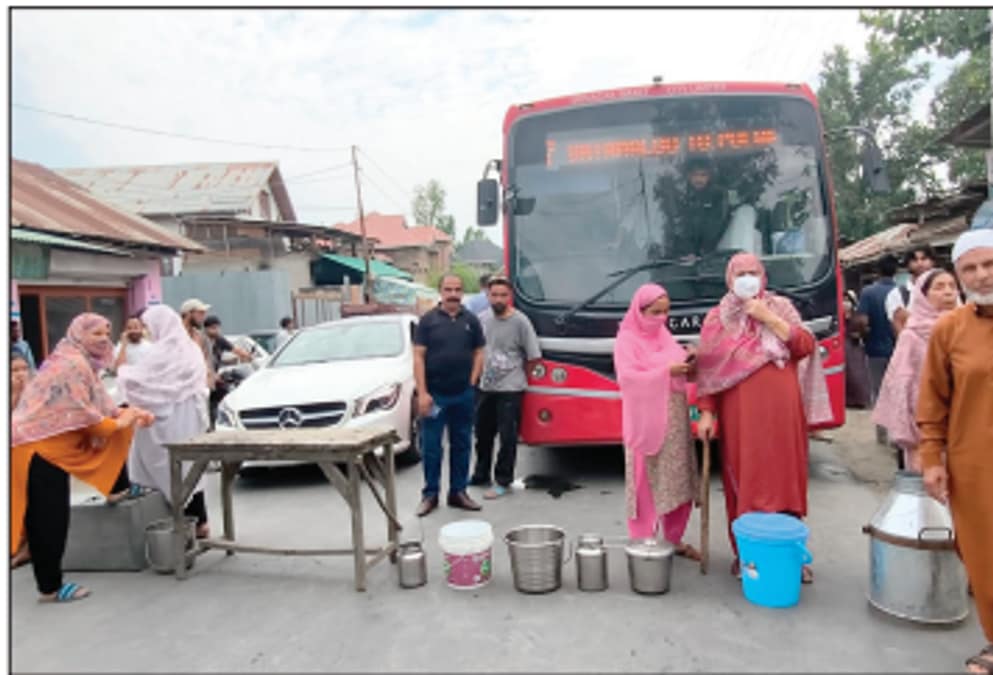
Scores of residents, including women, staged a protest in Pinglena village of south Kashmir’s Pulwama district on Tuesday, alleging that they have been facing an acute shortage of drinking water for the past three months.
The protesters took to the streets and briefly blocked traffic, accusing the Jal Shakti Department of failing to provide a regular supply of potable water despite repeated representations.
Women carrying empty utensils joined the demonstration to highlight the severity of the crisis and the hardships faced by households.
Residents said the prolonged shortage has disrupted their daily lives, forcing families to depend on water tankers and other temporary arrangements that they described as inadequate. “We have been grappling with this water crisis for the last three months, but the authorities have paid no attention to our repeated pleas,” said Ghulam Hasan Ganie, a resident of the village. “We were left with no option but to hit the streets because our genuine issue has remained unresolved despite several requests.”
Another woman protester said the department sends water tankers to the village only twice a week, which is insufficient to meet the needs of hundreds of families. “The water supplied through tankers does not last long. We need a regular drinking water supply, not temporary arrangements that leave us struggling after a day or two,” she said. The protesters urged the administration to restore a reliable water supply at the earliest, warning that the shortage has become increasingly difficult to manage during the ongoing summer months. Bilal Ahmad, Executive Engineer, Jal Shakti Department, said the existing water supply scheme serving the area depends on two spring sources, both of which have witnessed a significant decline in discharge due to the prevailing heatwave.
He said the department had already planned an alternative water supply scheme to address the problem. However, the proposed borewells identified as water sources could not be commissioned after laboratory tests found the water contained ammonium nitrate and iron beyond permissible limits for drinking purposes. “We had already envisaged a new scheme, but the borewell water was found unsuitable for human consumption after testing. Therefore, that source could not be utilised,” the official said. Ahmad added that the department has now identified another suitable site for the project and assured that work on the new scheme would begin soon to provide a permanent solution to the drinking water crisis in the village. Residents, however, said they would continue to press for immediate relief until a dependable water supply is restored.
About The Author