


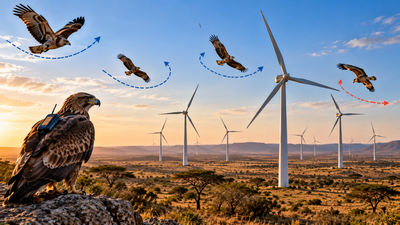
Wind farms are expanding across Africa, a continent with some of the world’s highest raptor diversity, yet species-specific collision risks remain poorly understood. Researchers fitted solar-powered GPS trackers to nine Augur Buzzards, two African Hawk Eagles, one Martial Eagle and three Rüppell’s Vultures at the Kipeto wind farm in southern Kenya between 2019 and 2024. According to the study published on ResearchGate, titled ‘Meso-scale avoidance of wind turbines by four raptors at a Kenyan wind farm’, meso-scale avoidance was found in all four species, in both the horizontal and vertical planes. Avoidance rates within the rotor height range were 48.9% for the Augur Buzzard and 74.4% for the African Hawk Eagle.
How did researchers use GPS to track African raptors at Kipeto
Kipeto lies approximately 45 km south-west of Nairobi in Kajiado County. It is a 100 MW wind farm with 60 turbines, covering an area of about 70 km². The turbines are 80 m high with a blade length of 50 m, and the farm has been fully operational since 1 July 2021. The authors state that African Hawk-Eagles (2–3 pairs), Martial Eagles (1 pair) and Augur Buzzards (5–7 pairs) breed at Kipeto, while Rüppell’s Vultures frequently fly over the wind farm. The vultures’ roost and nest sites are at the Kwenia cliffs, about 15 km to the west.The paper explains that avoidance “was calculated by comparing observed flight tracks with randomised simulated tracks”. Only high-resolution GPS data were used, and only in-flight fixes, defined as those with a ground speed above 1 m/s. For each track of at least 10 consecutive fixes within the farm, a randomised track was created by rotating the original horizontally by a random angle around its centroid. This was repeated 700 times. The authors defined the rotor height range as 25–135 m, which includes a 5 m buffer in both directions, and the risk distance as 55 m, the rotor radius plus that buffer.
How much time did African raptors spend near the wind turbines
The three species breeding at the wind farm spent close to half of their flight time within Kipeto, meaning within 1 km of the turbines. Rüppell’s Vultures spent less than 1% of their time there and ranged much further across southern Kenya. The proportion of in-flight GPS fixes within the rotor height range was 3% for Rüppell’s Vulture, 22% for Martial Eagle, 23% for African Hawk Eagle and 50% for Augur Buzzard. The authors write that this corresponded to an average daily time at rotor height of 2, 53, 51 and 74 minutes per individual bird, respectively.The paper states that Augur Buzzards and African Hawk Eagles spent more time at lower flight altitudes than the other two species, particularly Rüppell’s Vulture. The authors describe Augur Buzzards as flying and foraging “at much lower altitudes when hunting often agile ground prey (e.g. rodents)”, a behaviour that places them consistently within the rotor height range. Gyps vultures, they note, “will often soar well above RHR”. All species except Rüppell’s Vulture spent a larger proportion of flight time at rotor height when outside the wind farm than within it.
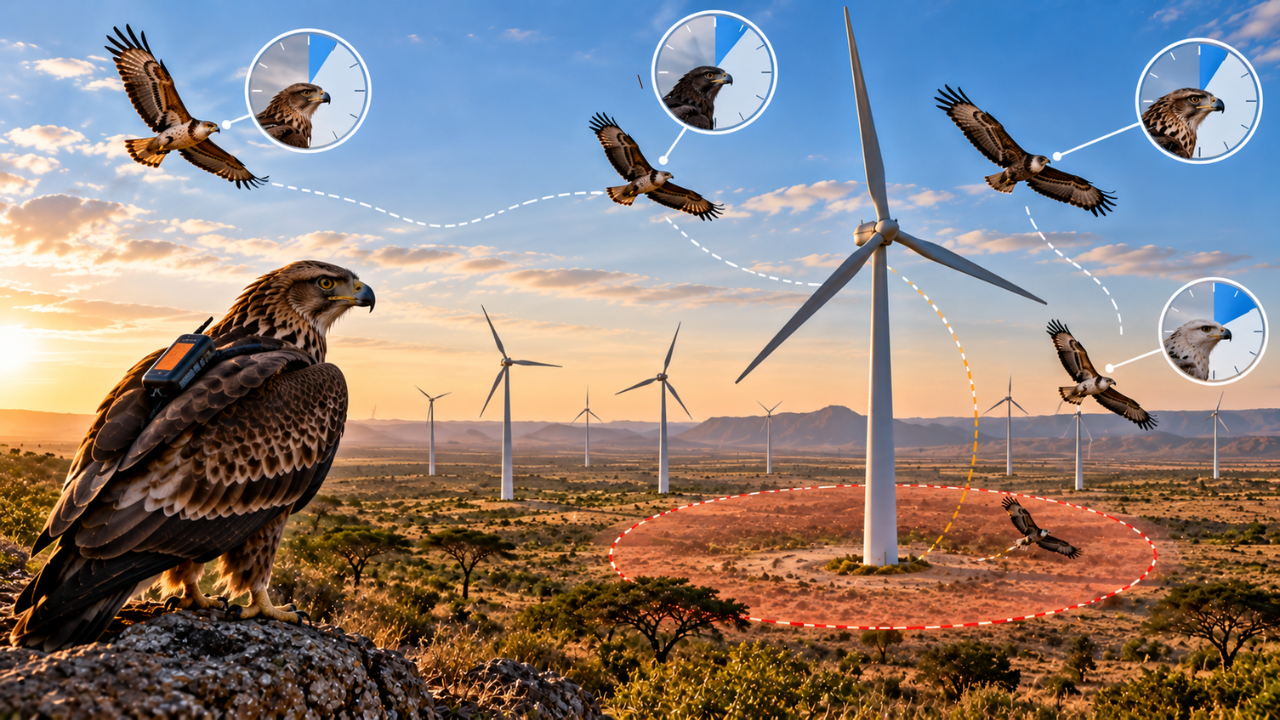
Image AI generated
What did GPS tracking reveal about raptor avoidance of wind turbines
The authors report that when birds were flying within the rotor height range, they were much less likely to be within the 55 m risk distance of the nearest turbine. According to the study, the calculated avoidance rate within that range was above 60% for all species except the Augur Buzzard, which recorded 48.9%. The paper lists the highest rate as 74.4% for the African Hawk Eagle, with Martial Eagle at 68.5% and Rüppell’s Vulture at 68.4%. Avoidance rates inside the rotor height range were greater than outside it for all four species.Kimani et al. (2026) write that within the 55 m risk distance, raptors showed significant avoidance of turbines whether above, within or below the rotor height range, but that “avoidance behaviour was clearest and strongest when flights were within RHR”. The authors compare their figures with earlier work, stating that avoidance rates for golden eagle, wedge-tailed eagle, white-bellied sea-eagle and white-tailed eagle “have been typically much higher (81%–99%)”. They also note that Rüppell’s Vulture showed a meso-scale avoidance rate of 68.4%, whereas the closely related Griffon Vulture in France did not display any significant avoidance of wind turbines.
How did African raptors change their flight height near wind turbines
Within the risk distance, but not outside it, African Hawk Eagle and Martial Eagle showed significant vertical avoidance when flying within the rotor height range, and this extended slightly above that range. Augur Buzzards showed significant avoidance only in the 55–110 m height bin, but attraction at the lowest height bin (below 55 m), and no response outside the risk distance. For Rüppell’s Vulture, the authors report that no significant avoidance was observed in the vertical plane. They add that Augur Buzzards “were less inclined than the eagles to adjust altitude when at risk of collision, highlighting their high vulnerability to collisions”.The authors conclude that “a uniform mitigation approach is unlikely to work across all at-risk raptor species”. For resident eagles and Augur Buzzards, they state that turbines should not be erected near nest sites, and they list shut-down on demand, camera detection, blade painting and carcass removal as interventions. They note that shut-down on demand is currently deployed at Kipeto. The paper also lists limits: a relatively low sample size, a limited number of species, and adult-only vultures and eagles, so the findings “should therefore be interpreted with some caution, pending confirmation from further studies”. The study received partial funding from Kipeto Energy PLC, and the authors disclose that D. K. Kimani is an employee of the company.
About The Author


