


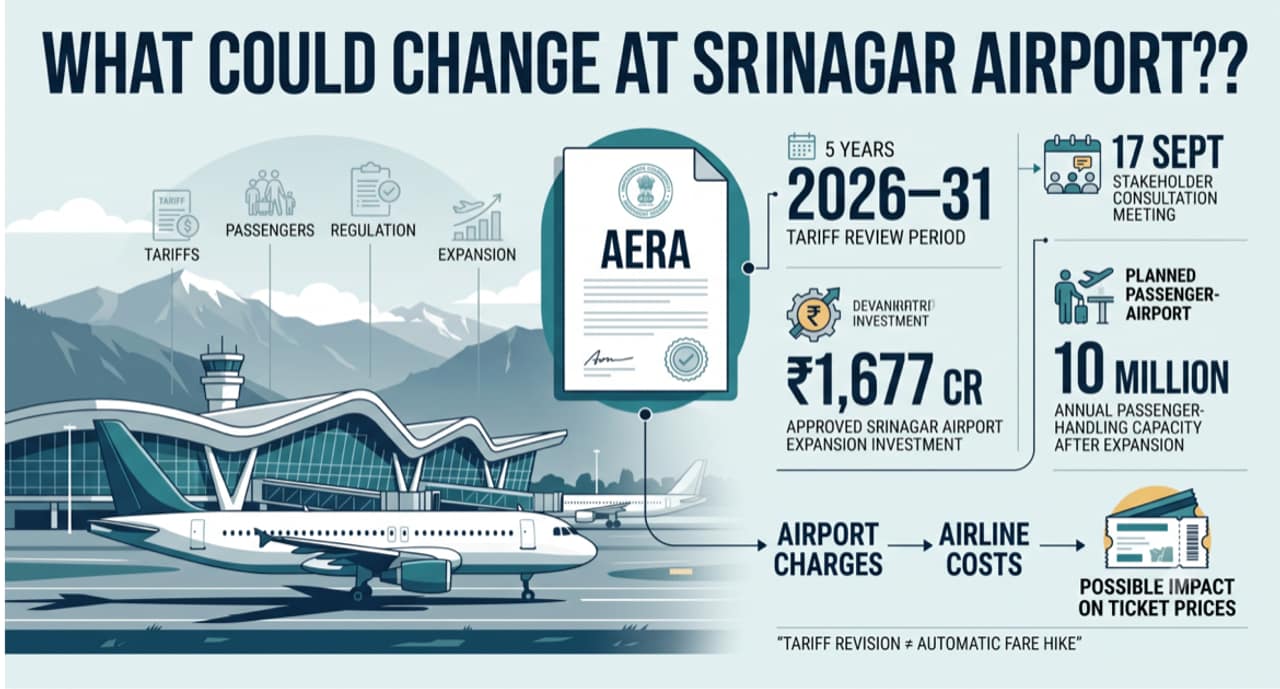

The Airports Economic Regulatory Authority of India (AERA) has begun the process of revising the regulated charges at Srinagar International Airport for the next five years, in an exercise that could eventually have a bearing on the cost of air travel but does not, at this stage, mean any immediate increase in airfares.
The tariff exercise covers the period from April 1, 2026, to March 31, 2031. AERA has issued a consultation paper and will hold a meeting with airlines, passenger associations, airport operators and other stakeholders on September 17 to seek their views before deciding the final charges.
The consultation meeting will be held at 4:30 pm at Udaan Bhawan, Safdarjung Airport, New Delhi, and will also be conducted online.
For passengers, the term “aeronautical charges” essentially refers to regulated fees associated with the use and operation of airport facilities. These are not the same as the basic airfare charged by an airline.
Such charges can include fees paid by airlines for aircraft parking and other regulated airport services. The User Development Fee, or UDF, is different in that it is a passenger-related airport charge and is generally collected as part of the air ticket.
In simple terms, when an aircraft lands, parks or uses certain regulated facilities at an airport, the airline or other airport user may have to pay prescribed charges. These costs form part of an airline’s operating expenses. Depending on the final tariff and the airline’s pricing, some of these costs may ultimately be reflected in ticket prices.
However, an increase in an airport charge does not automatically translate into an equivalent increase in the price paid by a passenger.
The present exercise is also significant because of Srinagar airport’s status as a major airport.
The Ministry of Civil Aviation had issued a notification on November 5, 2021, declaring Srinagar International Airport a “Major Airport” under the Airports Economic Regulatory Authority of India Act, 2008. The notification brought the airport within the regulatory framework under which AERA determines tariffs for aeronautical services.
Srinagar had earlier been declared a major airport in 2015 after its annual passenger traffic crossed the then applicable threshold of 1.5 million passengers. However, an amendment to the AERA Act in 2019 raised the threshold to 3.5 million passengers. The Centre subsequently issued the specific 2021 notification declaring Srinagar a major airport.
AERA had thereafter undertaken the tariff-setting exercise for Srinagar airport for the third control period, covering April 1, 2021, to March 31, 2026. The latest consultation begins the fourth control period and will determine the regulatory tariff framework for the following five years.
The exercise comes at a time when Srinagar airport is also set for a major expansion. The Union Cabinet in February 2026 approved a Rs 1,677-crore expansion project for the Civil Enclave at Srinagar International Airport.
The project includes a new terminal building with a built-up area of 71,500 square metres. Once completed, the expanded airport is planned to handle up to 10 million passengers annually and 2,900 passengers during peak hours.
The expansion is being undertaken amid sustained growth in passenger traffic and pressure on existing airport facilities, particularly during the peak tourism season.
The tariff decision will consequently be watched closely by airlines, the tourism industry, businesses and passengers. Stakeholders have been allowed to submit their views before AERA takes the final decision.
About The Author


