


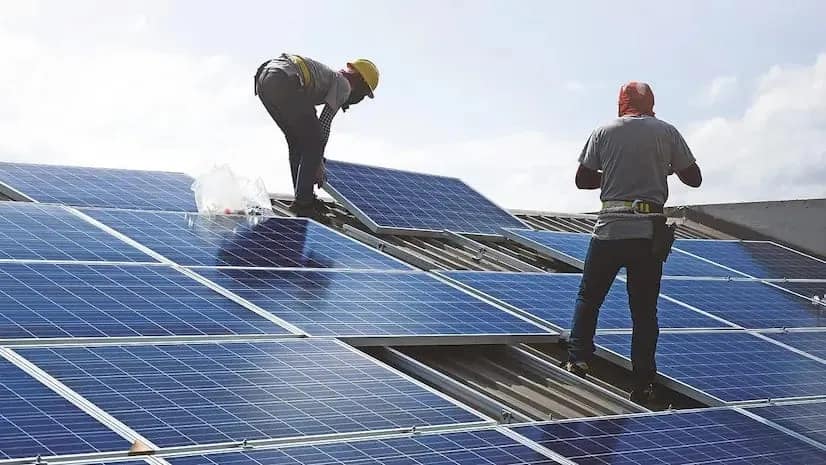
Srinagar, Mar 8: Jammu and Kashmir has solarised 16,799 households so far under the PM Surya Ghar Muft Bijli Yojana, generating a cumulative rooftop solar capacity of 62.11 MW, according to the Economic Survey Report 2025–26.
The initiative targets 83,550 households across the Union Territory, including 39,500 in the Jammu Power Distribution Corporation Limited (JPDCL) region and 44,000 in the Kashmir Power Distribution Corporation Limited (KPDCL) region.
Across the two power distribution regions, KPDCL has contributed the larger share of commissioned capacity at 34.60 MW, while JPDCL has added 27.51 MW.
The solarisation drive covers domestic, institutional, social and government sectors and forms part of the broader push to expand renewable energy generation in the Union Territory. Overall, Jammu and Kashmir has installed a total solar capacity of 130.87 MW so far.
The survey further states that under the Grid-Connected Rooftop Solar Power Plant Scheme of the Ministry of New and Renewable Energy (MNRE), 4,000 households in Jammu and Kashmir have already been covered.
In another major step aimed at expanding the benefits of rooftop solar, the Ministry of New and Renewable Energy, Government of India, has approved a project on the recommendation of the Jammu and Kashmir government to provide 200 free units of electricity to 2.21 lakh Antyodaya Anna Yojana (AAY) families in the Union Territory.
The initiative will be implemented under the PM Surya Ghar Muft Bijli Yojana through the Utility Led Aggregation (ULA) model, and its implementation is expected to begin soon.
The report also highlights progress in the solarisation of irrigation infrastructure under the PM-KUSUM scheme.
Under this programme, 5,000 solar-powered irrigation pumps have been planned for installation in Jammu and Kashmir with an 80 percent subsidy support. So far, 3,717 solar pumps have been successfully installed, helping promote sustainable agricultural practices and reduce dependence on conventional energy sources for irrigation.
The PM Surya Ghar Muft Bijli Yojana was launched on February 29, 2024 with the objective of increasing rooftop solar capacity and enabling households to generate their own electricity. The solarisation of government buildings and households in Jammu and Kashmir is being pursued as a major initiative to promote renewable energy, reduce carbon emissions and enhance energy efficiency in public infrastructure.
A large-scale rooftop solarisation programme is also underway for government buildings across the Union Territory. The project aims to install grid-tied rooftop solar systems on 22,494 government buildings with a total planned capacity of 270 MW. Of these, 12,994 buildings with a capacity of 70 MW are being developed under the CAPEX model, while 9,500 buildings with a capacity of 200 MW will be implemented under the RESCO model. The programme prioritises institutions in the education and health sectors.
According to the survey, 7,125 government buildings have already been successfully solarised under the CAPEX budget, contributing 68.76 MW to the region’s renewable energy capacity.
Over a period of 25 years, these rooftop solar installations on government buildings are expected to reduce carbon emissions by approximately 8.3 million tonnes. The project also incorporates the installation of bidirectional smart meters and the use of Virtual Net Metering (VNM) through DISCOMs to optimise energy management and ensure efficient utilisation of renewable power across Jammu and Kashmir.
About The Author