


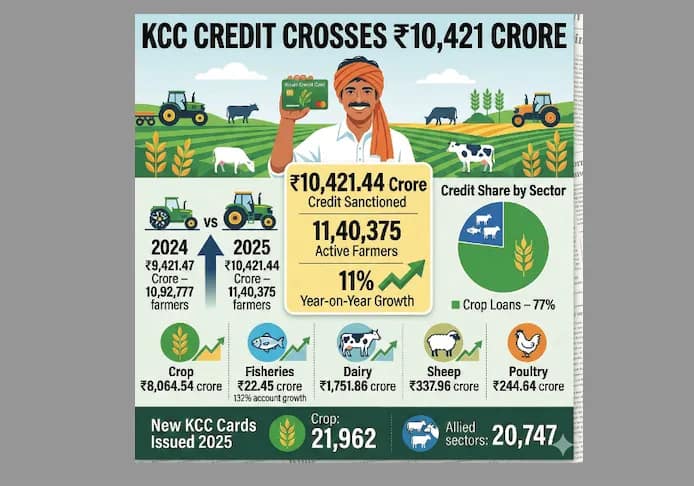
Srinagar, Mar 4: Institutional lending to farmers under the Kisan Credit Card (KCC) scheme has recorded a notable rise, with the total sanctioned credit reaching Rs 10,421.44 crore for 11,40,375 active cardholders as of September 30, 2025.
The figures mark an 11 per cent increase over Rs 9,421.47 crore extended to 10,92,777 farmers during the corresponding period last year, reflecting continued expansion in agricultural and allied-sector financing.
According to official progress data, crop-related KCC loans continue to dominate the scheme, accounting for nearly 77 percent of the total sanctioned credit.
The number of crop KCC accounts increased marginally from 8,68,331 in September 2024 to 8,77,087 in September 2025. Credit sanctioned under this category rose from Rs 7,588.19 crore to Rs 8,064.54 crore, registering a six percent increase.
These loans play a key role in supporting farmers with funds for essential agricultural activities such as purchasing seeds, fertilisers, pesticides, irrigation equipment and other farm inputs.
While crop loans remain the largest component, lending to allied agricultural sectors has witnessed strong growth over the past year.
The fisheries sector recorded the sharpest increase, with KCC accounts rising from 1,227 to 2,844, marking a jump of more than 130 percent. Credit sanctioned for fisheries activities also rose significantly from Rs 14.11 crore to Rs 22.45 crore.
Dairy financing also saw steady growth, with the number of accounts increasing from 1,80,155 to 2,03,557. The credit extended to dairy farmers rose by 26 percent, reaching Rs 1,751.86 crore compared to Rs 1,391 crore last year.
Similarly, KCC accounts for sheep rearing increased from 30,375 to 32,924, while credit sanctioned under the category rose from Rs 292.99 crore to Rs 337.96 crore.
Poultry farming recorded one of the most notable expansions. The number of KCC accounts nearly doubled from 12,689 to 23,963, while sanctioned credit rose sharply from Rs 135.17 crore to Rs 244.64 crore.
Combined lending to animal husbandry, sheep rearing and fisheries now accounts for about 23 percent of the total KCC credit portfolio, highlighting growing institutional support for diversified rural livelihoods.
As of September 30, 2025–26, authorities issued 21,962 new KCC cards for crop-related activities and 20,747 cards for allied sectors, including animal husbandry, sheep, and fisheries.
In comparison, during the same period of the previous financial year, 18,078 crop KCCs and 27,168 KCCs for allied sectors were issued.
The increase in crop KCC issuance indicates continued demand for crop production credit, while the allied sectors remain an important component of the rural credit ecosystem.
The Kisan Credit Card scheme continues to serve as a key instrument for delivering affordable and timely credit to farmers, helping strengthen agricultural productivity and expand income opportunities in the rural economy.
With more than 11.4 lakh active beneficiaries and credit sanctions exceeding Rs 10,400 crore, the scheme remains central to improving financial inclusion and supporting farming communities across the region.
About The Author