


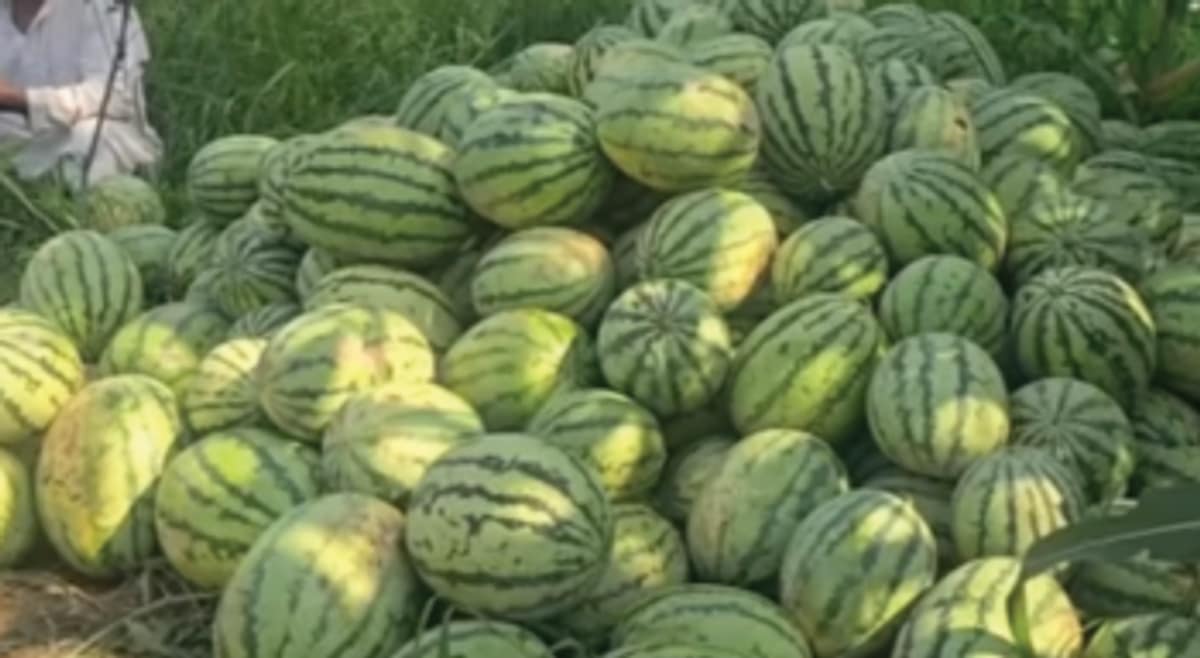
In a quiet agricultural transformation, central Kashmir’s Ganderbal district—long known for its grape vineyards, cherry orchards and apple orchards—is witnessing the rapid expansion of watermelon cultivation.
Once entirely dependent on supplies transported from warmer states such as Maharashtra and Gujarat, Kashmir is now producing its own watermelons, with farmers in Ganderbal increasingly adopting the crop as a profitable short-duration cash crop.
The fertile lands along the banks of the Sindh River, particularly in the Wakura block, have emerged as the centre of this diversification. Villages including Batwina, Ahan and Zazna have converted large stretches of conventional farmland into watermelon fields, producing fruit that is now meeting growing local demand.
Batwina village, popularly known as “Chhota Punjab” or Kashmir’s “Watermelon Village”, has become the hub of watermelon cultivation in the Valley. Nearly 200 to 300 kanals of land in and around the village are currently under the crop.
“When we first planted watermelons as an experiment a few years ago, many people doubted whether they could thrive in Kashmir’s cooler climate,” said Shabir Ahmad, a grower from the Wakura block. “But the results encouraged more farmers to take up cultivation, especially after seeing the strong local demand during the summer months.”
Farmers said the crop has emerged as an attractive alternative because of its relatively short cultivation period and high market potential. Locally grown watermelons reach consumers within hours of harvesting, ensuring better freshness and taste compared to fruit transported over long distances.
However, growers said sustaining the momentum will require stronger institutional support. They pointed to fluctuating market prices, erratic weather conditions and limited technical assistance as major challenges affecting the sector.
They urged the Agriculture and Horticulture departments to organise regular awareness programmes, provide scientific guidance on cultivation practices, develop cold storage facilities and introduce measures to stabilise prices, enabling Ganderbal to emerge as a sustainable watermelon-producing region.
Adil Ahmad, another grower from Batwina, said heavy rainfall this season has significantly reduced yields and affected farmers’ incomes.
“Despite the losses, Batwina continues to maintain its reputation as Kashmir’s premier watermelon-growing village,” he said.
According to Adil, watermelon cultivation begins in April with seeds sown inside greenhouses, where they remain for about a month. The saplings are transplanted to open fields in May, and harvesting starts by late June or early July.
“This village is now known as ‘Chhota Punjab’ because of the scale of watermelon cultivation. It costs around Rs 10,000 to Rs 12,000 to cultivate one kanal, while returns can reach nearly Rs 1 lakh if market prices remain favourable. During periods of high demand, earnings can be even higher,” he said.
Shabir Ahmad, who has been cultivating watermelons for the past three years, said the crop has proved to be a viable source of income.
“We started cultivating watermelons on an experimental basis and are satisfied with the returns. If farmers receive proper training, technical knowledge and awareness, the crop can become even more profitable,” he said.
He, however, added that the erratic weather witnessed this year had adversely affected watermelon production, reducing yields and highlighting the need for better climate-resilient farming support.
About The Author